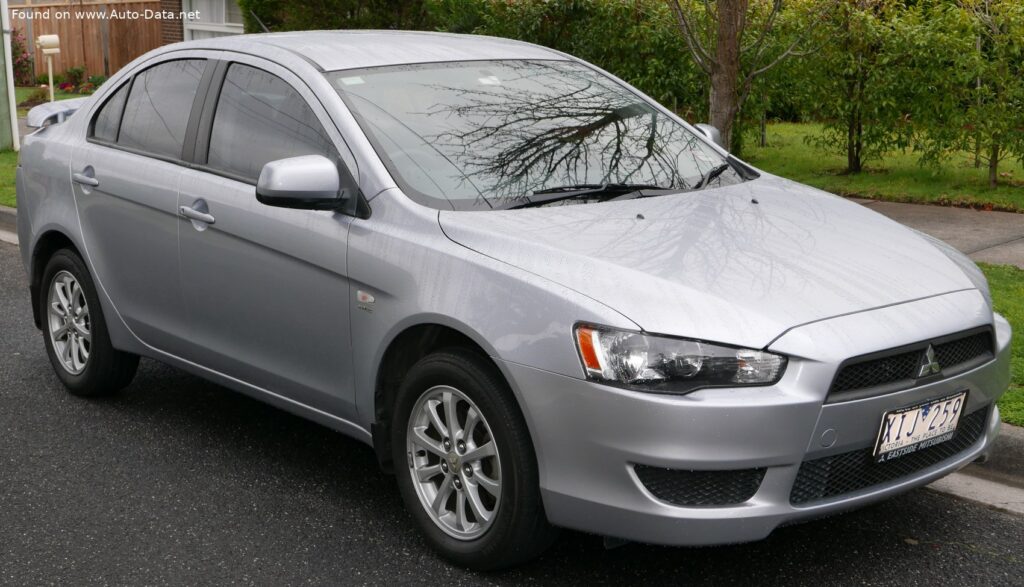
The Mitsubishi Lancer, a nameplate synonymous with accessible performance and robust reliability, has a storied history spanning multiple generations. The model referred to as the Mitsubishi Lancer IX 1.6 MIVEC (117 Hp), produced from October 2010 to December 2015, represents a specific iteration designed primarily for markets outside of North America. While the US market primarily received the Lancer (often referred to as the Lancer X or CY/CZ chassis code) during this period, this “Lancer IX” designation, particularly with the 1.6-liter MIVEC engine, points to a variant tailored for European, Asian, or other global regions where its blend of efficiency, practicality, and Mitsubishi’s engineering prowess found a strong foothold. This four-door, five-seat sedan was positioned as a competitive entry in the compact segment, offering a balance of everyday usability and a hint of the brand’s sporting heritage.
In its target markets, the Lancer IX was celebrated for its straightforward mechanicals, dependable performance, and a design that, while not revolutionary, was perceived as modern and sharp for its time. It continued Mitsubishi’s tradition of offering vehicles that were both economical to run and durable, appealing to a wide range of consumers looking for a no-nonsense compact car. The 1.6-liter MIVEC engine variant, in particular, was crucial for markets prioritizing fuel efficiency and lower emissions, making it a popular choice for urban commuting and family transport.
Engine & Performance: The 1.6 MIVEC Heart of the Mitsubishi Lancer IX 1.6 MIVEC (117 Hp)
At the core of this particular Lancer variant was Mitsubishi’s 4A92 engine, a 1.6-liter (1590 cm³ or 97.03 cu. in.) naturally aspirated inline-four gasoline unit. This engine featured Mitsubishi’s innovative MIVEC (Mitsubishi Innovative Valve timing Electronic Control) system, which optimizes valve timing for improved efficiency and power delivery across the RPM range. With a power output of 117 horsepower at 6000 rpm and a peak torque of 113.58 lb.-ft. (154 Nm) at 4000 rpm, the engine provided a respectable performance for its class and displacement.
Power was delivered to the front wheels via a five-speed manual transmission, a common and reliable setup for compact sedans of this era. This powertrain allowed the Lancer IX to achieve a 0 to 60 mph acceleration in a decent 10.2 seconds (0-100 km/h in 10.7 seconds), with a top speed of 118.68 mph (191 km/h). While not a performance leader, these figures ensured adequate responsiveness for daily driving and highway cruising. The vehicle’s weight-to-power ratio stood at 10.8 kg per horsepower (92.9 Hp/tonne), reflecting its efficient design.
Fuel economy was a strong suit for the 1.6 MIVEC engine. The combined cycle consumption was rated at 41.3 US mpg (5.7 l/100 km), with extra-urban driving yielding an impressive 50 US mpg (4.7 l/100 km). Urban driving saw figures of 31.8 US mpg (7.4 l/100 km). These numbers, coupled with CO2 emissions of 132 g/km and compliance with Euro 5 emission standards, made the Lancer IX an environmentally conscious and cost-effective option in its segment, particularly important in markets with strict emissions regulations or fuel pricing considerations.
Design & Features
The Mitsubishi Lancer IX 1.6 MIVEC (117 Hp) adopted a conventional yet appealing sedan body style, offering four doors and comfortable seating for five occupants. Its exterior dimensions measured 179.92 inches (4570 mm) in length, 69.29 inches (1760 mm) in width, and 58.27 inches (1480 mm) in height, with a wheelbase of 103.74 inches (2635 mm). These dimensions placed it firmly within the compact sedan category, providing a good balance between interior space and maneuverability, especially in crowded urban environments. The minimum turning circle of 32.81 feet (10 m) further aided its urban agility.
The design language of the Lancer IX was characterized by clean lines and a somewhat aggressive front fascia, drawing inspiration from its more performance-oriented siblings like the Lancer Evolution. Inside, the cabin was designed for functionality and durability, utilizing materials and ergonomics that were typical for the segment. While not luxurious, the interior provided a practical and comfortable environment for occupants, with features focused on essential needs rather than lavish amenities. Trunk space was a respectable 14.13 cu. ft. (400 liters), accommodating luggage and groceries for a family.
In terms of chassis and suspension, the Lancer IX featured an independent McPherson strut setup at the front and an independent multi-link suspension at the rear. This configuration aimed to provide a comfortable ride while maintaining competent handling dynamics. Braking duties were handled by ventilated discs at the front and solid discs at the rear, complemented by an Anti-lock Braking System (ABS) for enhanced safety during emergency stops. The steering system was a rack and pinion type, offering direct and predictable control. Despite its focus on economy, the Lancer IX still carried some of the inherent dynamic qualities that made the Lancer nameplate well-regarded.
Technical Specifications
| Category | Specification |
| Brand | Mitsubishi |
| Model | Lancer |
| Generation | Lancer IX |
| Engine Type | 1.6 MIVEC (117 Hp) |
| Production Start | October, 2010 |
| Production End | December, 2015 |
| Powertrain Architecture | Internal Combustion Engine |
| Body Type | Sedan |
| Seats | 5 |
| Doors | 4/5 |
| Performance Specifications | |
| Fuel Consumption (Urban) | 7.4 l/100 km |
| Fuel Consumption (Extra Urban) | 4.7 l/100 km |
| Fuel Consumption (Combined) | 5.7 l/100 km |
| CO2 Emissions | 132 g/km |
| Fuel Type | Petrol (Gasoline) |
| Acceleration 0 – 60 mph | 10.2 sec |
| Acceleration 0 – 100 km/h | 10.7 sec |
| Maximum Speed | 191 km/h |
| Emission Standard | Euro 5 |
| Weight-to-Power Ratio | 10.8 kg/Hp |
| Weight-to-Torque Ratio | 8.2 kg/Nm |
| Engine Specifications | |
| Power | 117 Hp @ 6000 rpm |
| Power per liter | 73.6 Hp/l |
| Torque | 154 Nm @ 4000 rpm |
| Engine Layout | Front, Transverse |
| Engine Model/Code | 4A92 |
| Engine Displacement | 1590 cm³ |
| Number of Cylinders | 4 |
| Engine Configuration | Inline |
| Number of Valves per Cylinder | 4 |
| Fuel Injection System | Multi-port manifold injection |
| Engine Aspiration | Naturally aspirated |
| Dimensions, Volume, and Weights | |
| Kerb Weight | 1260 kg |
| Trunk (Boot) Space – Minimum | 400 l |
| Fuel Tank Capacity | 59 l |
| Length | 4570 mm |
| Width | 1760 mm |
| Height | 1480 mm |
| Wheelbase | 2635 mm |
| Ride Height (Ground Clearance) | 140 mm |
| Minimum Turning Circle | 10 m |
| Drivetrain, Brakes, and Suspension | |
| Drivetrain Architecture | Front-wheel drive (ICE drives front wheels) |
| Drive Wheel | Front wheel drive |
| Gearbox Type | 5 gears, manual transmission |
| Front Suspension | Independent type McPherson |
| Rear Suspension | Independent multi-link suspension |
| Front Brakes | Ventilated discs |
| Rear Brakes | Disc |
| Assisting Systems | ABS (Anti-lock braking system) |
| Steering Type | Steering rack and pinion |
Legacy and Market Impact
The Mitsubishi Lancer IX 1.6 MIVEC (117 Hp), despite its specific generational numbering for certain markets, played a significant role in solidifying Mitsubishi’s presence in the global compact sedan segment during its production run. In regions like Europe, parts of Asia, and Australia, where it was often sold as a facelifted version of the Lancer (known as Lancer X in other contexts), it competed against a formidable array of rivals. Key competitors included the Honda Civic, Toyota Corolla, Mazda 3, Nissan Sentra (Tiida/Sylphy in some markets), and various offerings from European manufacturers like the Opel Astra Sedan or Ford Focus Sedan.
Its reputation was built on reliability, affordability, and a relatively spirited driving experience for a non-performance model. The MIVEC engine, in particular, was lauded for its balance of power and fuel economy, making it an attractive proposition for budget-conscious buyers and those seeking a dependable daily driver. While it lacked the cutting-edge technology or premium finishes of some European competitors, its Japanese engineering and solid build quality ensured longevity and low running costs, which were paramount for many consumers in its target markets.
The Lancer nameplate, globally, has always carried an association with motorsport success, particularly through the Lancer Evolution. While the 1.6 MIVEC sedan was far removed from its rally-bred cousin, it nonetheless benefited from this brand halo, imparting a sense of underlying engineering competence. The Lancer IX represented a period where Mitsubishi was navigating evolving market demands, particularly the increasing emphasis on fuel efficiency and lower emissions, while still offering a practical and engaging vehicle. Its discontinuation in 2015 marked the gradual shift in Mitsubishi’s global strategy, moving away from conventional sedans in some markets to focus more on SUVs and crossovers. However, its legacy as a reliable, efficient, and well-built compact sedan remains, serving as a testament to Mitsubishi’s enduring engineering capabilities.