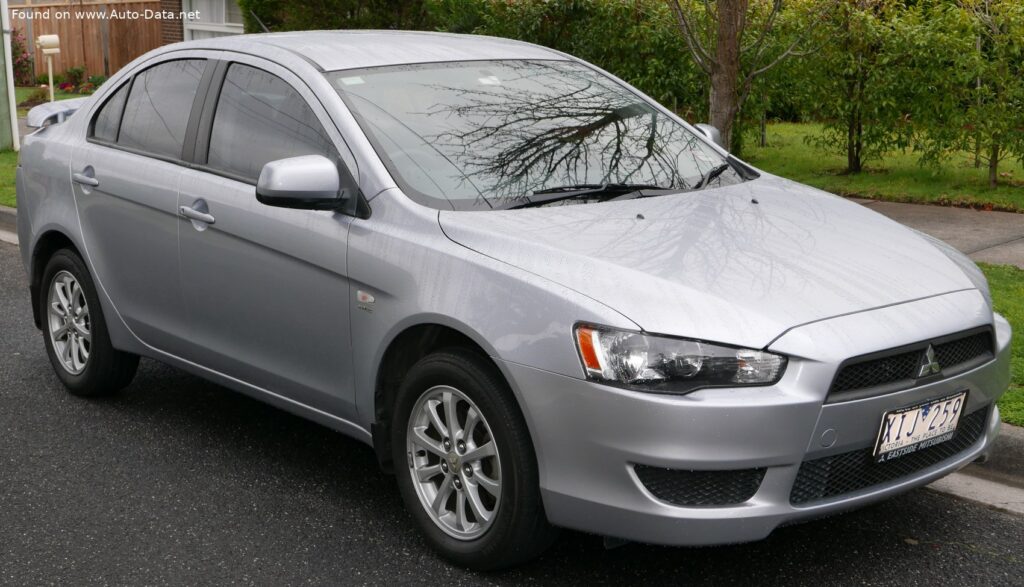
The Mitsubishi Lancer IX 1.8i (143 Hp) represents a significant iteration in the long-running Lancer lineage, a compact sedan renowned globally for its blend of practicality, reliability, and accessible performance. Produced between November 2007 and October 2010, this particular variant of the ninth-generation Lancer (often referred to as the Lancer EX in some markets) catered primarily to European and Asian markets, where its 1.8-liter engine offered a compelling balance of fuel efficiency and driving dynamics within the fiercely competitive C-segment. While the Lancer nameplate was well-established in North America, this specific engine configuration was not a staple offering in the United States, which typically received larger displacement engines. Nonetheless, the Lancer IX played a crucial role in Mitsubishi’s global strategy, embodying the brand’s commitment to engineering a dependable, family-friendly vehicle with a touch of its rally-bred heritage.
Mitsubishi Lancer IX 1.8i: An Overview
The Lancer IX, launched in 2007, was a pivotal model for Mitsubishi, representing a substantial redesign of the eighth-generation Lancer. It aimed to bridge the gap between affordability and a more sophisticated driving experience. The 1.8i variant specifically targeted buyers seeking a fuel-efficient and practical sedan without sacrificing driving enjoyment. It occupied the compact sedan segment, competing with established rivals like the Honda Civic, Toyota Corolla, and Ford Focus. Its success lay in offering a well-rounded package that prioritized reliability and everyday usability.
Engine & Performance
At the heart of the Mitsubishi Lancer IX 1.8i (143 Hp) lies the 4B10 engine, a 1.8-liter (1798 cm³) inline-four gasoline unit. This engine is part of Mitsubishi’s “World Engine” family, a collaborative effort with DaimlerChrysler and Hyundai, designed for efficiency and global application. The 4B10 features a Double Overhead Camshaft (DOHC) valvetrain with 4 valves per cylinder and utilizes multi-port fuel injection for smooth power delivery. It produces 143 horsepower at 6000 rpm and a peak torque of 131.29 lb.-ft. at 4250 rpm.
Power is channeled to the front wheels through a precise 5-speed manual transmission, providing drivers with engaging control. This configuration allows for a 0 to 60 mph acceleration time of 9.3 seconds and a maximum speed of 126.76 mph. These figures were competitive for a compact sedan of its era. The engine’s design prioritized a balance between performance and economy, aligning with the demands of its target markets. Fuel efficiency was a key strength, achieving a combined fuel economy of 30.5 US mpg, with 22.6 US mpg in urban driving and 38.6 US mpg on the highway. The engine also met the Euro 4 emission standard, demonstrating Mitsubishi’s commitment to environmental responsibility.
Design & Features
The 2007 Mitsubishi Lancer IX introduced a more aggressive and contemporary design language, influenced by the high-performance Lancer Evolution X. The 1.8i variant adopted the distinctive “shark-nose” front fascia, large grille, and sharp, angular headlights, giving it a sporty and assertive appearance. As a four-door sedan with seating for five, it fulfilled the role of a practical family vehicle.
The Lancer IX measures 179.92 inches in length, 69.29 inches in width, and 59.25 inches in height, offering a well-proportioned footprint for the compact segment. The interior focused on functionality and ergonomics, with robust materials designed for durability. Standard features included power windows, air conditioning, and a capable audio system. The trunk provided ample cargo space, enhancing its practicality. The chassis featured a Spring Strut front suspension and a Wishbone (multi-link) rear suspension, providing a comfortable ride and predictable handling. Ventilated disc brakes at the front and solid disc brakes at the rear, coupled with an Anti-lock Braking System (ABS), ensured reliable stopping power and enhanced safety. The vehicle rode on 205/60 R16 tires mounted on 6J x 16 wheel rims.
Technical Specifications
| Category | Specification |
| General Information | Brand |
| Mitsubishi | |
| Model | |
| Lancer | |
| Generation | |
| Lancer IX | |
| Type (Engine) | |
| 1.8i (143 Hp) | |
| Production Start | |
| November, 2007 | |
| Production End | |
| October, 2010 | |
| Powertrain Architecture | |
| Internal Combustion Engine | |
| Body Type | |
| Sedan | |
| Seats | |
| 5 | |
| Doors | |
| 4 | |
| Performance Specs | Fuel Consumption (Urban) |
| 22.6 US mpg | |
| Fuel Consumption (Extra Urban) | |
| 38.6 US mpg | |
| Fuel Consumption (Combined) | |
| 30.5 US mpg | |
| Fuel Type | |
| Petrol (Gasoline) | |
| Acceleration 0 – 60 mph | |
| 9.3 sec | |
| Maximum Speed | |
| 126.76 mph | |
| Emission Standard | |
| Euro 4 | |
| Weight-to-Power Ratio | |
| 9 kg/Hp, 110.9 Hp/tonne | |
| Weight-to-Torque Ratio | |
| 7.2 kg/Nm, 138 Nm/tonne | |
| Engine Specs | Power |
| 143 Hp @ 6000 rpm | |
| Torque | |
| 131.29 lb.-ft. @ 4250 rpm | |
| Engine Layout | |
| Front, Transverse | |
| Engine Model/Code | |
| 4B10 | |
| Number of Cylinders | |
| 4 | |
| Engine Configuration | |
| Inline | |
| Number of Valves per Cylinder | |
| 4 | |
| Fuel Injection System | |
| Multi-port manifold injection | |
| Engine Aspiration | |
| Naturally aspirated engine | |
| Valvetrain | |
| DOHC | |
| Engine Oil Capacity | |
| 4.54 US qt | |
| Coolant Capacity | |
| 7.4 US qt | |
| Space, Volume and Weights | Kerb Weight |
| 2843.96 lbs. | |
| Maximum Weight | |
| 3858.09 lbs. | |
| Maximum Load | |
| 1014.13 lbs. | |
| Fuel Tank Capacity | |
| 15.59 US gal | |
| Dimensions | Length |
| 179.92 in. | |
| Width | |
| 69.29 in. | |
| Height | |
| 59.25 in. | |
| Wheelbase | |
| 103.74 in. | |
| Front Track | |
| 60.24 in. | |
| Rear Track | |
| 60.24 in. | |
| Minimum Turning Circle | |
| 35.43 ft. | |
| Drivetrain, Brakes and Suspension | Drivetrain Architecture |
| Internal Combustion Engine drives the front wheels. | |
| Drive Wheel | |
| Front wheel drive | |
| Number of Gears / Gearbox Type | |
| 5 gears, manual transmission | |
| Front Suspension | |
| Spring Strut | |
| Rear Suspension | |
| Wishbone | |
| Front Brakes | |
| Ventilated discs | |
| Rear Brakes | |
| Disc | |
| Assisting Systems | |
| ABS (Anti-lock braking system) | |
| Steering Type | |
| Steering rack and pinion | |
| Tires Size | |
| 205/60 R16 | |
| Wheel Rims Size | |
| 6J x 16 |
Legacy and Market Impact
The Mitsubishi Lancer has a storied history, particularly known for its rally racing pedigree, most notably through the Lancer Evolution series. While the Mitsubishi Lancer IX 1.8i (143 Hp) was not a performance monster, it benefited from this brand association, inheriting a reputation for robust engineering and durability. In its primary markets of Europe and Asia, this Lancer variant was positioned as a reliable, economical, and stylish compact sedan, competing against formidable rivals such as the Honda Civic, Toyota Corolla, Mazda3, Ford Focus, and Volkswagen Jetta.
Its impact was largely felt in its ability to offer a compelling package for everyday drivers. The 1.8-liter engine provided a good balance of power for daily driving and reasonable fuel economy, making it an attractive option for budget-conscious buyers and families. The Lancer IX was often praised for its straightforward mechanics, which contributed to its perceived long-term reliability and lower maintenance costs compared to some European competitors. Its relatively spacious interior and generous trunk also made it a practical choice for various lifestyles. Globally, the Lancer IX helped Mitsubishi maintain a strong presence in the compact segment during a period of intense competition. While it might not have garnered the same enthusiast following as its Evolution brethren, the 1.8i variant was a workhorse that consistently delivered on its promise of dependable transportation. Its design, although shared with the more aggressive Evo, provided a modern and appealing aesthetic that helped it stand out. The Lancer IX’s tenure from 2007 to 2010 marked a period where Mitsubishi continued to evolve its core passenger car lineup, leveraging a global platform to offer region-specific powertrain options that best suited local market demands. The enduring legacy of the Lancer name, backed by models like the 1.8i, ensured its place as a recognizable and respected nameplate in the automotive world.