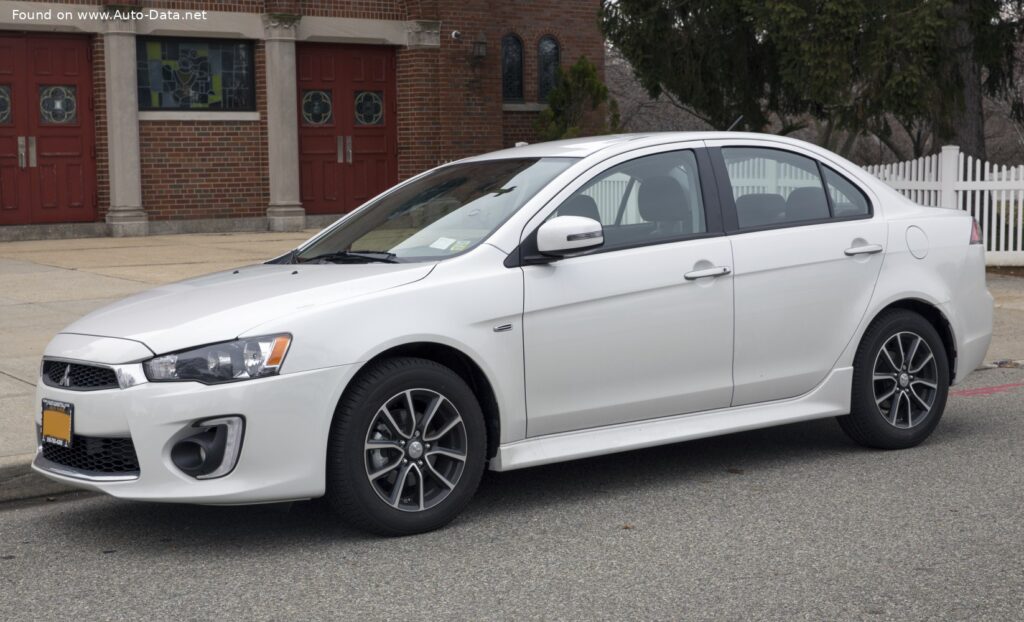
The Mitsubishi Lancer IX (facelift 2015) represents a late-stage iteration of a long-standing and globally recognized compact sedan from the Japanese automaker, Mitsubishi Motors. Introduced in 2015, this facelift aimed to refresh the ninth generation Lancer, which had been a staple in the compact car segment for over a decade. Produced until 2017, this specific variant, powered by a 2.4-liter engine delivering 168 horsepower and paired with a Continuously Variable Transmission (CVT), was designed to offer a balance of everyday usability, respectable performance, and modern efficiency. While the Lancer had a significant history in the American market, this facelifted model continued its role as a practical and reliable choice for consumers seeking an affordable and well-equipped compact sedan, particularly in its primary markets. It embodied Mitsubishi’s commitment to durability and straightforward engineering, even as the brand began to shift its focus towards SUVs.
Engine & Performance of the Mitsubishi Lancer IX (facelift 2015)
At the heart of the Mitsubishi Lancer IX (facelift 2015) 2.4 CVT model lies Mitsubishi’s robust 4B12 inline-four engine. This naturally aspirated, front-transverse mounted unit boasts a displacement of 2.4 liters (2360 cubic centimeters or 144.02 cubic inches). Engineered with a Double Overhead Camshaft (DOHC) valvetrain and four valves per cylinder, it ensures efficient breathing and power delivery. The engine utilizes a multi-port manifold injection system and features a compression ratio of 10.5:1, contributing to its responsive character.
The 4B12 engine generates a healthy 168 horsepower at 6000 rpm, providing ample power for daily commuting and highway cruising. Torque output is equally impressive for its class, peaking at 226 Newton-meters (166.69 pound-feet) at 4100 rpm. This torque figure, achieved at a relatively accessible engine speed, ensures good low-end and mid-range acceleration, making the Lancer feel capable in various driving scenarios. The power-per-liter rating stands at 71.2 Hp/l, indicating a well-tuned and efficient naturally aspirated design.
Transmission and Fuel Economy
Power is channeled to the front wheels through an automatic Continuously Variable Transmission (CVT). This transmission type is a key component in the Lancer’s efficiency strategy, allowing the engine to operate at its most optimal rpm range for varying speeds, thus enhancing fuel economy. While CVTs are sometimes criticized for a less direct driving feel compared to traditional geared automatics, Mitsubishi’s implementation aimed for smooth power delivery and reduced fuel consumption.
The fuel economy figures for the 2.4L CVT model are competitive for its segment. The Lancer achieves an urban fuel economy of 24 US mpg (9.8 l/100 km), an extra-urban (highway) rating of 30.9 US mpg (7.6 l/100 km), and a combined rating of 27 US mpg (8.7 l/100 km). These figures underscore the efficiency benefits of the CVT and the refined nature of the 4B12 engine, making it an economical choice for drivers concerned with running costs. The vehicle’s fuel tank capacity of 15.59 US gallons (59 liters) allows for a considerable driving range between fill-ups.
Design & Features of the Mitsubishi Lancer IX (facelift 2015)
The Mitsubishi Lancer IX (facelift 2015) retains the fundamental athletic stance of the ninth-generation Lancer, characterized by its sharp lines and aggressive front fascia. The facelift brought subtle yet impactful changes, typically including revised front grilles, updated bumper designs, and potentially new lighting signatures to keep the model visually fresh and aligned with contemporary design trends. As a four-door sedan, it offers seating for five occupants, emphasizing practicality and passenger comfort. The body dimensions – a length of 182.09 inches (4625 mm), a width of 69.29 inches (1760 mm), and a height ranging from 58.27 to 59.25 inches (1480-1505 mm) – place it firmly within the compact sedan category, offering a good balance between interior space and maneuverability. The wheelbase measures 103.74 inches (2635 mm), contributing to a stable ride.
Inside, the Lancer provided a straightforward and functional cabin. While not always at the forefront of luxury, it focused on ergonomic design and durability. The facelift often included updated trim materials, improved infotainment options, and enhanced connectivity features to meet evolving consumer expectations for modern vehicles. The trunk space of 14.13 cubic feet (400 liters) offers adequate room for luggage and groceries, further reinforcing its utility as a family or daily commuter vehicle.
Chassis, Suspension, and Safety
The Lancer’s chassis is built for a blend of comfort and responsive handling. It features an independent McPherson strut front suspension with coil springs and an anti-roll bar, a common and effective setup for front-wheel-drive compact cars, providing good road holding and ride quality. The rear suspension is an independent multi-link spring suspension, also equipped with a stabilizer, enhancing stability and comfort, especially over uneven surfaces.
Braking performance is handled by ventilated disc brakes at the front and solid disc brakes at the rear. These are complemented by an Anti-lock Braking System (ABS), a crucial safety feature that prevents wheel lock-up during hard braking, allowing the driver to maintain steering control. The steering system is a hydraulic rack and pinion setup, offering direct feedback to the driver. The vehicle rides on 215/45 R18 tires mounted on 18-inch wheel rims, which provide a sporty aesthetic and contribute to handling dynamics. With a minimum turning circle of 32.81 feet (10.0 meters), the Lancer remains agile in urban environments. The curb weight of 3042.38 lbs (1380 kg) and a maximum permissible weight of 4078.55 lbs (1850 kg) highlight its robust construction.
Technical Specifications of the Mitsubishi Lancer IX (facelift 2015)
| Category | Specification |
|---|---|
| General Information | |
| Brand | Mitsubishi |
| Model | Lancer |
| Generation | Lancer IX (facelift 2015) |
| Type (Engine) | 2.4 (168 Hp) CVT |
| Start of Production | 2015 year |
| End of Production | 2017 year |
| Powertrain Architecture | Internal Combustion engine |
| Body Type | Sedan |
| Seats | 5 |
| Doors | 4 |
| Performance Specs | |
| Fuel Consumption (Urban) | 9.8 l/100 km (24 US mpg) |
| Fuel Consumption (Extra Urban) | 7.6 l/100 km (30.9 US mpg) |
| Fuel Consumption (Combined) | 8.7 l/100 km (27 US mpg) |
| Fuel Type | Petrol (Gasoline) |
| Weight-to-Power Ratio | 8.2 kg/Hp (121.7 Hp/tonne) |
| Weight-to-Torque Ratio | 6.1 kg/Nm (163.8 Nm/tonne) |
| Engine Specs | |
| Power | 168 Hp @ 6000 rpm |
| Power per Liter | 71.2 Hp/l |
| Torque | 226 Nm (166.69 lb.-ft.) @ 4100 rpm |
| Engine Layout | Front, Transverse |
| Engine Model/Code | 4B12 |
| Engine Displacement | 2360 cm3 (2.4 liters / 144.02 cu. in.) |
| Number of Cylinders | 4 |
| Engine Configuration | Inline |
| Cylinder Bore | 88 mm (3.46 in.) |
| Piston Stroke | 97 mm (3.82 in.) |
| Compression Ratio | 10.5:1 |
| Number of Valves per Cylinder | 4 |
| Fuel Injection System | Multi-port manifold injection |
| Engine Aspiration | Naturally aspirated engine |
| Valvetrain | DOHC |
| Engine Oil Capacity | 4.6 l (4.86 US qt) |
| Coolant Capacity | 7 l (7.4 US qt) |
| Space, Volume and Weights | |
| Kerb Weight | 1380 kg (3042.38 lbs.) |
| Max. Weight (GVWR) | 1850 kg (4078.55 lbs.) |
| Max Load | 470 kg (1036.17 lbs.) |
| Trunk (boot) Space – Minimum | 400 l (14.13 cu. ft.) |
| Fuel Tank Capacity | 59 l (15.59 US gal) |
| Max. Roof Load | 80 kg (176.37 lbs.) |
| Permitted Towbar Download | 55 kg (121.25 lbs.) |
| Dimensions | |
| Length | 4625 mm (182.09 in.) |
| Width | 1760 mm (69.29 in.) |
| Width Including Mirrors | 2044 mm (80.47 in.) |
| Height | 1480-1505 mm (58.27 – 59.25 in.) |
| Wheelbase | 2635 mm (103.74 in.) |
| Front Track | 1530 mm (60.24 in.) |
| Rear (Back) Track | 1530 mm (60.24 in.) |
| Front Overhang | 1010 mm (39.76 in.) |
| Rear Overhang | 980 mm (38.58 in.) |
| Ride Height (Ground Clearance) | 147 mm (5.79 in.) |
| Minimum Turning Circle (Turning Diameter) | 10.0 m (32.81 ft.) |
| Drivetrain, Brakes and Suspension Specs | |
| Drivetrain Architecture | Front-wheel drive (ICE drives front wheels) |
| Drive Wheel | Front wheel drive |
| Number of Gears and Type of Gearbox | Automatic transmission CVT |
| Front Suspension | Independent, type McPherson with coil spring and anti-roll bar |
| Rear Suspension | Independent multi-link spring suspension with stabilizer |
| Front Brakes | Ventilated discs |
| Rear Brakes | Disc |
| Assisting Systems | ABS (Anti-lock braking system) |
| Steering Type | Steering rack and pinion |
| Power Steering | Hydraulic Steering |
| Tires Size | 215/45 R18 |
| Wheel Rims Size | 18 inches |
Legacy and Market Impact
The Mitsubishi Lancer has a storied history, particularly in the compact sedan segment, where it competed fiercely against established rivals for decades. The Mitsubishi Lancer IX (facelift 2015) represented the twilight years of this generation before the Lancer nameplate was eventually retired from many key markets, including North America, as Mitsubishi shifted its product strategy towards crossovers and SUVs.
In its prime, the Lancer was known for its robust build quality, straightforward mechanics, and a reputation for reliability. While it might not have always led the class in terms of cutting-edge technology or luxury appointments, it consistently offered a strong value proposition. The 2015 facelift aimed to inject renewed visual appeal and updated features to keep it relevant against a constantly evolving competitive landscape. In the compact sedan market, it faced formidable opponents such as the Honda Civic, Toyota Corolla, Mazda3, Hyundai Elantra, and Kia Forte. These competitors often boasted more frequent redesigns, advanced safety features, and increasingly sophisticated infotainment systems.
Despite the intense competition, the Lancer maintained a loyal following, particularly in markets where its affordability, durability, and the strength of the Mitsubishi brand were highly valued. The 2.4-liter engine, a larger option than many compact car rivals offered, provided a distinct advantage in terms of power and highway performance, appealing to buyers who desired a bit more grunt without stepping up to a mid-size sedan. The combination of its potent engine and the efficiency of the CVT made it a practical choice for a wide range of drivers.
Ultimately, the Lancer’s legacy is one of a dependable workhorse that served millions of drivers worldwide. While the ninth generation, even with its 2015 facelift, began to show its age against newer designs by 2017, it remained a testament to Mitsubishi’s engineering principles. It underscored the brand’s ability to produce long-lasting and capable vehicles, contributing significantly to its global presence before the automotive industry’s pivot towards new segments and propulsion technologies. The Lancer IX, particularly in its later facelifted forms, continues to be remembered as a reliable and practical choice in the compact sedan market.