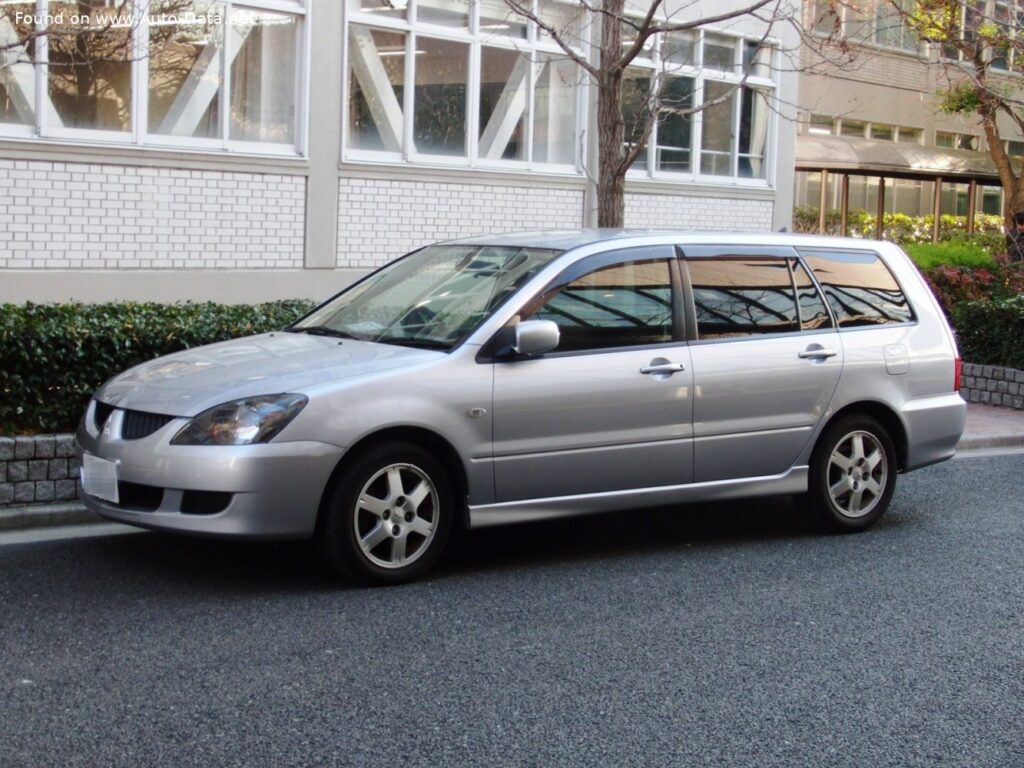
The Mitsubishi Lancer VIII Wagon Sport 2.0i 16V (135 Hp) represents a significant iteration within Mitsubishi’s long-running Lancer lineage, specifically tailored for markets where practicality, efficiency, and a touch of driving engagement were highly valued. Produced from 2003 to 2009, this generation, often referred to as the Cedia Lancer in some regions, evolved the Lancer’s design and engineering for a new millennium. While the Lancer nameplate gained considerable fame in North America through its sedan variants and the high-performance Evolution models, the station wagon (or estate) body style of the Lancer VIII, particularly with the “Sport” designation, was predominantly a fixture in European and Asian markets. It offered a compelling blend of family-friendly utility, reliable mechanics, and a surprisingly capable powertrain for its class, all wrapped in a practical, five-door package.
Mitsubishi Lancer VIII Wagon Sport: A Global Perspective
This particular variant, the Sport 2.0i 16V, was positioned as a more dynamic option within the wagon lineup. It aimed to provide drivers with a responsive and enjoyable experience without compromising on the essential virtues of a compact family hauler. Its design reflected the contemporary Mitsubishi aesthetic of the early 2000s, balancing aerodynamic efficiency with a robust, dependable appearance. For consumers seeking a versatile vehicle that could handle daily commutes, family trips, and cargo duties with ease, the Lancer VIII Wagon Sport offered a well-rounded and economically sensible choice.
Engine & Performance
At the core of the Mitsubishi Lancer VIII Wagon Sport 2.0i 16V (135 Hp) lies Mitsubishi’s venerable 4G63 engine, a powerplant renowned for its durability and adaptability across various Mitsubishi models, including its turbocharged iterations in the Lancer Evolution. In this naturally aspirated form, the 1997 cubic centimeter (2.0-liter) inline four-cylinder engine was engineered for smooth, reliable power delivery and reasonable fuel efficiency, rather than outright blistering performance. Featuring a Double Overhead Camshaft (DOHC) valvetrain with 16 valves (four per cylinder) and multi-port manifold injection, it produced a respectable 135 horsepower at 5750 rpm. This output was complemented by 129.81 lb.-ft. of torque, peaking at 4500 rpm, ensuring adequate pulling power for a vehicle of its size and purpose.
Power was routed to the front wheels via a precise 5-speed manual transmission, offering drivers direct control over the engine’s output. This combination allowed the Lancer VIII Wagon Sport to accelerate from 0 to 60 mph in a competitive 9.5 seconds, with a top speed of 123.65 mph. These figures positioned it as a capable performer within its compact wagon segment, providing enough zip for highway merging and confident overtaking. Despite its sporting designation, the Lancer VIII Wagon Sport also delivered commendable fuel economy for its time. On the combined European cycle, it achieved 27.4 US mpg (8.6 l/100 km). Urban driving saw figures around 20.1 US mpg (11.7 l/100 km), while extra-urban conditions yielded an impressive 34.6 US mpg (6.8 l/100 km). These efficiency numbers underscored its practicality as a daily driver, balancing performance with economical operation. The engine’s compression ratio of 10.3:1 further optimized its efficiency and power delivery for regular gasoline.
Design & Features
The Mitsubishi Lancer VIII Wagon Sport 2.0i 16V (135 Hp) embraced the functional yet tasteful design language prevalent in the early 2000s. As a five-door station wagon, its primary appeal was its versatility and spaciousness. Measuring 176.57 inches in length, 66.73 inches in width, and 57.09 inches in height, with a 102.36-inch wheelbase, the Lancer Wagon presented a compact footprint that made it agile in urban environments while still offering substantial interior volume.
The exterior styling, while not as aggressive as its Lancer Evolution siblings, featured clean lines and a purposeful stance. The “Sport” trim likely included specific alloy wheels (6.5J x 16 inches with 195/50 R16 tires), possibly a subtly sportier grille, or unique badging to differentiate it from standard models. Inside, the cabin was designed for five occupants, prioritizing ergonomics and user-friendliness. The true strength of the wagon body style was its cargo capacity: a minimum of 14.13 cubic feet (400 liters) with all seats in place, expanding to a generous 42.38 cubic feet (1200 liters) when the rear seats were folded down. This adaptability made it ideal for everything from grocery runs to hauling sports equipment or luggage for extended trips. In terms of chassis and safety, the Lancer VIII Wagon was equipped with a robust suspension system, featuring Spring Struts at the front and a Transverse Stabilizer at the rear, providing a balanced ride and competent handling. Braking duties were handled by ventilated discs at the front and solid discs at the rear, supported by an Anti-lock Braking System (ABS) for enhanced control during emergency stops. Hydraulic power steering, utilizing a rack and pinion system, offered a direct and communicative feel, contributing to the “Sport” designation’s promise of an engaging drive. These features, combined with its solid build quality, cemented its reputation as a safe and reliable family vehicle in its respective markets.
Technical Specifications
| General Information | |
| Brand | Mitsubishi |
| Model | Lancer |
| Generation | Lancer VIII Wagon |
| Type (Engine) | Sport 2.0i 16V (135 Hp) |
| Production Start | 2003 year |
| Production End | 2009 year |
| Powertrain Architecture | Internal Combustion Engine |
| Body type | Station wagon (estate) |
| Seats | 5 |
| Doors | 5 |
| Performance Specifications | |
| Fuel Consumption (City) | 11.7 l/100 km (20.1 US mpg) |
| Fuel Consumption (Highway) | 6.8 l/100 km (34.6 US mpg) |
| Fuel Consumption (Combined) | 8.6 l/100 km (27.4 US mpg) |
| Fuel Type | Petrol (Gasoline) |
| Acceleration 0-60 mph | 9.5 seconds |
| Acceleration 0-62 mph (0-100 km/h) | 10 seconds |
| Maximum Speed | 123.65 mph (199 km/h) |
| Weight-to-Power Ratio | 9.8 kg/Hp (102.3 Hp/tonne) |
| Weight-to-Torque Ratio | 7.5 kg/Nm (133.3 Nm/tonne) |
| Engine Specifications | |
| Power | 135 Hp @ 5750 rpm |
| Power per liter | 67.6 Hp/l |
| Torque | 129.81 lb.-ft. (176 Nm) @ 4500 rpm |
| Engine Layout | Front, Transverse |
| Engine Model/Code | 4G63 |
| Engine Displacement | 121.86 cu. in. (1997 cm3) |
| Number of Cylinders | 4 |
| Engine Configuration | Inline |
| Cylinder Bore | 3.35 in. (85 mm) |
| Piston Stroke | 3.46 in. (88 mm) |
| Compression Ratio | 10.3:1 |
| Valves per Cylinder | 4 |
| Fuel Injection System | Multi-port manifold injection |
| Engine Aspiration | Naturally aspirated |
| Valvetrain | DOHC |
| Engine Oil Capacity | 4.54 US qt (4.3 l) |
| Coolant Capacity | 7.4 US qt (7 l) |
| Dimensions, Volume, and Weights | |
| Kerb Weight | 2910.1 lbs. (1320 kg) |
| Maximum Weight | 3924.23 lbs. (1780 kg) |
| Maximum Load | 1014.13 lbs. (460 kg) |
| Trunk Space (Minimum) | 14.13 cu. ft. (400 l) |
| Trunk Space (Maximum) | 42.38 cu. ft. (1200 l) |
| Fuel Tank Capacity | 13.21 US gal (50 l) |
| Length | 176.57 in. (4485 mm) |
| Width | 66.73 in. (1695 mm) |
| Height | 57.09 in. (1450 mm) |
| Wheelbase | 102.36 in. (2600 mm) |
| Front Track | 57.87 in. (1470 mm) |
| Rear Track | 57.87 in. (1470 mm) |
| Drivetrain, Brakes, and Suspension | |
| Drivetrain Architecture | Front-wheel drive, Internal Combustion Engine |
| Drive Wheel | Front wheel drive |
| Gearbox Type | 5-speed manual transmission |
| Front Suspension | Spring Strut |
| Rear Suspension | Transverse stabilizer |
| Front Brakes | Ventilated discs |
| Rear Brakes | Disc |
| Assisting Systems | ABS (Anti-lock braking system) |
| Steering Type | Steering rack and pinion |
| Power Steering | Hydraulic Steering |
| Tires Size | 195/50 R16 |
| Wheel Rims Size | 6.5J x 16 |
The Mitsubishi Lancer VIII Wagon, particularly the Sport 2.0i 16V (135 Hp) variant, carved out a niche for itself in the global automotive landscape, primarily in regions where station wagons continued to be a popular and practical choice for families and businesses alike. While the Lancer Evolution garnered headlines and motorsport glory, the Lancer Wagon quietly fulfilled its role as a dependable, versatile, and economical mode of transport. Its reputation was built on Mitsubishi’s long-standing commitment to mechanical robustness and reliability, making it a favored choice for those seeking a no-nonsense vehicle that could withstand the rigors of daily use.
In markets like Europe and parts of Asia, the Lancer VIII Wagon competed against a strong field of compact family wagons. Key rivals included the Ford Focus Wagon, Opel Astra Caravan, Toyota Corolla Wagon, Honda Civic Tourer, and the Volkswagen Golf Variant. Against these competitors, the Lancer Wagon often distinguished itself with its competitive pricing, durable powertrain (the 4G63 engine’s heritage was a selling point), and a slightly more engaging driving experience than some of its more anodyne rivals, especially in the “Sport” trim. Its straightforward design and proven mechanics appealed to a segment of buyers who valued longevity and low running costs over cutting-edge luxury or flamboyant styling.
The Lancer VIII Wagon’s historical significance lies in its contribution to Mitsubishi’s global presence as a manufacturer of practical and reliable vehicles. It showcased Mitsubishi’s ability to adapt its core Lancer platform to meet diverse market demands, offering a body style that maximized utility without sacrificing too much of the Lancer’s inherent dynamic qualities. Although it never achieved the iconic status of its rally-bred sedan counterparts, the Lancer VIII Wagon Sport 2.0i 16V (135 Hp) remains a testament to Mitsubishi’s engineering prowess in creating a well-balanced, practical, and understatedly capable vehicle that served its owners faithfully throughout its production run and beyond. Its legacy is one of quiet competence and enduring utility, a true workhorse in the global compact segment.