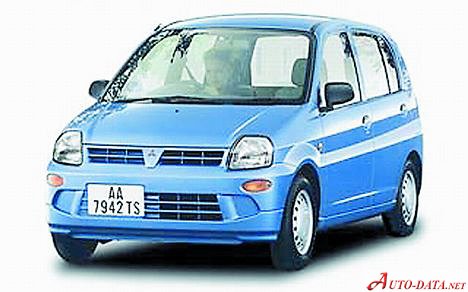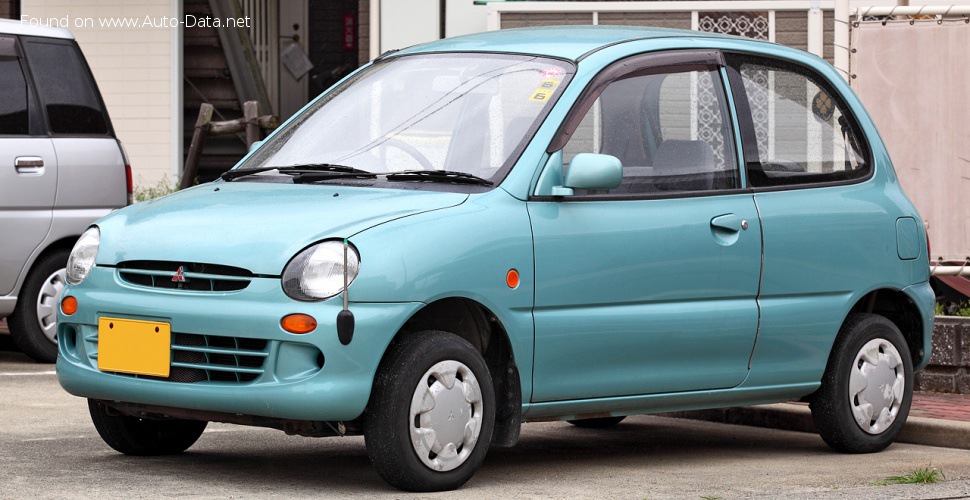
The Mitsubishi Minica V, specifically the 0.66 16V PG (50 Hp) variant, represents the fifth generation of Mitsubishi’s long-running Minica nameplate, a model series deeply rooted in Japan’s unique “Kei car” segment. Produced from 1993 to 1999, this diminutive 3-door hatchback was engineered with a singular focus: to provide efficient, economical, and highly maneuverable transportation within the strict regulatory framework governing Kei vehicles in Japan. While never officially imported to the United States, the Minica V embodies the ingenuity and practicality that defined Japanese automotive design for its domestic market, showcasing how maximum utility could be extracted from minimal dimensions and engine displacement. This particular iteration, with its 0.66-liter, 16-valve engine, offered a blend of modest performance and exceptional fuel economy, making it a popular choice for urban dwellers and those seeking low-cost mobility in its home country.
Mitsubishi Minica V: A Kei Car Engineered for Efficiency
Origins of the Kei Car
To understand the Minica V, it’s crucial to understand the Kei car class. Established by the Japanese government, Kei cars (literally “light cars”) are subject to strict regulations regarding size and engine displacement. These regulations, originally intended to provide affordable transportation after World War II, offer tax and insurance benefits to owners of Kei vehicles. The current regulations limit engine displacement to 660cc, length to 3.4 meters (133.9 inches), width to 1.48 meters (58.3 inches), and height to 2.0 meters (78.7 inches). This has resulted in a unique automotive segment focused on maximizing space and efficiency within these constraints.
Engine & Performance
At the heart of the Mitsubishi Minica V 0.66 16V PG (50 Hp) lies a 659 cm3 (40.21 cu. in.) inline-four engine. This engine configuration, featuring 16 valves and an Overhead Camshaft (OHC) valvetrain, was relatively sophisticated for a Kei car of the era. The use of a carbureted fuel injection system, rather than the increasingly common electronic fuel injection, represented a cost-saving measure appropriate for the vehicle’s target market. The engine produced 50 horsepower at 7500 rpm and 41.3 lb.-ft. of torque at 5500 rpm. While these figures are modest compared to larger vehicles, they were sufficient for urban driving.
Power is delivered to the front wheels via a 5-speed manual transmission, a common configuration for Kei cars. The Minica V achieved a top speed of 68.35 mph (110 km/h). However, its primary strength was fuel economy, achieving a combined rating of 58.8 US mpg (4 L/100 km). Its lightweight construction, with a kerb weight of just 1455.05 lbs (660 kg), contributed significantly to both its efficiency and agility, resulting in a weight-to-power ratio of 13.2 kg/Hp.
Design & Features
The Mitsubishi Minica V’s design was dictated by Kei car regulations, resulting in a compact 3-door hatchback. Its dimensions – 129.72 inches (3295 mm) in length, 54.92 inches (1395 mm) in width, and 57.68 inches (1465 mm) in height – allowed for easy maneuverability in crowded urban environments. Despite its small size, the Minica V could comfortably accommodate four passengers, a testament to efficient interior packaging. The wheelbase measured 89.76 inches (2280 mm), and the turning circle was a tight 27.56 feet (8.4 m).
The exterior styling was functional and understated, typical of Kei cars in the 1990s. Large windows provided good visibility, and the overall profile was aerodynamic. The interior was simple and durable, focusing on practicality. Safety features for the time included front disc brakes, rear drum brakes, and, notably, an available Anti-lock Braking System (ABS), which was relatively uncommon on Kei cars of that era. The rack and pinion steering, assisted by hydraulic power steering, made low-speed maneuvering effortless, utilizing 135/80 R12 S tires.
Technical Specifications
| Category | Specification |
| General Information | |
| Brand | Mitsubishi |
| Model | Minica |
| Generation | Minica V |
| Type (Engine) | 0.66 16V PG (50 Hp) |
| Start of production | 1993 year |
| End of production | 1999 year |
| Powertrain Architecture | Internal Combustion engine |
| Body type | Hatchback |
| Seats | 4 |
| Doors | 3 |
| Performance Specifications | |
| Fuel consumption (economy) – combined | 4 l/100 km (58.8 US mpg) |
| Fuel Type | Petrol (Gasoline) |
| Maximum speed | 110 km/h (68.35 mph) |
| Weight-to-power ratio | 13.2 kg/Hp |
| Engine Specifications | |
| Power | 50 Hp @ 7500 rpm |
| Torque | 56 Nm @ 5500 rpm (41.3 lb.-ft. @ 5500 rpm) |
| Engine displacement | 659 cm3 (0.7 liters, 40.21 cu. in.) |
| Number of cylinders | 4 |
| Fuel injection system | Carburettor |
| Space, Volume and Weights | |
| Kerb Weight | 660 kg (1455.05 lbs) |
| Dimensions | |
| Length | 3295 mm (129.72 in) |
| Width | 1395 mm (54.92 in) |
| Height | 1465 mm (57.68 in) |
| Wheelbase | 2280 mm (89.76 in) |
| Drivetrain, Brakes and Suspension Specifications | |
| Drivetrain Architecture | Front wheel drive |
| Front suspension | Spring Strut |
| Rear suspension | Coil spring |
| Front brakes | Disc |
| Rear brakes | Drum |
Legacy and Market Impact
The Mitsubishi Minica V was a significant player in the Japanese Kei car market during the 1990s. It competed with models like the Suzuki Alto, Daihatsu Mira, and Honda Life, all vying for the attention of consumers seeking affordable and efficient transportation. The Minica V’s reputation was built on reliability, fuel economy, and low running costs. Its 16-valve engine and 5-speed manual transmission offered a surprisingly engaging driving experience for a Kei car.
While the Minica V had limited impact outside of Japan, it exemplifies the innovative engineering that characterizes the Kei car segment. It demonstrated how to create a practical and beloved vehicle within strict regulatory constraints, providing accessible personal mobility and contributing to Japan’s unique automotive culture. The Minica V’s legacy is one of pragmatic design and efficient performance, paving the way for future generations of Kei cars.