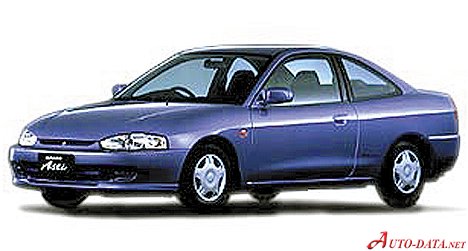
The Mitsubishi Mirage V Asti (CJO) is a compact coupe produced by Mitsubishi Motors between 1996 and 2002. Representing the fifth generation of the Mirage, the Asti was primarily marketed in Europe, Japan, and Australia, and was not officially sold in the United States. It served as Mitsubishi’s entry into the increasingly popular small coupe segment, offering a blend of sporty styling, reasonable performance, and practical features. The Asti distinguished itself with its distinctive fastback design and a focus on affordability, making it a popular choice for young drivers and those seeking an economical yet stylish vehicle.
Mitsubishi Mirage V Asti (CJO): Overview and Market Position
The Mirage V Asti occupied a niche market position, bridging the gap between smaller hatchbacks and larger, more expensive coupes. In Europe, it competed with models like the Peugeot 306 Coupe and the Renault Mégane Coupe. The Asti’s appeal lay in its relatively low price point, combined with a surprisingly spacious interior for a coupe and a decent level of equipment. While not a high-performance vehicle, the 1.5-liter engine provided adequate power for everyday driving, and the car’s nimble handling made it enjoyable to drive on winding roads. The “Asti” designation itself refers to a trim level, signifying a more feature-rich version of the Mirage V coupe.
Engine & Performance
The Mitsubishi Mirage V Asti (CJO) was typically powered by a 1.5-liter inline-four cylinder gasoline engine. This engine, designated the 4G15, produced 110 horsepower at 6000 rpm and 137 Nm (101.05 lb.-ft.) of torque at 3000 rpm. The engine featured multi-port fuel injection and a compression ratio of 9.5:1. Power delivery was adequate for its intended purpose, offering a balance between fuel efficiency and responsiveness. The Asti was equipped with a five-speed manual transmission as standard, contributing to a more engaging driving experience. Performance figures included a 0-60 mph (0-97 km/h) acceleration time of approximately 10 seconds and a top speed of 180 km/h (112 mph). The weight-to-power ratio of 8.9 kg/Hp and a weight-to-torque ratio of 7.2 kg/Nm contributed to its relatively nimble handling characteristics. The engine’s 74.9 horsepower per liter demonstrated a reasonable level of specific output for the era.
Design & Features
The Mirage V Asti’s design was characterized by its sleek, coupe silhouette and fastback roofline. The two-door body style offered a sporty aesthetic, while the relatively long wheelbase and careful packaging allowed for a surprisingly spacious interior for five passengers, although rear seat space was somewhat limited. The car’s exterior styling was modern for its time, with integrated headlights and a relatively streamlined profile. Inside, the Asti featured a functional dashboard layout with clear instrumentation. Standard features typically included power steering, front disc brakes, and an anti-lock braking system (ABS) for enhanced safety. The trunk offered 420 liters (14.83 cubic feet) of storage space, which was competitive for a coupe of its size. The Asti’s focus was on providing a stylish and practical vehicle at an affordable price point, making it an attractive option for buyers seeking a sporty yet economical car.
Technical Specifications
| Brand | Mitsubishi |
| Model | Mirage |
| Generation | Mirage V Asti (CJO) |
| Type (Engine) | 1.5 i 16V (110 Hp) |
| Start of production | 1996 |
| End of production | 2002 |
| Powertrain Architecture | Internal Combustion engine |
| Body type | Coupe |
| Seats | 5 |
| Doors | 2 |
| Fuel Type | Petrol (Gasoline) |
| Acceleration 0 – 100 km/h | 10.5 sec |
| Acceleration 0 – 62 mph | 10.5 sec |
| Acceleration 0 – 60 mph | 10 sec |
| Maximum speed | 180 km/h (111.85 mph) |
| Weight-to-power ratio | 8.9 kg/Hp |
| Weight-to-torque ratio | 7.2 kg/Nm |
| Power | 110 Hp @ 6000 rpm |
| Power per litre | 74.9 Hp/l |
| Torque | 137 Nm @ 3000 rpm (101.05 lb.-ft. @ 3000 rpm) |
| Engine layout | Front, Transverse |
| Engine displacement | 1468 cm3 (89.58 cu. in.) |
| Number of cylinders | 4 |
| Engine configuration | Inline |
| Cylinder Bore | 75.5 mm (2.97 in.) |
| Piston Stroke | 82 mm (3.23 in.) |
| Compression ratio | 9.5:1 |
| Number of valves per cylinder | 4 |
| Fuel injection system | Multi-port manifold injection |
| Engine aspiration | Naturally aspirated engine |
| Kerb Weight | 980 kg (2160.53 lbs.) |
| Trunk (boot) space – minimum | 420 l (14.83 cu. ft.) |
| Fuel tank capacity | 50 l (13.21 US gal | 11 UK gal) |
| Length | 4230 mm (166.54 in.) |
| Width | 1690 mm (66.54 in.) |
| Height | 1365 mm (53.74 in.) |
| Wheelbase | 2415 mm (95.08 in.) |
| Front track | 1450 mm (57.09 in.) |
| Rear (Back) track | 1460 mm (57.48 in.) |
| Drivetrain Architecture | The Internal combustion engine (ICE) drives the front wheels of the vehicle. |
| Drive wheel | Front wheel drive |
| Number of gears and type of gearbox | 5 gears, manual transmission |
| Front suspension | Spring-loaded rack |
| Rear suspension | Coil spring |
| Front brakes | Disc |
| Rear brakes | Drum |
| Assisting systems | ABS (Anti-lock braking system) |
| Steering type | Steering rack and pinion |
| Power steering | Hydraulic Steering |
| Tires size | 175/65 R14 |
The Mitsubishi Mirage V Asti, while not a groundbreaking vehicle, represented a solid offering in the compact coupe segment. Its blend of affordability, style, and practicality made it a popular choice in its target markets, and it remains a fondly remembered car for those who owned and drove one. It showcased Mitsubishi’s ability to produce well-rounded vehicles that appealed to a broad range of consumers.