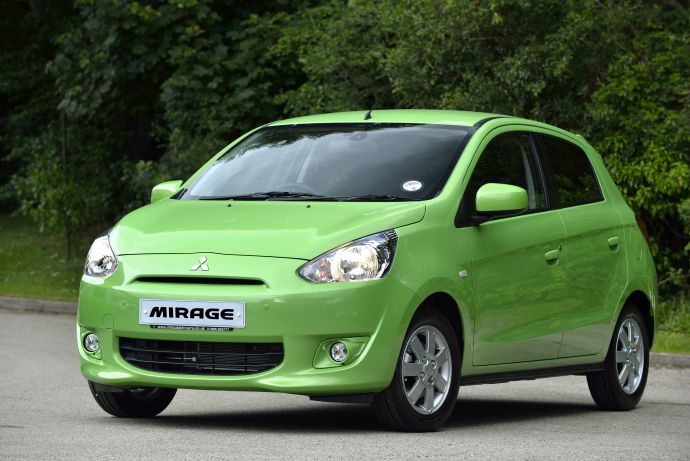
The Mitsubishi Mirage VI Hatchback 1.0 MIVEC (71 Hp) represents a pivotal chapter in the Japanese automaker’s strategy for global compact car markets, particularly in regions prioritizing fuel efficiency and affordability. Launched in 2012 and produced until 2016, this Mirage generation was engineered as a lightweight, aerodynamically efficient, and highly economical vehicle. While a different version of the Mirage was sold in North America, this specific 1.0-liter, 71-horsepower variant primarily targeted European, Asian, and other international markets, serving as a practical and low-cost entry point into the Mitsubishi lineup. It embodies Mitsubishi’s commitment to sustainable mobility, offering dependable transportation for urban and suburban environments.
Mitsubishi Mirage VI Hatchback 1.0 MIVEC: An Overview
The Mirage VI Hatchback, designated as the Mirage in most markets and the Space Star in Europe, was conceived as a direct response to the growing demand for fuel-efficient and affordable vehicles. It aimed to provide a modern, reliable, and economical solution for everyday transportation. The vehicle’s design philosophy centered around minimizing weight and maximizing aerodynamic efficiency to achieve exceptional fuel economy. This generation of the Mirage was a key component of Mitsubishi’s global strategy to expand its presence in the competitive subcompact car segment.
Engine & Performance
The Mitsubishi Mirage VI Hatchback 1.0 MIVEC (71 Hp) is powered by the 3A90 engine, a 1.0-liter (999 cm3 or 60.96 cu. in.) inline three-cylinder unit. This engine exemplifies modern small-displacement design, prioritizing efficiency. Equipped with Mitsubishi’s MIVEC (Mitsubishi Innovative Valve timing Electronic Control) system, the naturally aspirated engine optimizes valve timing for improved fuel economy and reduced emissions. It produces 71 horsepower at 6000 rpm and 88 Nm (64.91 lb.-ft.) of torque at 5000 rpm. This power is delivered to the front wheels via a standard 5-speed manual transmission, enhancing driver engagement and efficiency.
Performance figures reflect the vehicle’s practical orientation. Acceleration from 0 to 60 mph takes approximately 12.9 seconds, with a top speed of 106.88 mph (172 km/h). However, the Mirage excels in fuel economy, achieving a combined cycle consumption of 56 US mpg (4.2 l/100 km). Extra-urban driving yields an impressive 65.3 US mpg (3.6 l/100 km), while urban driving still achieves a respectable 47 US mpg (5 l/100 km). CO2 emissions are a low 96 g/km, meeting stringent Euro 5 emission standards.
Design & Features
The Mirage VI Hatchback features a practical five-door hatchback body style, designed to maximize interior space within a compact footprint. Its dimensions – 146.06 inches (3710 mm) in length, 65.55 inches (1665 mm) in width, and 58.66 inches (1490 mm) in height – make it ideal for navigating congested urban areas and fitting into tight parking spaces. The 96.46-inch (2450 mm) wheelbase contributes to a stable ride, and a 30.18-foot (9.2 m) turning circle ensures exceptional maneuverability. The exterior design is clean and functional, with a drag coefficient (Cd) of 0.28, contributing to its fuel efficiency.
Inside, the Mirage comfortably seats five occupants. Despite its exterior size, the interior is designed to be airy and functional, prioritizing usability. Trunk space is versatile, offering 17.2 cu. ft. (487 liters) with the rear seats up, expanding to 47 cu. ft. (1331 liters) with the rear seats folded. Standard features included ABS (Anti-lock Braking System) and electric power steering. The front suspension utilizes an independent McPherson strut setup with coil springs and an anti-roll bar, while the rear employs a torsion beam, balancing ride comfort and handling stability.
Technical Specifications
| Category | Specification |
| Brand | Mitsubishi |
| Model | Mirage |
| Generation | Mirage VI Hatchback |
| Type (Engine) | 1.0 MIVEC (71 Hp) |
| Start of Production | 2012 |
| End of Production | 2016 |
| Powertrain Architecture | Internal Combustion engine |
| Body Type | Hatchback |
| Seats | 5 |
| Doors | 5 |
| Fuel Consumption (Economy) – urban | 5 l/100 km (47 US mpg) |
| Fuel Consumption (Economy) – extra urban | 3.6 l/100 km (65.3 US mpg) |
| Fuel Consumption (Economy) – combined | 4.2 l/100 km (56 US mpg) |
| CO2 emissions | 96 g/km |
| Fuel Type | Petrol (Gasoline) |
| Acceleration 0 – 60 mph | 12.9 sec |
| Maximum speed | 172 km/h (106.88 mph) |
| Emission standard | Euro 5 |
| Weight-to-power ratio | 11.9 kg/Hp (84 Hp/tonne) |
| Engine Power | 71 Hp @ 6000 rpm |
| Engine Torque | 88 Nm @ 5000 rpm (64.91 lb.-ft. @ 5000 rpm) |
| Engine Displacement | 999 cm3 (1.0 Liters / 60.96 cu. in.) |
| Number of Cylinders | 3 |
| Kerb Weight | 845 kg (1862.91 lbs.) |
| Trunk (boot) space – minimum | 487 l (17.2 cu. ft.) |
| Trunk (boot) space – maximum | 1331 l (47 cu. ft.) |
| Length | 3710 mm (146.06 in.) |
| Width | 1665 mm (65.55 in.) |
| Height | 1490 mm (58.66 in.) |
| Wheelbase | 2450 mm (96.46 in.) |
| Drag coefficient (Cd) | 0.28 |
Legacy and Market Impact
The Mitsubishi Mirage VI Hatchback 1.0 MIVEC (71 Hp) established a strong presence in global automotive markets, particularly where compact size, low running costs, and fuel efficiency were highly valued. Competitors included the Volkswagen Up!, Skoda Citigo, SEAT Mii, Toyota Aygo, Peugeot 107/108, Citroën C1, and Kia Picanto. The Mirage distinguished itself through its emphasis on efficiency, lightweight construction, and Mitsubishi’s reputation for reliability.
The Mirage’s appeal lay in its straightforward, practical approach to transportation. It wasn’t designed for performance or luxury, but as an honest, reliable vehicle for daily commuting and urban living. Its fuel economy, low emissions, and competitive pricing made it attractive to first-time buyers and those seeking to minimize ownership expenses. The 1.0-liter MIVEC engine underscored this philosophy, providing sufficient power without sacrificing economy. Its simple mechanics also contributed to lower maintenance costs. Despite criticisms regarding its basic interior, the Mirage succeeded in its core mission, becoming a volume seller for Mitsubishi in numerous international markets and solidifying its position as a significant player in the global subcompact car segment.