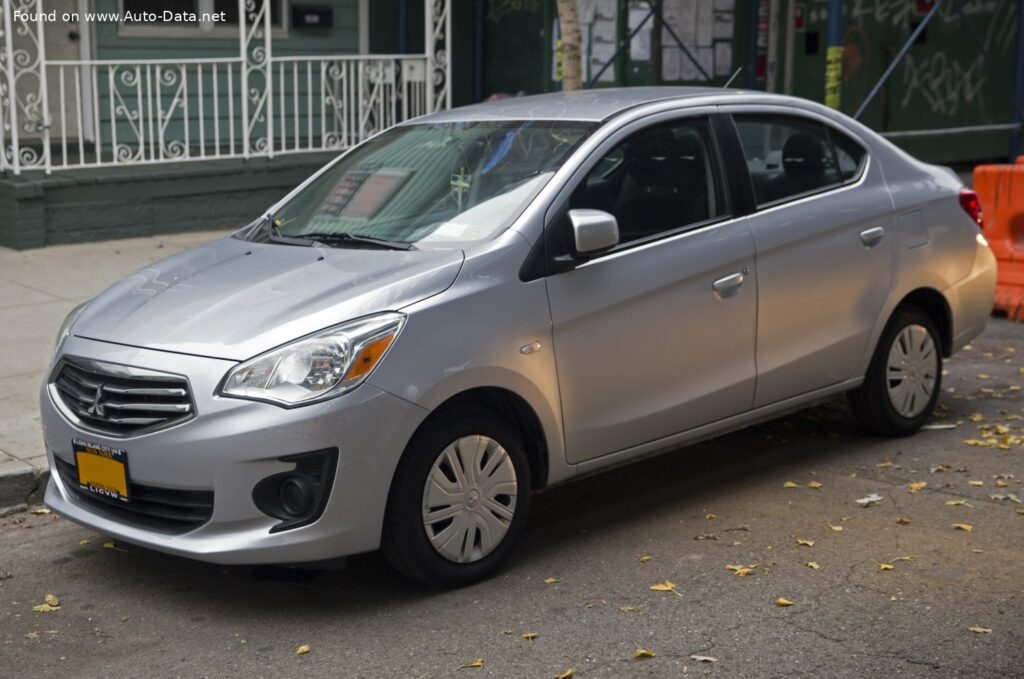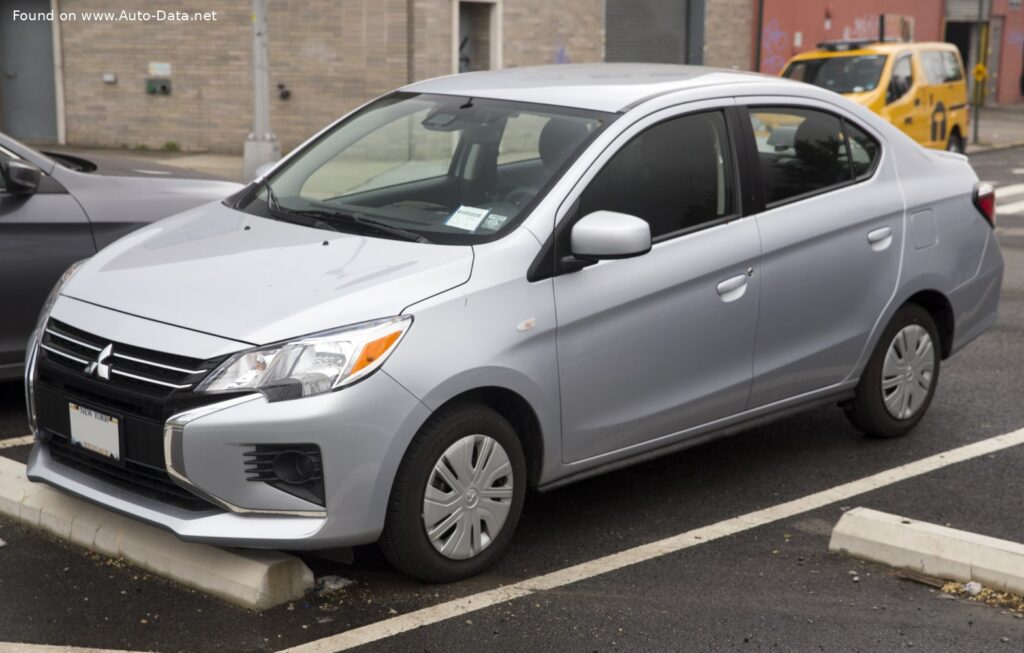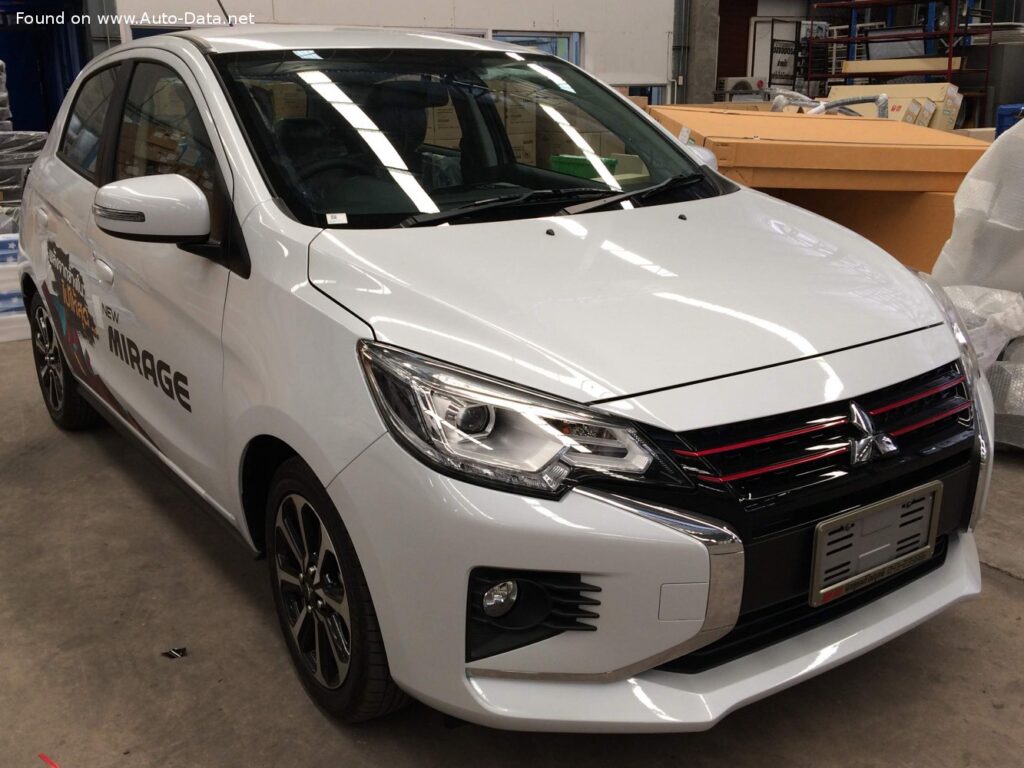
The Mitsubishi Mirage VI Hatchback, specifically the facelifted 2019 model with the 1.2 MIVEC engine and Continuously Variable Transmission (CVT), represents Mitsubishi’s entry-level offering in the subcompact hatchback segment. While not officially sold in the United States after 2022, the Mirage has been a significant model in various international markets, particularly in Europe, Australia, and parts of Asia, where fuel efficiency and affordability are key purchasing factors. This generation, introduced in 2012 and receiving a notable facelift in 2019, aimed to provide a practical and economical transportation solution for urban drivers.
Mitsubishi Mirage VI Hatchback (2019 Facelift): An Overview
The Mirage VI, in its various iterations, has consistently focused on providing a low-cost, fuel-efficient vehicle. The 2019 facelift brought updated styling, improved safety features, and refinements to the interior. Positioned below larger Mitsubishi models like the Outlander and Eclipse Cross, the Mirage targets first-time car buyers, commuters, and those seeking a secondary vehicle for city driving. Its compact size makes it easy to maneuver in congested urban environments, and its relatively low price point makes it accessible to a wider range of consumers.
Engine & Performance
The heart of the 2019 Mitsubishi Mirage VI Hatchback is the 3A92 1.2-liter MIVEC inline-3 cylinder engine. This naturally aspirated engine produces 80 horsepower at 6000 rpm and 106 Nm (78.18 lb.-ft.) of torque at 4000 rpm. While not a performance-oriented powerplant, the 1.2 MIVEC is designed for efficiency. The engine features multi-port fuel injection and a double overhead camshaft (DOHC) valvetrain. Power is delivered to the front wheels via a CVT (Continuously Variable Transmission), prioritizing smooth acceleration and optimal fuel economy over rapid gear changes. Acceleration from 0 to 100 km/h (0-62 mph) takes 13.5 seconds, and 0-60 mph is achieved in approximately 12.8 seconds. The vehicle has a top speed of 173 km/h (107.5 mph). The weight-to-power ratio is 11.3 kg/Hp, and the weight-to-torque ratio is 8.5 kg/Nm.
Design & Features
The Mirage VI Hatchback is a five-door, five-seat vehicle. The 2019 facelift included revisions to the front fascia, including a redesigned grille and headlights, giving the car a more modern appearance. The interior, while basic, offers essential features for comfort and convenience. Standard equipment typically includes air conditioning, power windows, and a basic audio system. Safety features, enhanced in the facelifted model, include ABS (Anti-lock Braking System) and multiple airbags. The vehicle’s compact dimensions – 3845 mm (151.38 in) in length, 1665 mm (65.55 in) in width, and 1505 mm (59.25 in) in height – contribute to its maneuverability. Trunk space is relatively modest at 175 liters (6.18 cu. ft.), but the rear seats can be folded down to increase cargo capacity. The Mirage VI utilizes a McPherson strut front suspension and a transverse stabilizer leaf spring rear suspension.
Technical Specifications
| Brand | Mitsubishi |
| Model | Mirage |
| Generation | Mirage VI Hatchback (facelift 2019) |
| Type (Engine) | 1.2 MIVEC (80 Hp) CVT |
| Start of production | February, 2020 |
| Powertrain Architecture | Internal Combustion engine |
| Body type | Hatchback |
| Seats | 5 |
| Doors | 5 |
| Fuel consumption at Low speed (WLTP) | 6.5 l/100 km (36.2 US mpg, 43.5 UK mpg, 15.4 km/l) |
| Fuel consumption at Medium speed (WLTP) | 5.1 l/100 km (46.1 US mpg, 55.4 UK mpg, 19.6 km/l) |
| Fuel consumption at high speed (WLTP) | 4.9 l/100 km (48 US mpg, 57.6 UK mpg, 20.4 km/l) |
| Fuel consumption at very high speed (WLTP) | 6.2 l/100 km (37.9 US mpg, 45.6 UK mpg, 16.1 km/l) |
| Combined fuel consumption (WLTP) | 5.6 l/100 km (42 US mpg, 50.4 UK mpg, 17.9 km/l) |
| CO2 emissions (NEDC, WLTP equivalent) | 106 g/km |
| Fuel Type | Petrol (Gasoline) |
| Acceleration 0 – 100 km/h | 13.5 sec |
| Acceleration 0 – 62 mph | 13.5 sec |
| Acceleration 0 – 60 mph | 12.8 sec |
| Maximum speed | 173 km/h (107.5 mph) |
| Emission standard | Euro 6d-TEMP |
| Weight-to-power ratio | 11.3 kg/Hp |
| Weight-to-torque ratio | 8.5 kg/Nm |
| Power | 80 Hp @ 6000 rpm |
| Torque | 106 Nm @ 4000 rpm (78.18 lb.-ft. @ 4000 rpm) |
| Engine layout | Front, Transverse |
| Engine Model/Code | 3A92 |
| Engine displacement | 1193 cm3 (72.8 cu. in.) |
| Number of cylinders | 3 |
| Engine configuration | Inline |
| Cylinder Bore | 75 mm (2.95 in.) |
| Piston Stroke | 90 mm (3.54 in.) |
| Compression ratio | 11:1 |
| Number of valves per cylinder | 4 |
| Fuel injection system | Multi-port manifold injection |
| Engine aspiration | Naturally aspirated engine |
| Valvetrain | DOHC |
| Engine oil capacity | 3 l (3.17 US qt | 2.64 UK qt) |
| Coolant | 4.6 l (4.86 US qt | 4.05 UK qt) |
| Kerb Weight | 905 kg (1995.18 lbs.) |
| Max. weight | 1370 kg (3020.33 lbs.) |
| Max load | 465 kg (1025.15 lbs.) |
| Trunk (boot) space – minimum | 175 l (6.18 cu. ft.) |
| Fuel tank capacity | 35 l (9.25 US gal | 7.7 UK gal) |
| Permitted trailer load with brakes (12%) | 200 kg (440.92 lbs.) |
| Length | 3845 mm (151.38 in.) |
| Width | 1665 mm (65.55 in.) |
| Height | 1505 mm (59.25 in.) |
| Wheelbase | 2450 mm (96.46 in.) |
| Front track | 1430 mm (56.3 in.) |
| Rear (Back) track | 1415 mm (55.71 in.) |
| Front overhang | 795 mm (31.3 in.) |
| Rear overhang | 600 mm (23.62 in.) |
| Ride height (ground clearance) | 150 mm (5.91 in.) |
| Minimum turning circle (turning diameter) | 9.2 m (30.18 ft.) |
| Drive wheel | Front wheel drive |
| Number of gears and type of gearbox | automatic transmission CVT |
| Front suspension | Independent, type McPherson with coil spring and anti-roll bar |
| Rear suspension | Transverse stabilizer, Leaf spring |
| Front brakes | Ventilated discs, 356 mm |
| Rear brakes | Drum |
| Steering type | Steering rack and pinion |
| Power steering | Electric Steering |
| Tires size | 175/55 R15 |
| Wheel rims size | 5J x 15 |
The Mitsubishi Mirage VI Hatchback (2019 facelift) remains a compelling option for budget-conscious buyers prioritizing fuel efficiency and practicality. While not offering exhilarating performance, its affordability and ease of use have secured its place in numerous international markets.