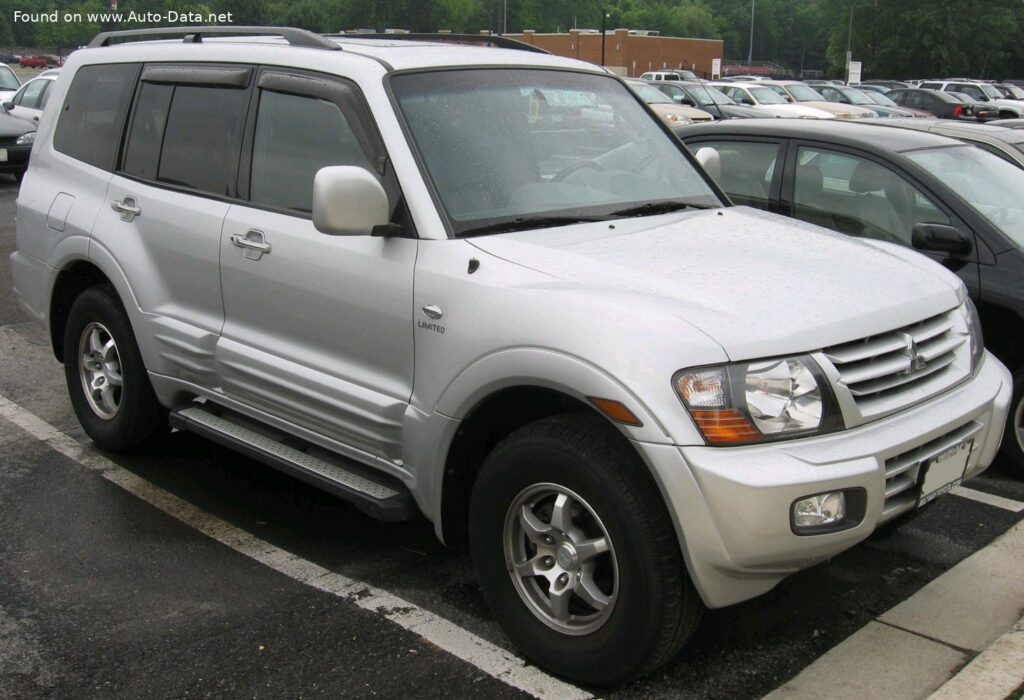
The Mitsubishi Montero, known as the Pajero in many international markets, is a mid-size SUV produced by Mitsubishi Motors. The first generation, produced from 1982 until 1999, established the Montero as a capable and reliable off-road vehicle. The model detailed here represents a later iteration of the first generation, specifically the 3.0 i V6 GLS variant produced between 1990 and 1996. While not officially sold in large numbers in the United States during this period, the Montero gained a reputation amongst enthusiasts for its robust four-wheel-drive system and comfortable ride. It served as a key competitor to vehicles like the Toyota Land Cruiser and Nissan Patrol, particularly in markets outside North America.
Mitsubishi Montero 3.0 i V6 GLS: An Overview
The 1990-1996 Mitsubishi Montero 3.0 i V6 GLS was positioned as a premium SUV, offering a blend of off-road capability and on-road comfort. It was designed to appeal to buyers seeking a versatile vehicle suitable for both daily commuting and adventurous excursions. The “GLS” designation indicated a higher trim level, typically including features like upgraded interior appointments and enhanced exterior styling. This generation of Montero was particularly popular in Europe, Australia, and parts of Asia, where its ruggedness and dependability were highly valued.
Engine & Performance
The Montero 3.0 i V6 GLS is powered by a 2.972-liter (181.36 cubic inches) naturally aspirated V6 gasoline engine. This engine produces 150 horsepower at 5000 rpm and 236 Newton-meters (174.06 lb-ft) of torque at 4000 rpm. Power is delivered to all four wheels via a four-speed automatic transmission and a sophisticated four-wheel-drive system. The engine’s configuration, with its longitudinal mounting, contributes to a balanced weight distribution. Acceleration from 0 to 100 km/h (0-62 mph) takes approximately 14 seconds, while 0 to 60 mph is achieved in around 13.3 seconds. The vehicle has a maximum speed of 165 km/h (102.53 mph). The weight-to-power ratio of 13.6 kg/Hp and weight-to-torque ratio of 8.7 kg/Nm indicate a vehicle that prioritizes usability and durability over outright performance. Fuel consumption is rated at 14 liters per 100 kilometers (16.8 US mpg or 20.2 UK mpg).
Design & Features
The 1990-1996 Mitsubishi Montero boasts a traditional SUV body style, characterized by its boxy shape and high ground clearance. It is a five-door vehicle with seating for up to seven passengers. The exterior design emphasizes practicality and robustness, with large windows providing good visibility. Key features of the GLS trim level likely included alloy wheels, upgraded interior trim, and potentially features like power windows and locks. Safety features for the era included an Anti-lock Braking System (ABS), which was becoming increasingly common on higher-end vehicles. The Montero’s spacious interior offers a comfortable environment for passengers, and the rear seats can be folded down to increase cargo capacity. Trunk space ranges from a minimum of 1080 liters (38.14 cubic feet) to a maximum of 2050 liters (72.4 cubic feet) with the rear seats folded. The vehicle’s dimensions are: length 4725 mm (186.02 in), width 1785 mm (70.28 in), and height 1865 mm (73.43 in). The wheelbase measures 2725 mm (107.28 in).
Technical Specifications
| Brand | Mitsubishi |
| Model | Montero |
| Generation | Montero |
| Type (Engine) | 3.0 i V6 GLS (150 Hp) Automatic |
| Start of production | 1990 year |
| End of production | 1996 year |
| Powertrain Architecture | Internal Combustion engine |
| Body type | SUV |
| Seats | 7 |
| Doors | 5 |
| Fuel consumption (combined) | 14 l/100 km |
| Fuel consumption (US mpg) | 16.8 US mpg |
| Fuel consumption (UK mpg) | 20.2 UK mpg |
| Fuel consumption (km/l) | 7.1 km/l |
| Fuel Type | Petrol (Gasoline) |
| Acceleration 0 – 100 km/h | 14 sec |
| Acceleration 0 – 62 mph | 14 sec |
| Acceleration 0 – 60 mph | 13.3 sec |
| Maximum speed | 165 km/h |
| Maximum speed (mph) | 102.53 mph |
| Weight-to-power ratio | 13.6 kg/Hp |
| Weight-to-torque ratio | 8.7 kg/Nm |
| Power | 150 Hp @ 5000 rpm |
| Power per litre | 50.5 Hp/l |
| Torque | 236 Nm @ 4000 rpm |
| Torque (lb-ft) | 174.06 lb.-ft. @ 4000 rpm |
| Engine layout | Front, Longitudinal |
| Engine displacement | 2972 cm3 |
| Engine displacement (cu. in.) | 181.36 cu. in. |
| Number of cylinders | 6 |
| Engine configuration | V-engine |
| Cylinder Bore | 91.1 mm |
| Cylinder Bore (in.) | 3.59 in. |
| Piston Stroke | 76 mm |
| Piston Stroke (in.) | 2.99 in. |
| Compression ratio | 8.9:1 |
| Number of valves per cylinder | 2 |
| Fuel injection system | Multi-port manifold injection |
| Engine aspiration | Naturally aspirated engine |
| Valvetrain | OHC |
| Kerb Weight | 2045 kg |
| Kerb Weight (lbs) | 4508.45 lbs. |
| Max. weight | 2650 kg |
| Max. weight (lbs) | 5842.25 lbs. |
| Max load | 605 kg |
| Max load (lbs) | 1333.8 lbs. |
| Trunk (boot) space – minimum | 1080 l |
| Trunk (boot) space – minimum (cu. ft.) | 38.14 cu. ft. |
| Trunk (boot) space – maximum | 2050 l |
| Trunk (boot) space – maximum (cu. ft.) | 72.4 cu. ft. |
| Fuel tank capacity | 92 l |
| Fuel tank capacity (US gal) | 24.3 US gal |
| Fuel tank capacity (UK gal) | 20.24 UK gal |
| Length | 4725 mm |
| Length (in.) | 186.02 in. |
| Width | 1785 mm |
| Width (in.) | 70.28 in. |
| Height | 1865 mm |
| Height (in.) | 73.43 in. |
| Wheelbase | 2725 mm |
| Wheelbase (in.) | 107.28 in. |
| Front track | 1465 mm |
| Front track (in.) | 57.68 in. |
| Rear (Back) track | 1480 mm |
| Rear (Back) track (in.) | 58.27 in. |
| Drive wheel | All wheel drive (4×4) |
| Number of gears | 4 |
| Type of gearbox | automatic transmission |
| Front suspension | Torsion |
| Rear suspension | Coil spring |
| Front brakes | Ventilated discs |
| Rear brakes | Disc |
| Assisting systems | ABS (Anti-lock braking system) |
| Power steering | Hydraulic Steering |
| Tires size | 265/70 R15 |
| Wheel rims size | 15 |