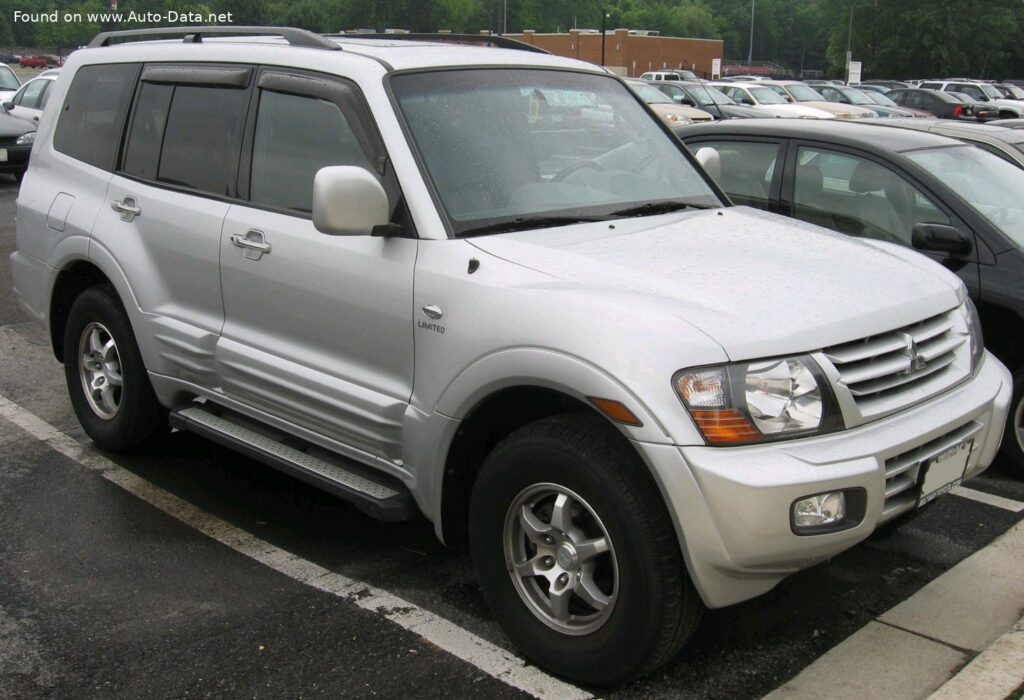
The Mitsubishi Montero, known as the Pajero in many international markets, is a full-size SUV produced by Mitsubishi Motors. The second-generation Montero, produced between 1994 and 2000, represented a significant evolution of the original, offering increased refinement, capability, and a larger interior. While not widely sold in the United States during this period, the Montero held a strong position in markets like Europe, Australia, and Latin America as a robust and reliable off-road vehicle capable of tackling challenging terrain while providing family-friendly practicality. This generation of Montero aimed to bridge the gap between rugged off-road performance and on-road comfort, making it a versatile choice for a wide range of drivers.
Mitsubishi Montero 3.5 i V6 24V: A Detailed Overview
The 3.5 i V6 24V variant, equipped with a 3.5-liter V6 engine, was a key offering within the second-generation Montero lineup. This model focused on providing a balance of power and refinement, appealing to buyers who desired a capable SUV with a more sophisticated driving experience. The Montero’s seven-seat configuration and spacious interior made it a practical choice for families, while its four-wheel-drive system and robust construction ensured it could handle demanding off-road conditions. The vehicle’s design reflected a move towards more modern SUV aesthetics, while retaining the rugged character associated with the Montero nameplate.
Engine & Performance
The heart of the Montero 3.5 i V6 24V is its 3.5-liter V6 engine, producing 208 horsepower at 5000 rpm and 300 Nm (221.27 lb.-ft.) of torque at 3000 rpm. This naturally aspirated engine, featuring a multi-port fuel injection system and a double overhead camshaft (DOHC) valvetrain, delivers a respectable power-to-weight ratio of 10 kg/Hp. The engine’s longitudinal front-engine layout contributes to balanced handling. Acceleration from 0 to 100 km/h (0-62 mph) takes approximately 10.5 seconds, while 0-60 mph is achieved in around 10 seconds. The Montero achieves a maximum speed of 185 km/h (114.95 mph). Fuel consumption is rated at 14.5 liters per 100 kilometers (16.2 US mpg, 19.5 UK mpg, 6.9 km/l), which is typical for a vehicle of this size and capability from that era. The five-speed manual transmission allows for driver control and efficient power delivery.
Design & Features
The second-generation Mitsubishi Montero boasts a classic SUV body style, characterized by its boxy shape and high ground clearance. Its five-door configuration and seven-seat layout provide ample space for passengers and cargo. The vehicle’s dimensions – 4725 mm (186.02 in) in length, 1785 mm (70.28 in) in width, and 1895 mm (74.61 in) in height – contribute to its imposing presence. The Montero’s interior prioritizes practicality and durability, with a focus on providing a comfortable and functional space for both driver and passengers. Key features include hydraulic power steering and an Anti-lock Braking System (ABS), enhancing safety and control. The trunk offers a versatile cargo area, with a minimum capacity of 1080 liters (38.14 cu. ft.) expanding to 2050 liters (72.4 cu. ft.) with the rear seats folded down. The Montero’s robust suspension system, featuring torsion bars at the front and coil springs at the rear, ensures a comfortable ride even on rough terrain. It rides on 265/70 R15 H tires.
Technical Specifications
| Brand | Mitsubishi |
| Model | Montero |
| Generation | Montero |
| Type (Engine) | 3.5 i V6 24V (208 Hp) |
| Start of production | 1994 |
| End of production | 2000 |
| Powertrain Architecture | Internal Combustion engine |
| Body type | SUV |
| Seats | 7 |
| Doors | 5 |
| Fuel consumption (combined) | 14.5 l/100 km |
| Fuel consumption (US mpg) | 16.2 US mpg |
| Fuel consumption (UK mpg) | 19.5 UK mpg |
| Fuel consumption (km/l) | 6.9 km/l |
| Fuel Type | Petrol (Gasoline) |
| Acceleration 0 – 100 km/h | 10.5 sec |
| Acceleration 0 – 62 mph | 10.5 sec |
| Acceleration 0 – 60 mph | 10 sec |
| Maximum speed | 185 km/h (114.95 mph) |
| Weight-to-power ratio | 10 kg/Hp |
| Weight-to-torque ratio | 7 kg/Nm |
| Power | 208 Hp @ 5000 rpm |
| Power per litre | 59.5 Hp/l |
| Torque | 300 Nm @ 3000 rpm (221.27 lb.-ft. @ 3000 rpm) |
| Engine layout | Front, Longitudinal |
| Engine displacement | 3497 cm3 (213.4 cu. in.) |
| Number of cylinders | 6 |
| Engine configuration | V-engine |
| Cylinder Bore | 93 mm (3.66 in.) |
| Piston Stroke | 85.8 mm (3.38 in.) |
| Compression ratio | 9.5:1 |
| Number of valves per cylinder | 4 |
| Fuel injection system | Multi-port manifold injection |
| Engine aspiration | Naturally aspirated engine |
| Valvetrain | DOHC |
| Kerb Weight | 2085 kg (4596.64 lbs.) |
| Max. weight | 2720 kg (5996.57 lbs.) |
| Max load | 635 kg (1399.94 lbs.) |
| Trunk (boot) space – minimum | 1080 l (38.14 cu. ft.) |
| Trunk (boot) space – maximum | 2050 l (72.4 cu. ft.) |
| Fuel tank capacity | 92 l (24.3 US gal | 20.24 UK gal) |
| Length | 4725 mm (186.02 in.) |
| Width | 1785 mm (70.28 in.) |
| Height | 1895 mm (74.61 in.) |
| Wheelbase | 2725 mm (107.28 in.) |
| Front track | 1465 mm (57.68 in.) |
| Rear (Back) track | 1480 mm (58.27 in.) |
| Drive wheel | All wheel drive (4×4) |
| Number of gears and type of gearbox | 5 gears, manual transmission |
| Front suspension | Torsion |
| Rear suspension | Coil spring |
| Front brakes | Ventilated discs |
| Rear brakes | Disc |
| Assisting systems | ABS (Anti-lock braking system) |
| Power steering | Hydraulic Steering |
| Tires size | 265/70 R15 H |
The Mitsubishi Montero 3.5 i V6 24V represented a compelling package for buyers seeking a capable, comfortable, and spacious SUV. Its blend of off-road prowess, on-road refinement, and practical features solidified its position as a popular choice in numerous international markets during its production run.