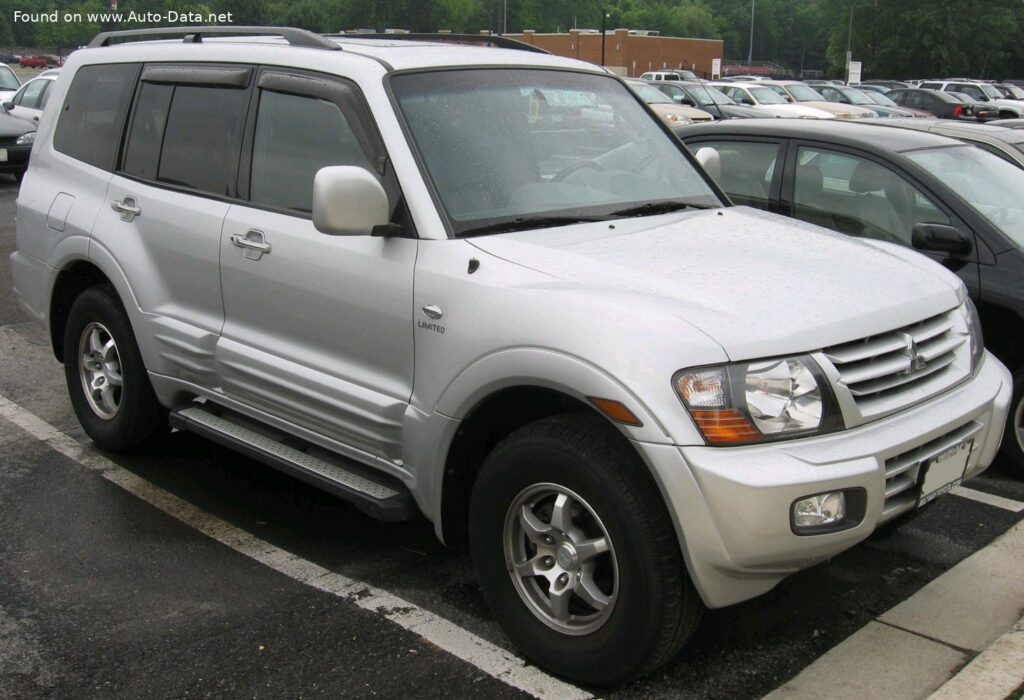
The Mitsubishi Montero, known as the Pajero in many international markets, is a full-size SUV produced by Mitsubishi Motors. The second-generation Montero, produced between 1994 and 2000, represented a significant evolution of the original, offering increased refinement, capability, and a larger interior. While not a major seller in the United States, the Montero held a strong position in markets like Europe, Australia, and Latin America as a robust and reliable off-road vehicle capable of tackling challenging terrain while providing family-friendly practicality. This generation of Montero aimed to bridge the gap between rugged off-road performance and on-road comfort, making it a versatile choice for a wide range of drivers.
Mitsubishi Montero 3.5 i V6: A Detailed Overview
The 3.5 i V6 variant of the second-generation Montero was a key offering, providing a substantial increase in power and refinement compared to earlier four-cylinder models. This model was particularly popular in markets where larger displacement engines were favored. The Montero’s design focused on providing a spacious and comfortable cabin, capable of seating up to seven passengers, making it a practical choice for families and those requiring ample cargo space. Its robust four-wheel-drive system and durable construction ensured it could handle both daily commutes and demanding off-road adventures.
Engine & Performance
The heart of the Montero 3.5 i V6 is a 3.5-liter V6 engine, producing 208 horsepower at 5000 rpm and 300 Nm (221.27 lb.-ft.) of torque at 3000 rpm. This naturally aspirated engine features a double overhead camshaft (DOHC) valvetrain with four valves per cylinder, and utilizes multi-port fuel injection. The engine’s longitudinal front-engine layout contributes to a balanced weight distribution. The power output translates to a 0-60 mph acceleration time of approximately 10 seconds and a top speed of 114.95 mph (185 km/h). The engine’s specific output is 59.5 horsepower per liter, demonstrating a good balance between displacement and power. The Montero’s weight-to-power ratio of 10 kg/Hp and weight-to-torque ratio of 7 kg/Nm indicate a respectable level of performance for a vehicle of its size and class. The four-speed automatic transmission provides smooth gear changes, enhancing the driving experience.
Design & Features
The second-generation Montero boasts a traditional SUV body style, characterized by its boxy shape and high ground clearance. The five-door configuration and seven-seat layout provide ample space for passengers and cargo. The vehicle’s dimensions – 4725 mm (186.02 in) in length, 1785 mm (70.28 in) in width, and 1895 mm (74.61 in) in height – contribute to its imposing presence. Key features included a robust four-wheel-drive system with selectable drive modes, allowing drivers to adapt to various terrain conditions. Safety features for the era included an Anti-lock Braking System (ABS) and hydraulic power steering. The interior was designed with practicality in mind, featuring durable materials and a functional layout. Trunk space is generous, ranging from 1080 liters (38.14 cu. ft.) with the rear seats up to 2050 liters (72.4 cu. ft.) with the seats folded down. The Montero’s 2725 mm (107.28 in) wheelbase provides a stable and comfortable ride.
Technical Specifications
| Brand | Mitsubishi |
| Model | Montero |
| Generation | Montero |
| Type (Engine) | 3.5 i V6 24V (208 Hp) Automatic |
| Start of production | 1994 |
| End of production | 2000 |
| Powertrain Architecture | Internal Combustion engine |
| Body type | SUV |
| Seats | 7 |
| Doors | 5 |
| Fuel consumption (combined) | 14.5 l/100 km |
| Fuel consumption (US mpg) | 16.2 US mpg |
| Fuel consumption (UK mpg) | 19.5 UK mpg |
| Fuel consumption (km/l) | 6.9 km/l |
| Fuel Type | Petrol (Gasoline) |
| Acceleration 0 – 100 km/h | 10.5 sec |
| Acceleration 0 – 62 mph | 10.5 sec |
| Acceleration 0 – 60 mph | 10 sec |
| Maximum speed | 185 km/h (114.95 mph) |
| Weight-to-power ratio | 10 kg/Hp |
| Weight-to-torque ratio | 7 kg/Nm |
| Power | 208 Hp @ 5000 rpm |
| Power per litre | 59.5 Hp/l |
| Torque | 300 Nm @ 3000 rpm (221.27 lb.-ft. @ 3000 rpm) |
| Engine layout | Front, Longitudinal |
| Engine displacement | 3497 cm3 (213.4 cu. in.) |
| Number of cylinders | 6 |
| Engine configuration | V-engine |
| Cylinder Bore | 93 mm (3.66 in.) |
| Piston Stroke | 85.8 mm (3.38 in.) |
| Compression ratio | 9.5:1 |
| Number of valves per cylinder | 4 |
| Fuel injection system | Multi-port manifold injection |
| Engine aspiration | Naturally aspirated engine |
| Valvetrain | DOHC |
| Kerb Weight | 2085 kg (4596.64 lbs.) |
| Max. weight | 2720 kg (5996.57 lbs.) |
| Max load | 635 kg (1399.94 lbs.) |
| Trunk (boot) space – minimum | 1080 l (38.14 cu. ft.) |
| Trunk (boot) space – maximum | 2050 l (72.4 cu. ft.) |
| Fuel tank capacity | 92 l (24.3 US gal | 20.24 UK gal) |
| Length | 4725 mm (186.02 in.) |
| Width | 1785 mm (70.28 in.) |
| Height | 1895 mm (74.61 in.) |
| Wheelbase | 2725 mm (107.28 in.) |
| Front track | 1465 mm (57.68 in.) |
| Rear (Back) track | 1480 mm (58.27 in.) |
| Drive wheel | All wheel drive (4×4) |
| Number of gears and type of gearbox | 4 gears, automatic transmission |
| Front suspension | Torsion |
| Rear suspension | Coil spring |
| Front brakes | Ventilated discs |
| Rear brakes | Disc |
| Assisting systems | ABS (Anti-lock braking system) |
| Power steering | Hydraulic Steering |
| Tires size | 265/70 R15 H |
| Wheel rims size | 15 |
The Mitsubishi Montero 3.5 i V6 represented a significant step forward for the model, offering a compelling combination of off-road capability, on-road comfort, and spaciousness. While not widely available in the US market, it remains a respected and capable SUV, particularly valued for its durability and reliability in regions where it was officially sold.