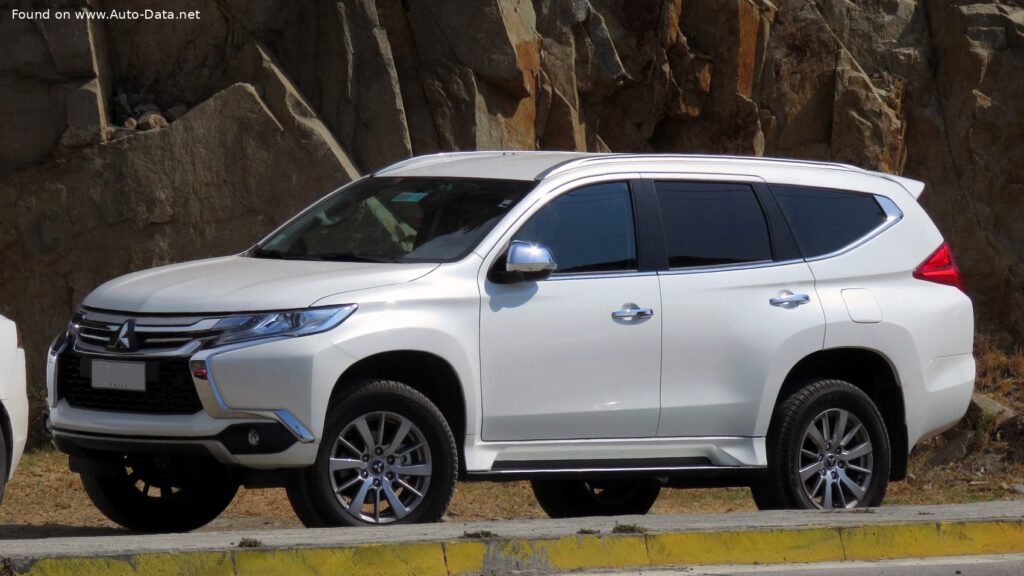
The Mitsubishi Montero Sport III 2.5 DI-D, produced between 2015 and 2019, represents the third generation of Mitsubishi’s popular mid-size SUV. While not officially sold in the United States under the Montero Sport name – Mitsubishi instead marketed similar vehicles as the Pajero Sport in many international markets – this generation was a significant model for Mitsubishi, particularly in regions like Southeast Asia, Australia, and Latin America. It served as a robust, body-on-frame SUV aimed at buyers needing a capable vehicle for both on-road comfort and off-road adventures. The “DI-D” designation signifies Mitsubishi’s direct-injection diesel engine technology, offering a balance of fuel efficiency and torque. This model competed with vehicles like the Toyota Fortuner, Isuzu MU-X, and Ford Everest in its primary markets.
Mitsubishi Montero Sport III 2.5 DI-D: An Overview
The Montero Sport III was designed to appeal to families and individuals requiring a versatile SUV with seven-passenger capacity. It built upon the strengths of its predecessors, offering improved refinement, safety features, and a more modern interior. The third-generation model represented a shift towards a more comfortable and technologically advanced SUV, while retaining the ruggedness expected of the Montero/Pajero lineage. The 2.5 DI-D engine variant was a popular choice, providing ample power for various driving conditions and terrains.
Engine & Performance
The heart of the Montero Sport III 2.5 DI-D is a 2.5-liter inline-four cylinder diesel engine, designated the 4D56. This engine produces 136 horsepower at 4000 rpm and 324 Nm (238.97 lb.-ft.) of torque at 2000 rpm. The engine utilizes a diesel commonrail fuel injection system and is equipped with a turbocharger and intercooler to enhance performance and efficiency. The longitudinal engine layout contributes to a balanced weight distribution. The power-to-weight ratio of 14 kg/Hp and torque-to-weight ratio of 5.9 kg/Nm demonstrate a focus on usable power rather than outright speed. The engine’s 17:1 compression ratio is typical for a diesel engine designed for efficiency and torque. Power delivery is characterized by strong low-end torque, making it well-suited for towing and off-road driving. The engine is paired with a 5-speed manual transmission, sending power to the rear wheels.
Design & Features
The Montero Sport III features a traditional SUV body style with a five-door configuration and seating for up to seven passengers. Its design incorporates a robust front grille, prominent headlights, and a relatively high ground clearance of 218 mm (8.58 inches), emphasizing its off-road capability. The vehicle’s dimensions – 4785 mm (188.39 in) in length, 1815 mm (71.46 in) in width, and 1805 mm (71.06 in) in height – provide ample interior space. The interior of the Montero Sport III was designed with practicality and comfort in mind. Features included air conditioning, power windows, and a basic audio system. Safety features, while not as extensive as in modern vehicles, included ABS (Anti-lock Braking System). The vehicle’s approach angle of 30°, departure angle of 24.6°, and ramp-over angle of 23.1° contribute to its off-road prowess. The 68-liter (17.96 US gal) fuel tank provides a reasonable driving range. The suspension system consists of a coil spring, double wishbone setup with a transverse stabilizer at the front, and a rigid axle suspension with a transverse stabilizer and coil springs at the rear, designed to handle both on-road and off-road conditions.
Technical Specifications
| Brand | Mitsubishi |
| Model | Montero Sport |
| Generation | Montero Sport III |
| Type (Engine) | 2.5 DI-D (136 Hp) |
| Start of production | 2015 |
| End of production | 2019 |
| Powertrain Architecture | Internal Combustion engine |
| Body type | Off-road vehicle, SUV |
| Seats | 7 |
| Doors | 5 |
| Fuel Type | Diesel |
| Maximum speed | 168 km/h (104.39 mph) |
| Emission standard | Euro 2 |
| Weight-to-power ratio | 14 kg/Hp |
| Weight-to-torque ratio | 5.9 kg/Nm |
| Power | 136 Hp @ 4000 rpm |
| Torque | 324 Nm @ 2000 rpm (238.97 lb.-ft. @ 2000 rpm) |
| Engine layout | Front, Longitudinal |
| Engine Model/Code | 4D56 |
| Engine displacement | 2477 cm3 (151.16 cu. in.) |
| Number of cylinders | 4 |
| Engine configuration | Inline |
| Cylinder Bore | 91.1 mm (3.59 in) |
| Piston Stroke | 95 mm (3.74 in) |
| Compression ratio | 17:1 |
| Number of valves per cylinder | 4 |
| Fuel injection system | Diesel Commonrail |
| Engine aspiration | Turbocharger, Intercooler |
| Valvetrain | DOHC |
| Engine oil capacity | 6.5 l (6.87 US qt | 5.72 UK qt) |
| Coolant | 8.2 l (8.66 US qt | 7.21 UK qt) |
| Kerb Weight | 1900 kg (4188.78 lbs) |
| Max. weight | 2600 kg (5732.02 lbs) |
| Max load | 700 kg (1543.24 lbs) |
| Fuel tank capacity | 68 l (17.96 US gal | 14.96 UK gal) |
| Length | 4785 mm (188.39 in) |
| Width | 1815 mm (71.46 in) |
| Height | 1805 mm (71.06 in) |
| Wheelbase | 2800 mm (110.24 in) |
| Front track | 1520 mm (59.84 in) |
| Rear (Back) track | 1515 mm (59.65 in) |
| Front overhang | 880 mm (34.65 in) |
| Rear overhang | 1105 mm (43.5 in) |
| Ride height (ground clearance) | 218 mm (8.58 in) |
| Minimum turning circle (turning diameter) | 11.2 m (36.75 ft) |
| Drivetrain Architecture | Rear wheel drive |
| Number of gears and type of gearbox | 5 gears, manual transmission |
| Front suspension | Coil spring, Double wishbone, Transverse stabilizer |
| Rear suspension | Rigid axle suspension, Transverse stabilizer, Coil spring |
| Front brakes | Ventilated discs, 294 mm |
| Rear brakes | Drum |
| Assisting systems | ABS (Anti-lock braking system) |
| Steering type | Steering rack and pinion |
| Power steering | Hydraulic Steering |
| Tires size | 265/70 R16 |
| Wheel rims size | 7J x 16 |
The Mitsubishi Montero Sport III 2.5 DI-D offered a compelling package for buyers seeking a capable and reliable SUV. Its blend of diesel power, seven-passenger capacity, and off-road credentials made it a popular choice in its target markets. While not sold in the US market, it represents a significant chapter in Mitsubishi’s SUV history and a testament to their engineering expertise.