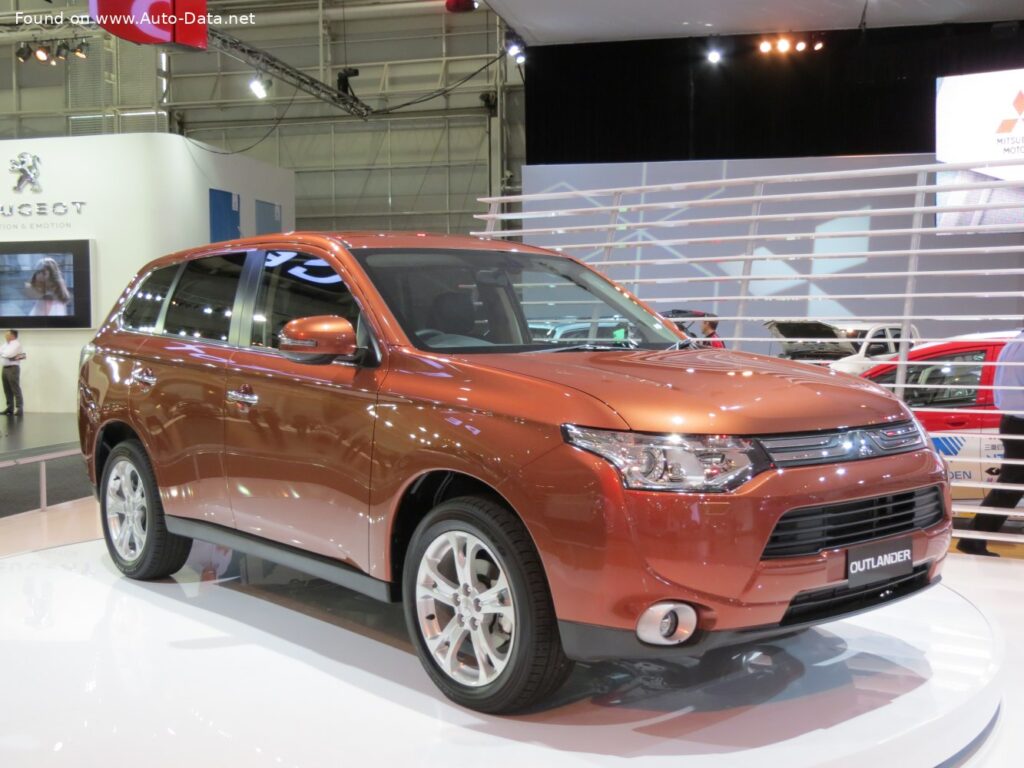
The Mitsubishi Outlander III 2.4 MIVEC (166 Hp) CVT, produced between 2013 and 2015, represents the third generation of Mitsubishi’s popular crossover SUV. Positioned as a mid-size family vehicle, the Outlander III aimed to provide a practical and fuel-efficient option in a segment increasingly dominated by Japanese and Korean manufacturers. While not initially a major seller in the North American market, the Outlander III offered a compelling blend of space, features, and a continuously variable transmission (CVT) designed for improved fuel economy. This model was particularly significant in European and Asian markets, where compact and mid-size SUVs were gaining substantial traction.
Mitsubishi Outlander III: Overview and Market Positioning
The Outlander III marked a significant evolution in Mitsubishi’s SUV lineup, building upon the foundations laid by its predecessors. It was designed to appeal to families seeking a versatile vehicle capable of handling both daily commutes and weekend adventures. The availability of seven seats, a relatively uncommon feature in its class, further broadened its appeal. The 2.4-liter MIVEC engine, coupled with the CVT, was a key component of Mitsubishi’s strategy to offer a balance between performance and efficiency, catering to increasingly stringent emissions regulations and consumer demand for better fuel economy.
Engine & Performance
The heart of the Mitsubishi Outlander III 2.4 MIVEC is a 2.4-liter inline-four cylinder gasoline engine, designated the 4J12. This naturally aspirated engine produces 166 horsepower at 6000 rpm and 220 Newton-meters (162.26 lb.-ft.) of torque at 4200 rpm. The engine features Mitsubishi’s MIVEC (Mitsubishi Innovative Valve timing and lift Electronic Control) technology, which optimizes valve timing for improved performance and fuel efficiency across a wider range of engine speeds. Power is delivered to the front wheels via a continuously variable transmission (CVT). The CVT is designed to provide smooth, seamless acceleration and maximize fuel economy by keeping the engine operating within its most efficient range. The weight-to-power ratio of 8.9 kg/Hp and a weight-to-torque ratio of 6.8 kg/Nm contribute to a reasonably responsive driving experience, although it’s not positioned as a performance-oriented vehicle. Fuel consumption is rated at 8.7 liters per 100 kilometers combined (27 US mpg, 32.5 UK mpg, 11.5 km/l).
Design & Features
The Outlander III boasts a contemporary SUV design, characterized by its sleek lines and relatively compact dimensions. Available as a five-door crossover, it offers seating for up to seven passengers, depending on the configuration. The interior is designed with practicality in mind, offering a comfortable and spacious cabin. Key features include a multi-port fuel injection system, independent McPherson strut front suspension, and an independent multi-link rear suspension, contributing to a comfortable ride quality. Safety features, crucial for family vehicles, include an Anti-lock Braking System (ABS). The vehicle’s dimensions – 4656 mm in length, 1801 mm in width, and 1679 mm in height – position it squarely within the mid-size crossover segment. The trunk offers a versatile 292 liters of space with all seats up, expanding to a substantial 1792 liters when the rear seats are folded down. The Outlander III’s design prioritized functionality and family-friendliness, offering a practical and adaptable vehicle for everyday use.
Technical Specifications
| Brand | Mitsubishi |
| Model | Outlander |
| Generation | Outlander III |
| Type (Engine) | 2.4 MIVEC (166 Hp) CVT |
| Start of production | 2013 |
| End of production | 2015 |
| Powertrain Architecture | Internal Combustion engine |
| Body type | SUV, Crossover |
| Seats | 7 |
| Doors | 5 |
| Fuel consumption (urban) | 9.4 l/100 km (25 US mpg) |
| Fuel consumption (extra urban) | 7.6 l/100 km (30.9 US mpg) |
| Fuel consumption (combined) | 8.7 l/100 km (27 US mpg) |
| Fuel Type | Petrol (Gasoline) |
| Emission standard | LEV-II-ULEV |
| Weight-to-power ratio | 8.9 kg/Hp |
| Weight-to-torque ratio | 6.8 kg/Nm |
| Power | 166 Hp @ 6000 rpm |
| Torque | 220 Nm @ 4200 rpm (162.26 lb.-ft. @ 4200 rpm) |
| Maximum engine speed | 6500 rpm |
| Engine layout | Front, Transverse |
| Engine Model/Code | 4J12 |
| Engine displacement | 2360 cm3 (144.02 cu. in.) |
| Number of cylinders | 4 |
| Engine configuration | Inline |
| Cylinder Bore | 88 mm (3.46 in.) |
| Piston Stroke | 97 mm (3.82 in.) |
| Compression ratio | 10.5:1 |
| Number of valves per cylinder | 4 |
| Fuel injection system | Multi-port manifold injection |
| Engine aspiration | Naturally aspirated engine |
| Valvetrain | SOHC |
| Engine oil capacity | 4.3 l (4.54 US qt | 3.78 UK qt) |
| Coolant | 7.5 l (7.93 US qt | 6.6 UK qt) |
| Kerb Weight | 1485-1495 kg (3273.86 – 3295.91 lbs.) |
| Max. weight | 2175 kg (4795.05 lbs.) |
| Max load | 680-690 kg (1499.14 – 1521.19 lbs.) |
| Trunk (boot) space – minimum | 292 l (10.31 cu. ft.) |
| Trunk (boot) space – maximum | 1792 l (63.28 cu. ft.) |
| Fuel tank capacity | 63 l (16.64 US gal | 13.86 UK gal) |
| Permitted trailer load with brakes (12%) | 680 kg (1499.14 lbs.) |
| Permitted towbar download | 68 kg (149.91 lbs.) |
| Length | 4656 mm (183.31 in.) |
| Width | 1801 mm (70.91 in.) |
| Height | 1679 mm (66.1 in.) |
| Wheelbase | 2670 mm (105.12 in.) |
| Front track | 1539 mm (60.59 in.) |
| Rear (Back) track | 1539 mm (60.59 in.) |
| Ride height (ground clearance) | 216 mm (8.5 in.) |
| Minimum turning circle (turning diameter) | 10.6 m (34.78 ft.) |
| Drivetrain Architecture | Front wheel drive |
| Number of gears and type of gearbox | automatic transmission CVT |
| Front suspension | Independent type McPherson |
| Rear suspension | Independent multi-link suspension |
| Front brakes | Ventilated discs, 294 mm |
| Rear brakes | Disc, 302 mm |
| Assisting systems | ABS (Anti-lock braking system) |
| Steering type | Steering rack and pinion |
| Power steering | Electric Steering |
| Tires size | 215/70 R16; 225/55 R18 |
| Wheel rims size | 6.5J x 16; 7J x 18 |