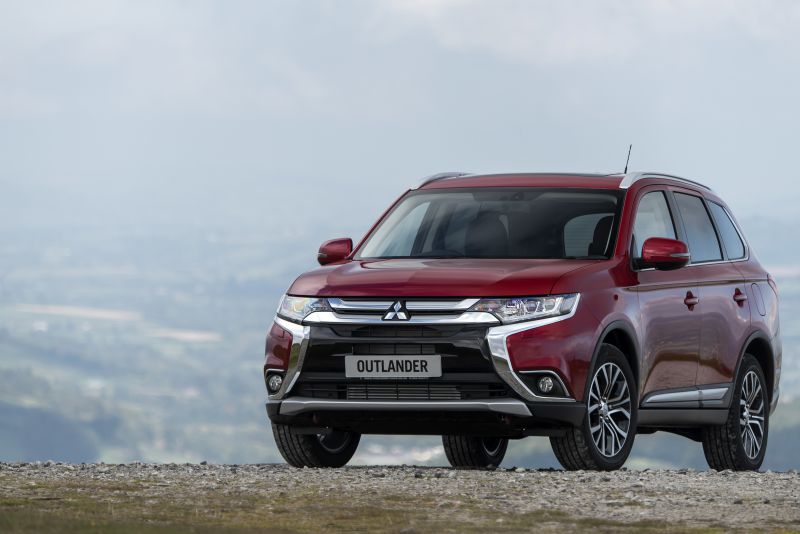
The Mitsubishi Outlander III, particularly the facelifted version introduced in 2015, represents a significant iteration in Mitsubishi’s compact crossover SUV lineup. Positioned as a competitor to vehicles like the Honda CR-V, Toyota RAV4, and Nissan X-Trail, the Outlander III aimed to offer a blend of practicality, fuel efficiency, and available all-wheel drive. This generation, while not initially a major seller in the North American market, found considerable success in Europe and other regions, offering a seven-seat option – a relatively uncommon feature in its class. The 2.2 DI-D variant, equipped with a diesel engine and automatic transmission, was a popular choice in European markets due to its fuel economy and torque characteristics.
Mitsubishi Outlander III (2015-2018) 2.2 DI-D: An Overview
The 2015 facelift brought styling updates, improved interior materials, and enhancements to the vehicle’s safety and infotainment systems. The 2.2 DI-D model specifically targeted buyers seeking a capable and efficient SUV for both daily commuting and longer journeys. The “DI-D” designation signifies Mitsubishi’s direct-injection diesel engine technology, known for its balance of power and fuel economy. This version of the Outlander was produced from 2015 through 2018, serving as a bridge between generations as Mitsubishi developed its next-generation Outlander.
Engine & Performance
The heart of the Outlander III 2.2 DI-D is a 2.3-liter (2268 cm3) inline-four cylinder diesel engine, designated the 4N14. This engine produces 150 horsepower at 3500 rpm and 360 Nm (265.52 lb.-ft.) of torque between 1500 and 2750 rpm. The engine utilizes a turbocharger with an intercooler to enhance performance and efficiency. Power is delivered to all four wheels via a six-speed automatic transmission and Mitsubishi’s all-wheel drive system. Acceleration from 0 to 100 km/h (0-62 mph) takes 11.6 seconds, while the vehicle achieves a maximum speed of 190 km/h (118.06 mph). The weight-to-power ratio is 10.7 kg/Hp, and the weight-to-torque ratio is 4.5 kg/Nm, indicating a reasonable balance between weight and performance. Fuel economy is a strong point, with combined cycle consumption rated at 5.8 l/100 km (40.6 US mpg, 48.7 UK mpg), and CO2 emissions of 154 g/km, meeting Euro 6 emission standards.
Design & Features
The Mitsubishi Outlander III is a five-door SUV/Crossover, offering seating for five passengers. Its body style is characterized by a relatively conservative, yet modern design. The 2015 facelift brought a revised front fascia with a bolder grille and updated headlights, along with minor alterations to the rear end. Inside, the Outlander III offers a practical and functional cabin. The facelifted model featured improved materials and a more refined interior ambiance. Key features include an available touchscreen infotainment system, climate control, and a range of safety technologies. The Outlander III prioritizes practicality with a versatile cargo area, offering 128 liters (4.52 cu. ft.) of space with the rear seats up and expanding to 1608 liters (56.79 cu. ft.) with the seats folded down. The vehicle’s dimensions are 4695 mm (184.84 in.) in length, 1810 mm (71.26 in.) in width, and 1680 mm (66.14 in.) in height, with a wheelbase of 2670 mm (105.12 in.). Ground clearance is 190 mm (7.48 in.).
Technical Specifications
| Brand | Mitsubishi |
| Model | Outlander |
| Generation | Outlander III (facelift 2015) |
| Type (Engine) | 2.2 DI-D (150 Hp) 4WD Automatic |
| Start of production | 2015 |
| End of production | 2018 |
| Powertrain Architecture | Internal Combustion engine |
| Body type | SUV, Crossover |
| Seats | 5 |
| Doors | 5 |
| Fuel consumption (urban) | 6.9 l/100 km (34.1 US mpg, 40.9 UK mpg, 14.5 km/l) |
| Fuel consumption (extra urban) | 5.2 l/100 km (45.2 US mpg, 54.3 UK mpg, 19.2 km/l) |
| Fuel consumption (combined) | 5.8 l/100 km (40.6 US mpg, 48.7 UK mpg, 17.2 km/l) |
| CO2 emissions | 154 g/km |
| Fuel Type | Diesel |
| Acceleration 0 – 100 km/h | 11.6 sec |
| Acceleration 0 – 62 mph | 11.6 sec |
| Acceleration 0 – 60 mph | 11 sec |
| Maximum speed | 190 km/h (118.06 mph) |
| Emission standard | Euro 6 |
| Weight-to-power ratio | 10.7 kg/Hp |
| Weight-to-torque ratio | 4.5 kg/Nm |
| Power | 150 Hp @ 3500 rpm |
| Torque | 360 Nm @ 1500-2750 rpm (265.52 lb.-ft. @ 1500-2750 rpm) |
| Engine layout | Front, Transverse |
| Engine Model/Code | 4N14 |
| Engine displacement | 2268 cm3 (138.4 cu. in.) |
| Number of cylinders | 4 |
| Engine configuration | Inline |
| Number of valves per cylinder | 4 |
| Fuel injection system | Diesel Commonrail |
| Engine aspiration | Turbocharger, Intercooler |
| Valvetrain | DOHC |
| Engine oil capacity | 5.3 l (5.6 US qt | 4.66 UK qt) |
| Coolant capacity | 8 l (8.45 US qt | 7.04 UK qt) |
| Kerb Weight | 1610 kg (3549.44 lbs.) |
| Trunk (boot) space – minimum | 128 l (4.52 cu. ft.) |
| Trunk (boot) space – maximum | 1608 l (56.79 cu. ft.) |
| Fuel tank capacity | 60 l (15.85 US gal | 13.2 UK gal) |
| Length | 4695 mm (184.84 in.) |
| Width | 1810 mm (71.26 in.) |
| Height | 1680 mm (66.14 in.) |
| Wheelbase | 2670 mm (105.12 in.) |
| Ride height (ground clearance) | 190 mm (7.48 in.) |
| Minimum turning circle | 10.6 m (34.78 ft.) |
| Drive wheel | All wheel drive (4×4) |
| Number of gears | 6 |
| Gearbox type | Automatic transmission |
| Front suspension | Independent type McPherson |
| Rear suspension | Independent multi-link suspension |
| Front brakes | Ventilated discs |
| Rear brakes | Disc |
| Assisting systems | ABS (Anti-lock braking system) |
| Steering type | Steering rack and pinion |