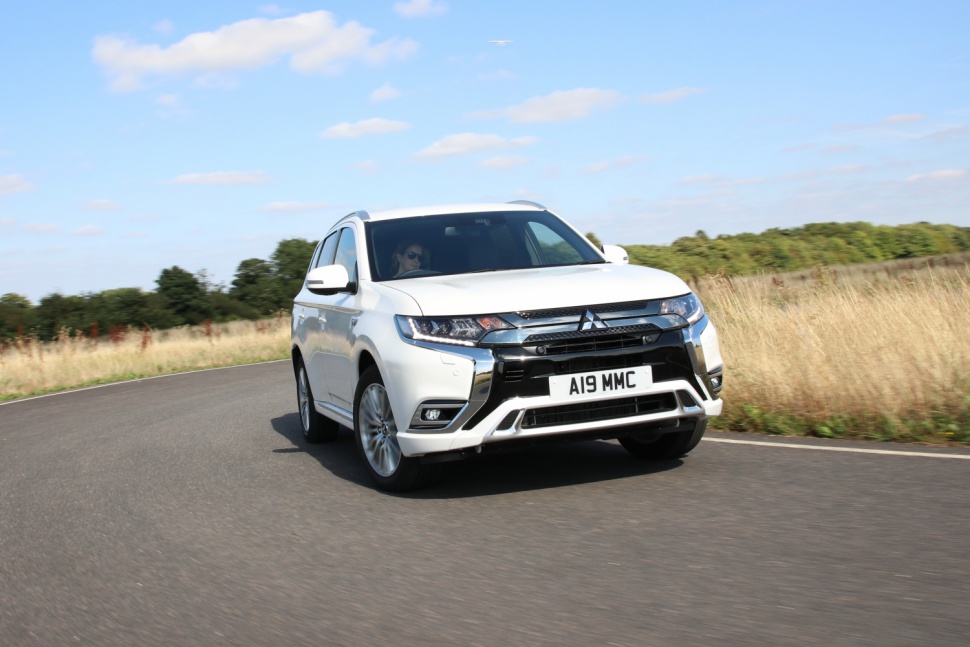
The Mitsubishi Outlander III, particularly the facelifted version introduced in 2018, represents a significant iteration of Mitsubishi’s popular crossover SUV. Positioned as a mid-size, seven-passenger vehicle, the Outlander aimed to compete with established players like the Honda CR-V, Toyota RAV4, and Nissan Rogue. While not initially a high-volume seller in the United States compared to its competitors, the Outlander offered a compelling combination of space, features, and Mitsubishi’s Super All-Wheel Control (S-AWC) system. The 2018 facelift brought styling updates, improved interior materials, and enhancements to the S-AWC system, aiming to elevate the Outlander’s appeal in a competitive segment. This article focuses on the 2.4 MIVEC variant equipped with a Continuously Variable Transmission (CVT), sold primarily between 2018 and 2021.
Mitsubishi Outlander III (Facelift 2018) 2.4 MIVEC S-AWC CVT
The Outlander III, launched initially in 2012, underwent a substantial facelift in 2018. This refresh was crucial for maintaining the model’s relevance in a rapidly evolving SUV market. The 2.4 MIVEC engine paired with the S-AWC system and CVT transmission became a core offering, balancing fuel efficiency with all-weather capability. The Outlander’s seven-passenger configuration was a key selling point, differentiating it from many competitors offering only five seats. The vehicle was designed to appeal to families seeking a versatile and practical vehicle with a focus on safety and comfort.
Engine & Performance
The heart of the 2018-2021 Mitsubishi Outlander 2.4 MIVEC is a 2.4-liter inline-four cylinder gasoline engine, designated the 4J12. This naturally aspirated engine produces 166 horsepower at 6000 rpm and 220 Newton-meters (162.26 lb.-ft.) of torque at 4200 rpm. The engine features Mitsubishi’s MIVEC (Mitsubishi Innovative Valve timing and lift Electronic Control) technology, optimizing valve timing for improved performance and fuel efficiency across the engine’s operating range. Power is delivered to all four wheels via Mitsubishi’s S-AWC system and a Continuously Variable Transmission (CVT). The CVT is tuned for smooth acceleration and optimal fuel economy, though it may not offer the same direct feel as a traditional automatic transmission. The weight-to-power ratio of 9.5 kg/Hp and a weight-to-torque ratio of 7.2 kg/Nm contribute to a reasonably responsive driving experience, considering the vehicle’s size and weight. The engine’s 10.5:1 compression ratio is typical for a naturally aspirated gasoline engine of this type. A Start & Stop system was included to further enhance fuel economy during city driving.
Design & Features
The Mitsubishi Outlander III is a five-door SUV/Crossover body style, offering seating for up to seven passengers across three rows. The 2018 facelift brought a more aggressive front fascia with a redesigned grille and headlights, giving the Outlander a more modern appearance. Inside, the cabin received updates to materials and trim, improving the overall sense of quality. The third-row seats are best suited for children or shorter adults, and accessing them requires folding and sliding the second-row seats. Key features included a touchscreen infotainment system (varying in size depending on trim level), available Apple CarPlay and Android Auto integration, and a suite of safety technologies. Safety features were a priority, with available options like automatic emergency braking, lane departure warning, and adaptive cruise control. The Outlander’s cargo capacity is a significant advantage, offering 292 liters (10.31 cu. ft.) with all seats in place and expanding to 1792 liters (63.28 cu. ft.) with the rear seats folded down. The vehicle’s ride height of 216 mm (8.5 in) provides adequate ground clearance for light off-road use and navigating varied terrain.
Technical Specifications
| Brand | Mitsubishi |
| Model | Outlander |
| Generation | Outlander III (facelift 2018) |
| Type (Engine) | 2.4 MIVEC (166 Hp) S-AWC CVT |
| Start of production | 2018 |
| End of production | 2021 |
| Powertrain Architecture | Internal Combustion engine |
| Body type | SUV, Crossover |
| Seats | 7 |
| Doors | 5 |
| Fuel consumption (economy) – urban (EPA) | 9.8 l/100 km (24 US mpg) |
| Fuel consumption (economy) – extra urban (EPA) | 8.1 l/100 km (29 US mpg) |
| Fuel consumption (economy) – combined (EPA) | 9 l/100 km (26.1 US mpg) |
| Fuel Type | Petrol (Gasoline) |
| Emission standard | LEV III ULEV70 |
| Weight-to-power ratio | 9.5 kg/Hp |
| Weight-to-torque ratio | 7.2 kg/Nm |
| Power | 166 Hp @ 6000 rpm |
| Torque | 220 Nm @ 4200 rpm (162.26 lb.-ft. @ 4200 rpm) |
| Maximum engine speed | 6500 rpm |
| Engine layout | Front, Transverse |
| Engine Model/Code | 4J12 |
| Engine displacement | 2360 cm3 (144.02 cu. in.) |
| Number of cylinders | 4 |
| Engine configuration | Inline |
| Cylinder Bore | 88 mm (3.46 in.) |
| Piston Stroke | 97 mm (3.82 in.) |
| Compression ratio | 10.5:1 |
| Number of valves per cylinder | 4 |
| Fuel injection system | Multi-port manifold injection |
| Engine aspiration | Naturally aspirated engine |
| Valvetrain | SOHC |
| Engine oil capacity | 4.3 l (4.54 US qt | 3.78 UK qt) |
| Coolant | 6 l (6.34 US qt | 5.28 UK qt) |
| Kerb Weight | 1575 kg (3472.28 lbs.) |
| Max. weight | 2205 kg (4861.19 lbs.) |
| Max load | 630 kg (1388.91 lbs.) |
| Trunk (boot) space – minimum | 292 l (10.31 cu. ft.) |
| Trunk (boot) space – maximum | 1792 l (63.28 cu. ft.) |
| Fuel tank capacity | 60 l (15.85 US gal | 13.2 UK gal) |
| Max. roof load | 50 kg (110.23 lbs.) |
| Permitted trailer load with brakes (12%) | 680 kg (1499.14 lbs.) |
| Permitted trailer load without brakes | 567 kg (1250.02 lbs.) |
| Permitted towbar download | 68 kg (149.91 lbs.) |
| Length | 4695 mm (184.84 in.) |
| Width | 1810 mm (71.26 in.) |
| Height | 1710 mm (67.32 in.) |
| Wheelbase | 2670 mm (105.12 in.) |
| Front track | 1539 mm (60.59 in.) |
| Rear (Back) track | 1539 mm (60.59 in.) |
| Ride height (ground clearance) | 216 mm (8.5 in.) |
| Minimum turning circle (turning diameter) | 10.6 m (34.78 ft.) |
| Drivetrain Architecture | All wheel drive (4×4). ICE drives front wheels, rear driven by clutch. |
| Number of gears and type of gearbox | automatic transmission CVT |
| Front suspension | Independent, McPherson with coil spring and anti-roll bar |
| Rear suspension | Independent multi-link spring suspension with stabilizer |
| Front brakes | Ventilated discs, 295 mm |
| Rear brakes | Disc, 302 mm |
| Assisting systems | ABS (Anti-lock braking system) |
| Steering type | Steering rack and pinion |
| Power steering | Electric Steering |
| Tires size | 225/55 R18 |
| Wheel rims size | 7J x 18 |