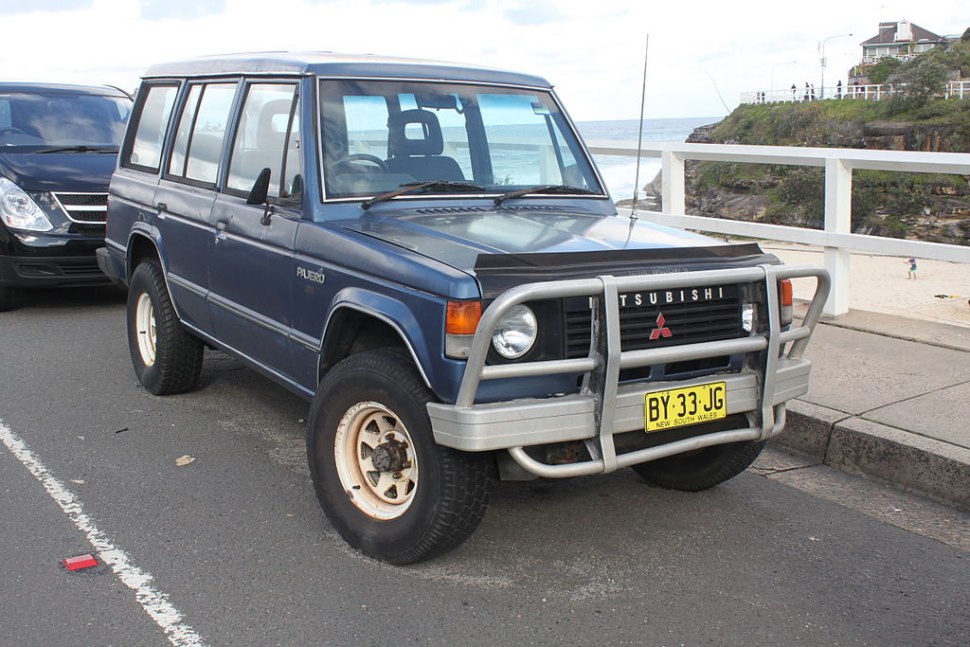
The Mitsubishi Pajero II Metal Top (V2_W, V4_W) 2.5 TD GL, produced between 1992 and 1999, represents a significant evolution in Mitsubishi’s renowned off-road vehicle lineage. While not widely sold in the United States, the Pajero – known as the Montero in some markets – held a prominent position in Europe, Australia, and Asia as a robust and capable SUV. The “Metal Top” designation refers to the removable hardtop, offering a unique blend of open-air freedom and secure passenger protection. This second-generation Pajero built upon the success of its predecessor, offering improved refinement, enhanced off-road capability, and a wider range of engine options, including the 2.5-liter turbocharged diesel featured in the GL trim.
Mitsubishi Pajero II Metal Top: A Legacy of Off-Road Capability
The Pajero II, launched in 1991, was a pivotal model for Mitsubishi, solidifying its reputation for building durable and versatile SUVs. The V2_W and V4_W chassis codes denote variations in suspension and drivetrain configurations, with the Metal Top version adding a distinctive aesthetic and functional element. The Pajero II was designed to compete with established players like the Toyota Land Cruiser and Nissan Patrol, offering a compelling combination of on-road comfort and serious off-road prowess. Its popularity stemmed from its ability to handle diverse terrains, from challenging mountain trails to everyday commuting, making it a favorite among adventurers and families alike.
Engine & Performance
The 2.5 TD GL variant of the Pajero II Metal Top is powered by a 2.5-liter inline-four cylinder diesel engine, producing 99 horsepower at 4200 rpm and 240 Nm (177.01 lb.-ft.) of torque at 2000 rpm. This engine utilizes a precombustion chamber injection system and is equipped with a turbocharger to enhance power and efficiency. While its horsepower figure may seem modest by modern standards, the diesel engine’s substantial torque output provides excellent low-end grunt, crucial for tackling challenging off-road conditions. The engine’s longitudinal front-mounted layout contributes to a balanced weight distribution. Acceleration from 0 to 100 km/h (0-62 mph) takes 16.4 seconds, and 0 to 60 mph is achieved in 15.6 seconds. The vehicle reaches a maximum speed of 145 km/h (90.1 mph). The weight-to-power ratio of 17.2 kg/Hp and weight-to-torque ratio of 7.1 kg/Nm highlight the engine’s focus on usable power rather than outright speed.
Design & Features
The Pajero II Metal Top is a three-door SUV with seating for five passengers. Its body-on-frame construction provides exceptional durability and torsional rigidity, essential for off-road driving. The removable metal hardtop is a defining feature, allowing for an open-air driving experience when desired. The vehicle’s design prioritizes functionality and robustness, with a relatively boxy shape maximizing interior space and providing good visibility. Features included hydraulic power steering, ventilated front disc brakes, and disc brakes on the rear axle. The suspension system utilizes a double wishbone configuration at the front and coil springs at the rear, providing a comfortable ride and good articulation for off-road use. The 235/75 R15 tires are designed to provide a balance of on-road comfort and off-road traction. Trunk space ranges from a minimum of 330 liters (11.65 cu. ft.) to a maximum of 1100 liters (38.85 cu. ft.) with the rear seats folded down. Safety features for the era were relatively basic, focusing on structural integrity and reliable braking performance.
Technical Specifications
| Brand | Mitsubishi |
| Model | Pajero |
| Generation | Pajero II Metal Top (V2_W, V4_W) |
| Type (Engine) | 2.5 TD GL (99 Hp) |
| Start of production | 1992 |
| End of production | 1999 |
| Powertrain Architecture | Internal Combustion engine |
| Body type | SUV |
| Seats | 5 |
| Doors | 3 |
| Fuel consumption (urban) | 13 l/100 km (18.1 US mpg, 21.7 UK mpg, 7.7 km/l) |
| Fuel consumption (extra urban) | 10.9 l/100 km (21.6 US mpg, 25.9 UK mpg, 9.2 km/l) |
| Fuel Type | Diesel |
| Acceleration 0 – 100 km/h | 16.4 sec |
| Acceleration 0 – 62 mph | 16.4 sec |
| Acceleration 0 – 60 mph | 15.6 sec |
| Maximum speed | 145 km/h (90.1 mph) |
| Weight-to-power ratio | 17.2 kg/Hp |
| Weight-to-torque ratio | 7.1 kg/Nm |
| Power | 99 Hp @ 4200 rpm |
| Power per litre | 40 Hp/l |
| Torque | 240 Nm @ 2000 rpm (177.01 lb.-ft. @ 2000 rpm) |
| Engine layout | Front, Longitudinal |
| Engine displacement | 2477 cm3 (151.16 cu. in.) |
| Number of cylinders | 4 |
| Engine configuration | Inline |
| Cylinder Bore | 91.1 mm (3.59 in.) |
| Piston Stroke | 95 mm (3.74 in.) |
| Compression ratio | 21:1 |
| Number of valves per cylinder | 2 |
| Fuel injection system | Precombustion chamber injection |
| Engine aspiration | Turbocharger |
| Valvetrain | OHC |
| Kerb Weight | 1706 kg (3761.09 lbs.) |
| Max. weight | 2300 kg (5070.63 lbs.) |
| Max load | 594 kg (1309.55 lbs.) |
| Trunk (boot) space – minimum | 330 l (11.65 cu. ft.) |
| Trunk (boot) space – maximum | 1100 l (38.85 cu. ft.) |
| Fuel tank capacity | 75 l (19.81 US gal | 16.5 UK gal) |
| Length | 4075 mm (160.43 in.) |
| Width | 1695 mm (66.73 in.) |
| Height | 1805 mm (71.06 in.) |
| Wheelbase | 2420 mm (95.28 in.) |
| Front track | 1420 mm (55.91 in.) |
| Rear (Back) track | 1435 mm (56.5 in.) |
| Drive wheel | All wheel drive (4×4) |
| Number of gears and type of gearbox | 5 gears, manual transmission |
| Front suspension | Double wishbone |
| Rear suspension | Coil spring |
| Front brakes | Ventilated discs |
| Rear brakes | Disc |
| Power steering | Hydraulic Steering |
| Tires size | 235/75 R15 R |
The Mitsubishi Pajero II Metal Top 2.5 TD GL remains a popular choice among enthusiasts and collectors, appreciated for its ruggedness, reliability, and unique character. Its blend of off-road capability and on-road comfort, coupled with the distinctive removable hardtop, continues to appeal to those seeking a versatile and adventurous vehicle.