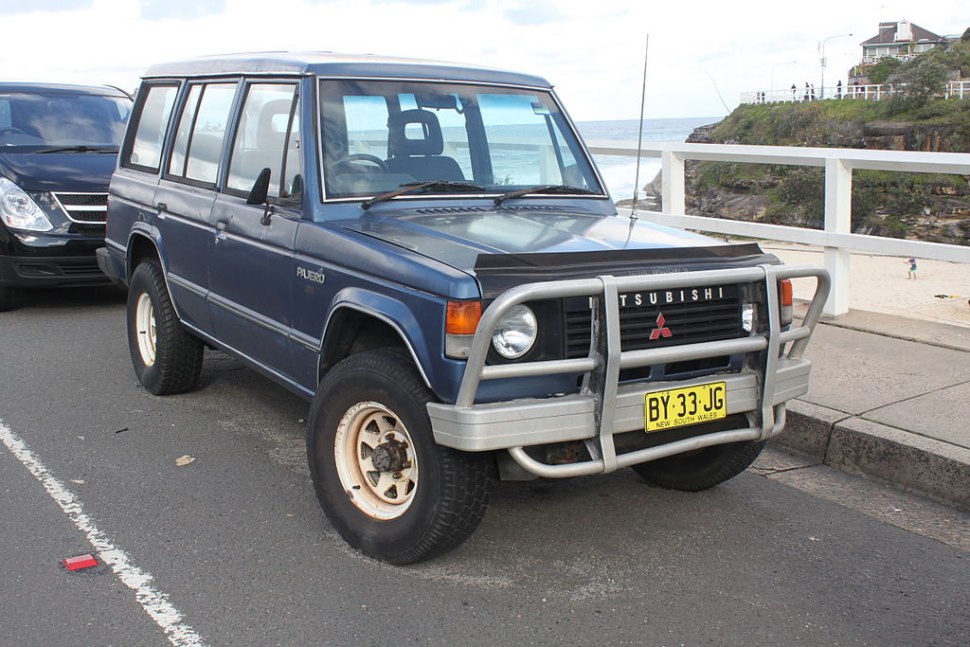
The Mitsubishi Pajero II Metal Top (V2_W, V4_W) 3.0 i V6 24V GLS represents a significant evolution in Mitsubishi’s renowned off-road vehicle lineage. Produced from 1990 to 1999, this second-generation Pajero was primarily marketed outside of North America, becoming a popular choice in Europe, Australia, and Asia. It distinguished itself as a robust and capable SUV, blending off-road prowess with a degree of on-road comfort. The “Metal Top” designation refers to the removable hardtop, offering open-air driving experiences. This model occupied the mid-size SUV segment, competing with vehicles like the Toyota Land Cruiser Prado and Nissan Patrol.
Mitsubishi Pajero II: A Legacy of Off-Road Capability
The Pajero II built upon the success of the original Pajero, introducing a more refined and technologically advanced package. While not officially sold in the United States, the Pajero series gained a cult following among enthusiasts who imported them privately. The V2_W and V4_W chassis codes denote variations in suspension and drivetrain configurations, with the V4_W typically featuring a more robust four-wheel-drive system. The 3.0 i V6 24V GLS variant, equipped with a 3.0-liter V6 engine and automatic transmission, was a popular configuration, offering a balance of power and convenience.
Engine & Performance
At the heart of the Pajero II 3.0 i V6 GLS lies a naturally aspirated 3.0-liter V6 engine, producing 150 horsepower at 5000 rpm and 236 Nm (174.06 lb.-ft.) of torque at 4000 rpm. This engine, with its 24 valves and multi-port fuel injection, provided adequate power for both on-road cruising and off-road adventures. The engine’s longitudinal front-engine layout contributed to a balanced weight distribution. The automatic transmission, featuring four forward gears, offered smooth shifting and ease of use. Performance figures included a 0-100 km/h (0-62 mph) acceleration time of 12.5 seconds and a maximum speed of 165 km/h (102.53 mph). The weight-to-power ratio of 12.2 kg/Hp and weight-to-torque ratio of 7.8 kg/Nm indicated a reasonably efficient powertrain for its time. Fuel consumption was rated at 13.7 liters per 100 kilometers (17.2 US mpg, 20.6 UK mpg).
Design & Features
The Pajero II Metal Top is characterized by its classic SUV silhouette – a boxy, utilitarian design prioritizing functionality over flamboyant aesthetics. The three-door configuration, combined with the removable metal hardtop, offered a unique blend of practicality and open-air enjoyment. The vehicle’s robust construction and high ground clearance were essential for tackling challenging terrain. Inside, the Pajero II offered seating for five passengers, although rear passenger space was somewhat limited due to the shorter wheelbase. Key features included hydraulic power steering and an Anti-lock Braking System (ABS), enhancing both driver control and safety. The trunk space varied from 330 liters (11.65 cu. ft.) with the rear seats up to 1100 liters (38.85 cu. ft.) with the seats folded down, providing ample cargo capacity for its class. The Pajero II’s design focused on durability and off-road capability, making it a favorite among those seeking a reliable and versatile vehicle.
Technical Specifications
| Brand | Mitsubishi |
| Model | Pajero |
| Generation | Pajero II Metal Top (V2_W, V4_W) |
| Type | 3.0 i V6 24V GLS (150 Hp) Automatic |
| Start of production | 1990 |
| End of production | 1999 |
| Powertrain Architecture | Internal Combustion engine |
| Body type | SUV |
| Seats | 5 |
| Doors | 3 |
| Fuel consumption (combined) | 13.7 l/100 km (17.2 US mpg, 20.6 UK mpg, 7.3 km/l) |
| Fuel Type | Petrol (Gasoline) |
| Acceleration 0 – 100 km/h | 12.5 sec |
| Acceleration 0 – 62 mph | 12.5 sec |
| Acceleration 0 – 60 mph | 11.9 sec |
| Maximum speed | 165 km/h (102.53 mph) |
| Weight-to-power ratio | 12.2 kg/Hp |
| Weight-to-torque ratio | 7.8 kg/Nm |
| Power | 150 Hp @ 5000 rpm |
| Power per litre | 50.5 Hp/l |
| Torque | 236 Nm @ 4000 rpm (174.06 lb.-ft. @ 4000 rpm) |
| Engine layout | Front, Longitudinal |
| Engine displacement | 2972 cm3 (181.36 cu. in.) |
| Number of cylinders | 6 |
| Engine configuration | V-engine |
| Cylinder Bore | 91.1 mm (3.59 in.) |
| Piston Stroke | 76 mm (2.99 in.) |
| Compression ratio | 8.9:1 |
| Number of valves per cylinder | 2 |
| Fuel injection system | Multi-port manifold injection |
| Engine aspiration | Naturally aspirated engine |
| Valvetrain | OHC |
| Kerb Weight | 1830 kg (4034.46 lbs.) |
| Max. weight | 2350 kg (5180.86 lbs.) |
| Max load | 520 kg (1146.4 lbs.) |
| Trunk (boot) space – minimum | 330 l (11.65 cu. ft.) |
| Trunk (boot) space – maximum | 1100 l (38.85 cu. ft.) |
| Fuel tank capacity | 75 l (19.81 US gal | 16.5 UK gal) |
| Length | 4145 mm (163.19 in.) |
| Width | 1785 mm (70.28 in.) |
| Height | 1815 mm (71.46 in.) |
| Wheelbase | 2420 mm (95.28 in.) |
| Front track | 1785 mm (70.28 in.) |
| Rear (Back) track | 1785 mm (70.28 in.) |
| Drive wheel | All wheel drive (4×4) |
| Number of gears and type of gearbox | 4 gears, automatic transmission |
| Front suspension | Double wishbone |
| Rear suspension | Coil spring |
| Front brakes | Ventilated discs |
| Rear brakes | Disc |
| Assisting systems | ABS (Anti-lock braking system), Hydraulic Steering |
| Tires size | 265/70 R15 |
| Wheel rims size | 15 |