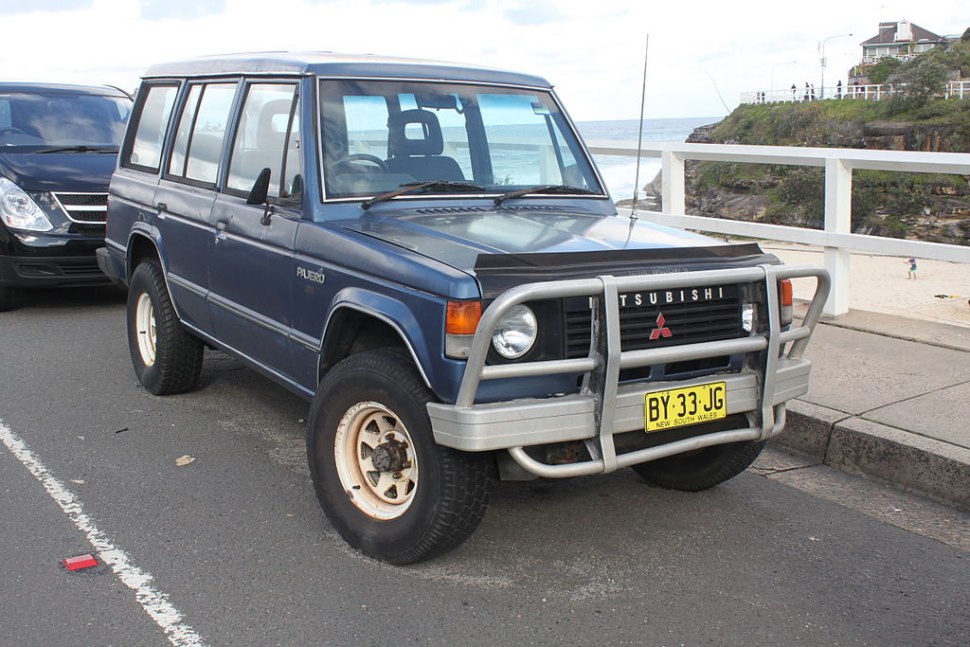
The Mitsubishi Pajero II Metal Top (V2_W, V4_W) 3.5 i V6 24V GLS, produced between 1997 and 2000, represents a significant evolution in Mitsubishi’s renowned off-road SUV lineage. While not widely sold in the United States during its production run, the Pajero held a prominent position in markets like Europe, Australia, and Asia as a capable and comfortable all-terrain vehicle. This second-generation Pajero, known for its robust build and advanced features for its time, bridged the gap between rugged utility and passenger vehicle refinement. The “Metal Top” designation refers to the removable hardtop configuration, offering open-air driving capabilities alongside the security of a fully enclosed cabin.
Mitsubishi Pajero II Metal Top: A Detailed Overview
The Pajero II, launched in 1991, built upon the success of the original Pajero, offering increased size, improved refinement, and a wider range of engine options. The Metal Top variant, specifically the 3.5 i V6 24V GLS model, was positioned as a premium offering within the Pajero II range. It catered to buyers seeking a versatile vehicle capable of handling both daily commuting and challenging off-road adventures. The Pajero’s reputation for reliability and off-road prowess made it a popular choice for overland travel and recreational activities.
Engine & Performance
At the heart of the Pajero II Metal Top 3.5 i V6 24V GLS lies a naturally aspirated 3.5-liter V6 engine, producing 194 horsepower at 5000 rpm and 313 Nm (230.86 lb.-ft.) of torque at 3500 rpm. This engine, with its multi-port fuel injection system, provided a good balance of power and responsiveness for both on-road and off-road driving. The engine’s longitudinal front-engine layout contributed to a balanced weight distribution, enhancing handling characteristics. Acceleration from 0 to 100 km/h (0-62 mph) took approximately 9.9 seconds, while 0 to 60 mph was achieved in around 9.4 seconds. The vehicle boasted a maximum speed of 185 km/h (114.95 mph). The power-to-weight ratio of 9.3 kg/Hp and torque-to-weight ratio of 5.8 kg/Nm further highlight the engine’s capability in moving the substantial SUV. Fuel consumption was rated at 17.8 l/100 km (13.2 US mpg) in urban settings and 10.6 l/100 km (22.2 US mpg) on the extra-urban cycle.
Design & Features
The Pajero II Metal Top is a three-door SUV with seating for five passengers. Its body-on-frame construction provided exceptional durability and off-road capability. The removable metal hardtop, a defining feature of this variant, allowed for open-air driving during favorable weather conditions. The vehicle’s design incorporated a blend of rugged aesthetics and functional practicality. Key features included a robust suspension system – double wishbones at the front and coil springs at the rear – designed to absorb impacts and maintain stability on uneven terrain. Braking duties were handled by ventilated discs at the front and discs at the rear, supplemented by an Anti-lock Braking System (ABS) for enhanced safety. Hydraulic power steering assisted with maneuverability, particularly during low-speed off-road maneuvers. The Pajero II Metal Top offered a trunk space ranging from 330 liters (11.65 cu. ft.) with the rear seats up to 1100 liters (38.85 cu. ft.) with the seats folded down, providing ample cargo capacity for luggage and equipment. The vehicle’s all-wheel-drive system, coupled with a five-speed manual transmission, ensured optimal traction and control in a variety of driving conditions.
Technical Specifications
| Brand | Mitsubishi |
| Model | Pajero |
| Generation | Pajero II Metal Top (V2_W, V4_W) |
| Type (Engine) | 3.5 i V6 24V GLS (194 Hp) |
| Start of production | 1997 |
| End of production | 2000 |
| Powertrain Architecture | Internal Combustion engine |
| Body type | SUV |
| Seats | 5 |
| Doors | 3 |
| Fuel consumption (urban) | 17.8 l/100 km (13.2 US mpg) |
| Fuel consumption (extra urban) | 10.6 l/100 km (22.2 US mpg) |
| Fuel Type | Petrol (Gasoline) |
| Acceleration 0 – 100 km/h | 9.9 sec |
| Acceleration 0 – 62 mph | 9.9 sec |
| Acceleration 0 – 60 mph | 9.4 sec |
| Maximum speed | 185 km/h (114.95 mph) |
| Weight-to-power ratio | 9.3 kg/Hp |
| Weight-to-torque ratio | 5.8 kg/Nm |
| Power | 194 Hp @ 5000 rpm |
| Torque | 313 Nm @ 3500 rpm (230.86 lb.-ft. @ 3500 rpm) |
| Engine layout | Front, Longitudinal |
| Engine displacement | 3497 cm3 (213.4 cu. in.) |
| Number of cylinders | 6 |
| Engine configuration | V-engine |
| Cylinder Bore | 93 mm (3.66 in.) |
| Piston Stroke | 85.8 mm (3.38 in.) |
| Compression ratio | 9.5:1 |
| Number of valves per cylinder | 4 |
| Fuel injection system | Multi-port manifold injection |
| Engine aspiration | Naturally aspirated engine |
| Kerb Weight | 1800 kg (3968.32 lbs.) |
| Max. weight | 2510 kg (5533.6 lbs.) |
| Max load | 710 kg (1565.28 lbs.) |
| Trunk (boot) space – minimum | 330 l (11.65 cu. ft.) |
| Trunk (boot) space – maximum | 1100 l (38.85 cu. ft.) |
| Fuel tank capacity | 75 l (19.81 US gal | 16.5 UK gal) |
| Length | 4145 mm (163.19 in.) |
| Width | 1785 mm (70.28 in.) |
| Height | 1845 mm (72.64 in.) |
| Wheelbase | 2420 mm (95.28 in.) |
| Front track | 1465 mm (57.68 in.) |
| Rear (Back) track | 1480 mm (58.27 in.) |
| Drive wheel | All wheel drive (4×4) |
| Number of gears and type of gearbox | 5 gears, manual transmission |
| Front suspension | Double wishbone |
| Rear suspension | Coil spring |
| Front brakes | Ventilated discs |
| Rear brakes | Disc |
| Assisting systems | ABS (Anti-lock braking system) |
| Power steering | Hydraulic Steering |
| Tires size | 265/70 R16 |
The Mitsubishi Pajero II Metal Top 3.5 i V6 24V GLS remains a sought-after vehicle among enthusiasts and collectors, appreciated for its blend of off-road capability, comfortable interior, and distinctive design. Its robust construction and reliable powertrain ensure its continued usability and appeal for years to come.