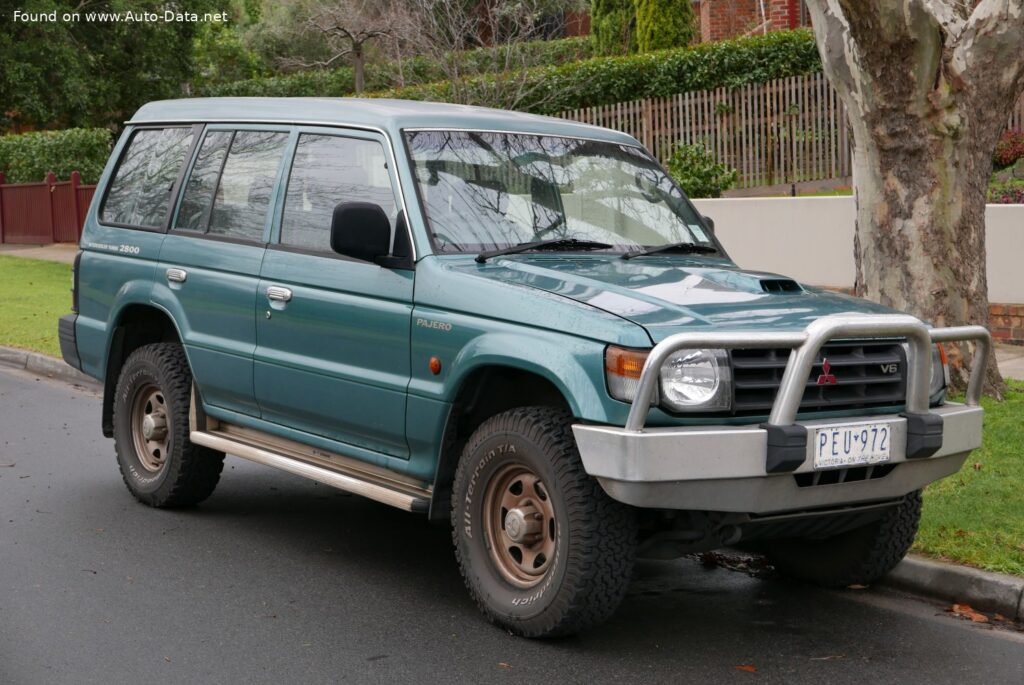
The Mitsubishi Pajero II, known as the Montero in some markets, represents a significant evolution in Mitsubishi’s long-running Pajero (or Montero) lineage. Produced between 1996 and 2000, this second-generation model (chassis codes V2_W and V4_W) solidified the Pajero’s reputation as a capable and comfortable full-size SUV. While not officially sold in large numbers in the United States during this generation, the Pajero II was a popular choice in Europe, Australia, South America, and Asia, offering a blend of off-road prowess and on-road refinement. The 3.5 i V6 24V GLS variant, with its 194 horsepower engine, was a top-of-the-line offering, aimed at buyers seeking a powerful and well-equipped SUV.
Mitsubishi Pajero II: A Legacy of Capability
The Pajero nameplate dates back to 1982, and the second generation, introduced in 1996, built upon the success of the original. The Pajero II was designed to appeal to a broader audience than its predecessor, offering increased comfort, improved handling, and a more sophisticated interior. It competed with vehicles like the Toyota Land Cruiser Prado, Nissan Patrol, and Land Rover Discovery, offering a compelling alternative with its robust engineering and competitive pricing. The V2 and V4 designations refer to different wheelbase lengths, with the V4 typically offering more interior space and a longer cargo area. The GLS trim level signified a higher level of equipment, including features like power windows, air conditioning, and upgraded interior trim.
Engine & Performance
The heart of the Pajero II 3.5 i V6 24V GLS is a 3.5-liter V6 gasoline engine, producing 194 horsepower at 5000 rpm and 313 Nm (230.86 lb-ft) of torque at 3500 rpm. This naturally aspirated engine features a multi-port fuel injection system and a compression ratio of 9.5:1. The engine’s longitudinal front-engine layout contributes to a balanced weight distribution, enhancing handling. Power is delivered to all four wheels via a five-speed manual transmission, providing the driver with full control over gear selection. Acceleration from 0 to 100 km/h (0-62 mph) takes 11.3 seconds, while 0 to 60 mph is achieved in 10.7 seconds. The Pajero II boasts a top speed of 185 km/h (114.95 mph). The weight-to-power ratio of 10.2 kg/Hp and a weight-to-torque ratio of 6.3 kg/Nm demonstrate a respectable level of performance for a vehicle of its size and class. Fuel economy is rated at 18.2 l/100 km (12.9 US mpg) in urban conditions and 11.1 l/100 km (21.2 US mpg) on the extra-urban cycle.
Design & Features
The Mitsubishi Pajero II is a classic body-on-frame SUV, offering robust construction and excellent off-road capability. Its five-door configuration and seven-seat layout provide ample space for passengers and cargo. The exterior design is characterized by its boxy shape, large windows, and prominent wheel arches. The GLS trim level includes features such as alloy wheels, body-colored bumpers, and upgraded interior trim. Inside, the Pajero II offers a comfortable and spacious cabin, with seating for up to seven passengers. The rear seats can be folded down to create a larger cargo area, with a minimum capacity of 1350 liters (47.67 cu. ft.) and a maximum capacity of 2600 liters (91.82 cu. ft.). Safety features include an Anti-lock Braking System (ABS) and hydraulic power steering. The Pajero II’s robust suspension system, featuring torsion bars at the front and coil springs at the rear, provides a comfortable ride both on and off-road. The vehicle rides on 265/70 R15 tires, providing good grip and durability.
Technical Specifications
| Brand | Mitsubishi |
| Model | Pajero |
| Generation | Pajero II (V2_W, V4_W) |
| Type (Engine) | 3.5 i V6 24V GLS (194 Hp) |
| Start of production | 1996 |
| End of production | 2000 |
| Powertrain Architecture | Internal Combustion engine |
| Body type | SUV |
| Seats | 7 |
| Doors | 5 |
| Fuel consumption (urban) | 18.2 l/100 km (12.9 US mpg) |
| Fuel consumption (extra urban) | 11.1 l/100 km (21.2 US mpg) |
| Fuel Type | Petrol (Gasoline) |
| Acceleration 0 – 100 km/h | 11.3 sec |
| Acceleration 0 – 62 mph | 11.3 sec |
| Acceleration 0 – 60 mph | 10.7 sec |
| Maximum speed | 185 km/h (114.95 mph) |
| Weight-to-power ratio | 10.2 kg/Hp |
| Weight-to-torque ratio | 6.3 kg/Nm |
| Power | 194 Hp @ 5000 rpm |
| Torque | 313 Nm @ 3500 rpm (230.86 lb.-ft. @ 3500 rpm) |
| Engine layout | Front, Longitudinal |
| Engine displacement | 3497 cm3 (213.4 cu. in.) |
| Number of cylinders | 6 |
| Engine configuration | V-engine |
| Cylinder Bore | 93 mm (3.66 in.) |
| Piston Stroke | 85.8 mm (3.38 in.) |
| Compression ratio | 9.5:1 |
| Number of valves per cylinder | 4 |
| Fuel injection system | Multi-port manifold injection |
| Engine aspiration | Naturally aspirated engine |
| Kerb Weight | 1985 kg (4376.18 lbs.) |
| Max. weight | 2720 kg (5996.57 lbs.) |
| Max load | 735 kg (1620.4 lbs.) |
| Trunk (boot) space – minimum | 1350 l (47.67 cu. ft.) |
| Trunk (boot) space – maximum | 2600 l (91.82 cu. ft.) |
| Fuel tank capacity | 92 l (24.3 US gal | 20.24 UK gal) |
| Length | 4725 mm (186.02 in.) |
| Width | 1775 mm (69.88 in.) |
| Height | 1900 mm (74.8 in.) |
| Wheelbase | 2725 mm (107.28 in.) |
| Front track | 1465 mm (57.68 in.) |
| Rear (Back) track | 1480 mm (58.27 in.) |
| Drive wheel | All wheel drive (4×4) |
| Number of gears and type of gearbox | 5 gears, manual transmission |
| Front suspension | Torsion |
| Rear suspension | Coil spring |
| Front brakes | Ventilated discs |
| Rear brakes | Disc |
| Assisting systems | ABS (Anti-lock braking system) |
| Power steering | Hydraulic Steering |
| Tires size | 265/70 R15 |
The Mitsubishi Pajero II 3.5 i V6 24V GLS remains a highly regarded SUV, appreciated for its blend of off-road capability, on-road comfort, and robust construction. While not a common sight on American roads, its enduring popularity in other parts of the world is a testament to its quality and versatility.