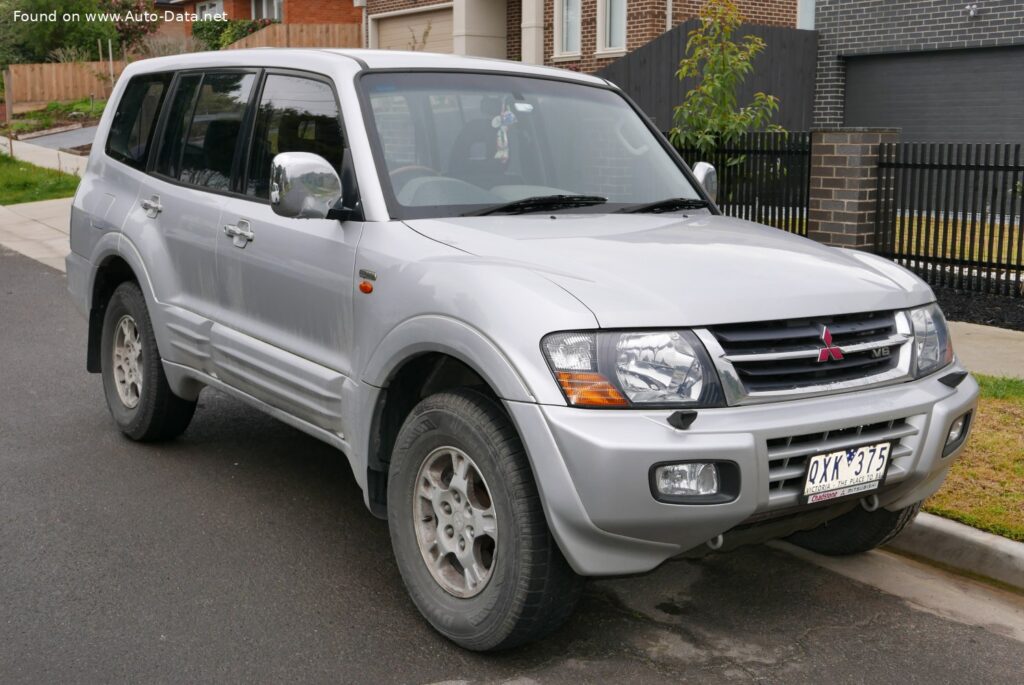
The Mitsubishi Pajero III 3.2 DI-D, produced between 2000 and 2006, represents a significant evolution in Mitsubishi’s long-running Pajero (Montero in some markets) lineage. This third-generation Pajero was primarily aimed at the European and Asian markets, where demand for robust, capable, and comfortable SUVs remained strong. While not officially sold in the United States, the Pajero III is recognized for its blend of off-road prowess and on-road refinement, offering a compelling alternative to vehicles like the Land Rover Discovery and Toyota Land Cruiser Prado. The 3.2 DI-D variant, equipped with a direct-injection diesel engine, was a popular choice for those seeking both power and fuel efficiency.
Mitsubishi Pajero III 3.2 DI-D: An Overview
The Pajero III marked a departure from the more utilitarian focus of earlier generations, incorporating a more sophisticated chassis, improved suspension, and a more refined interior. It retained the body-on-frame construction crucial for off-road durability but added independent suspension on all four wheels – a relatively advanced feature for its time. The 3.2 DI-D model specifically offered a balance between performance and economy, making it suitable for both daily driving and more adventurous pursuits. The three-door configuration, as featured in this model, prioritized maneuverability and a more compact footprint, appealing to drivers who valued agility over maximum passenger capacity.
Engine & Performance
At the heart of the Pajero III 3.2 DI-D lies the 4M41 3.2-liter inline-four diesel engine. This engine, a mainstay of Mitsubishi’s diesel offerings, produces 165 horsepower at 3800 rpm and a substantial 373 Nm (275.11 lb.-ft.) of torque at 2000 rpm. The use of a turbocharger and a common rail direct injection system contributes to both power output and improved fuel efficiency. The engine’s longitudinal front-engine layout and the availability of a five-speed manual transmission provide a traditional, driver-focused experience. Acceleration from 0 to 100 km/h (0-62 mph) takes 11.5 seconds, while 0 to 60 mph is achieved in 10.9 seconds. The Pajero III 3.2 DI-D boasts a top speed of 170 km/h (105.63 mph). The weight-to-power ratio of 12.1 kg/Hp and a weight-to-torque ratio of 5.4 kg/Nm highlight the engine’s ability to move the substantial vehicle with reasonable responsiveness.
Design & Features
The Pajero III 3.2 DI-D is a classic three-door SUV, characterized by its boxy, yet modern, design. The three-door configuration offers a more compact size, enhancing its off-road agility. The vehicle’s robust construction and high ground clearance are indicative of its off-road capabilities. Inside, the Pajero III offers seating for five passengers, although rear seat space is somewhat limited due to the shorter wheelbase. Key features include a fully independent suspension system, providing a comfortable ride both on and off-road. Safety features, while not as comprehensive as those found in modern vehicles, include an Anti-lock Braking System (ABS). The interior appointments, while functional, prioritize durability and practicality over luxury. Trunk space is configurable, ranging from a minimum of 415 liters (14.66 cu. ft.) to a maximum of 1253 liters (44.25 cu. ft.) with the rear seats folded down. The Pajero III’s design reflects a focus on functionality and ruggedness, making it a capable and reliable vehicle for a variety of terrains.
Technical Specifications
| Brand | Mitsubishi |
| Model | Pajero |
| Generation | Pajero III |
| Type (Engine) | 3.2 DI-D (165 Hp) |
| Start of production | 2000 |
| End of production | 2006 |
| Powertrain Architecture | Internal Combustion engine |
| Body type | SUV |
| Seats | 5 |
| Doors | 3 |
| Fuel consumption (urban) | 12.4 l/100 km (19 US mpg, 22.8 UK mpg, 8.1 km/l) |
| Fuel consumption (extra urban) | 7.9 l/100 km (29.8 US mpg, 35.8 UK mpg, 12.7 km/l) |
| Fuel consumption (combined) | 9.5 l/100 km (24.8 US mpg, 29.7 UK mpg, 10.5 km/l) |
| Fuel Type | Diesel |
| Acceleration 0 – 100 km/h | 11.5 sec |
| Acceleration 0 – 62 mph | 11.5 sec |
| Acceleration 0 – 60 mph | 10.9 sec |
| Maximum speed | 170 km/h (105.63 mph) |
| Weight-to-power ratio | 12.1 kg/Hp |
| Weight-to-torque ratio | 5.4 kg/Nm |
| Power | 165 Hp @ 3800 rpm |
| Torque | 373 Nm @ 2000 rpm (275.11 lb.-ft. @ 2000 rpm) |
| Engine layout | Front, Longitudinal |
| Engine Model/Code | 4M41 |
| Engine displacement | 3200 cm3 (195.28 cu. in.) |
| Number of cylinders | 4 |
| Engine configuration | Inline |
| Cylinder Bore | 98.5 mm (3.88 in.) |
| Piston Stroke | 105 mm (4.13 in.) |
| Compression ratio | 17:1 |
| Number of valves per cylinder | 4 |
| Fuel injection system | Diesel Commonrail |
| Engine aspiration | Turbocharger |
| Valvetrain | DOHC |
| Engine oil capacity | 9.8 l (10.36 US qt | 8.62 UK qt) |
| Coolant | 9 l (9.51 US qt | 7.92 UK qt) |
| Kerb Weight | 2000 kg (4409.25 lbs.) |
| Max. weight | 2510 kg (5533.6 lbs.) |
| Max load | 510 kg (1124.36 lbs.) |
| Trunk (boot) space – minimum | 415 l (14.66 cu. ft.) |
| Trunk (boot) space – maximum | 1253 l (44.25 cu. ft.) |
| Fuel tank capacity | 71 l (18.76 US gal | 15.62 UK gal) |
| Length | 4260 mm (167.72 in.) |
| Width | 1845 mm (72.64 in.) |
| Height | 1845 mm (72.64 in.) |
| Wheelbase | 2545 mm (100.2 in.) |
| Front track | 1560 mm (61.42 in.) |
| Rear (Back) track | 1560 mm (61.42 in.) |
| Drive wheel | All wheel drive (4×4) |
| Number of gears and type of gearbox | 5 gears, manual transmission |
| Front suspension | Double wishbone |
| Rear suspension | Coil spring |
| Front brakes | Ventilated discs |
| Rear brakes | Ventilated discs |
| Assisting systems | ABS (Anti-lock braking system) |
| Steering type | Steering rack and pinion |
| Power steering | Hydraulic Steering |
| Tires size | 235/80 R16 S |