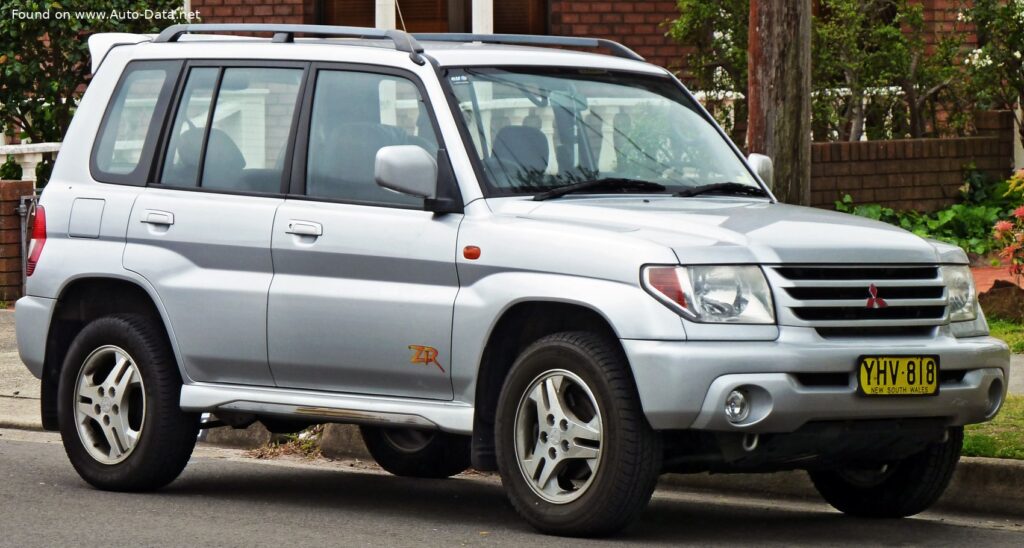
The Mitsubishi Pajero IO (H60) is a compact sport utility vehicle (SUV) produced by Mitsubishi Motors between 1998 and 2005. Positioned below the full-size Pajero, the IO was designed to appeal to buyers seeking a more manageable and fuel-efficient SUV, particularly in Japan and Europe. While not officially sold in the United States, the Pajero IO represents Mitsubishi’s attempt to capture a growing segment of the market that desired the versatility of an SUV in a smaller package. The “IO” designation stands for “Inner Off-roader,” highlighting its capability despite its compact dimensions. This generation of the Pajero was known for its blend of off-road prowess, relatively economical engine, and practical interior.
Mitsubishi Pajero IO (H60): A Detailed Overview
The Pajero IO (H60) was a significant model for Mitsubishi, offering a more accessible entry point into the Pajero family. It was particularly popular in Japan, where compact SUVs were highly sought after due to urban driving conditions and road size limitations. In Europe, it competed with vehicles like the Suzuki Vitara and Honda CR-V, offering a compelling alternative with its robust four-wheel-drive system and Mitsubishi’s reputation for reliability. The H60 series underwent minor revisions throughout its production run, primarily focusing on cosmetic updates and refinements to the interior.
Engine & Performance
The Pajero IO (H60) 1.8 i 16V GDI 4WD is powered by a 1.8-liter inline four-cylinder engine. This engine, producing 160 horsepower at 5200 rpm and 220 Nm (162.26 lb.-ft.) of torque at 3500 rpm, utilizes Mitsubishi’s GDI (Gasoline Direct Injection) technology. GDI improves fuel efficiency and power output by injecting fuel directly into the combustion chamber, allowing for more precise control over the combustion process. The engine’s power-to-weight ratio of 8.7 kg/Hp (115.1 Hp/tonne) provides adequate performance for both on-road driving and light off-road excursions. The engine is longitudinally mounted, contributing to a balanced weight distribution. Power is delivered to all four wheels through a four-speed automatic transmission, providing smooth and convenient gear changes. Fuel economy is rated at 7.69 liters per 100 kilometers (30.6 US mpg) in urban conditions.
Design & Features
The Pajero IO (H60) features a traditional SUV body style with a five-door configuration and seating for five passengers. Its design is functional and robust, prioritizing practicality over flamboyant styling. The vehicle’s relatively compact dimensions – 3975 mm (156.5 in) in length and 1680 mm (66.14 in) in width – make it easy to maneuver in urban environments. The interior is designed with durability and ease of use in mind, featuring comfortable seating and a straightforward dashboard layout. Key features include a coil spring suspension on both the front and rear axles, providing a comfortable ride quality. Ventilated disc brakes on the front and disc brakes on the rear ensure adequate stopping power, enhanced by an Anti-lock Braking System (ABS). Hydraulic power steering assists with maneuverability. The vehicle rides on 215/65 R16 S tires. Safety features, while limited by the standards of the late 1990s and early 2000s, include ABS as standard equipment. The Pajero IO’s focus was on providing a reliable and capable vehicle for everyday use and occasional off-road adventures.
Technical Specifications
| Brand | Mitsubishi |
| Model | Pajero |
| Generation | Pajero IO (H60) |
| Type | 1.8 i 16V GDI 4WD (5 dr) (160 Hp) |
| Start of production | 1998 |
| End of production | 2005 |
| Powertrain Architecture | Internal Combustion engine |
| Body type | SUV |
| Seats | 5 |
| Doors | 5 |
| Fuel consumption (urban) | 7.69 l/100 km (30.6 US mpg) |
| Fuel Type | Petrol (Gasoline) |
| Weight-to-power ratio | 8.7 kg/Hp |
| Weight-to-torque ratio | 6.3 kg/Nm |
| Power | 160 Hp @ 5200 rpm |
| Power per litre | 87.2 Hp/l |
| Torque | 220 Nm @ 3500 rpm (162.26 lb.-ft. @ 3500 rpm) |
| Engine layout | Front, Longitudinal |
| Engine displacement | 1834 cm3 (111.92 cu. in.) |
| Number of cylinders | 4 |
| Engine configuration | Inline |
| Cylinder Bore | 81 mm (3.19 in.) |
| Piston Stroke | 89 mm (3.5 in.) |
| Compression ratio | 10:1 |
| Number of valves per cylinder | 4 |
| Fuel injection system | Direct injection |
| Engine aspiration | Naturally aspirated |
| Valvetrain | DOHC |
| Kerb Weight | 1390 kg (3064.43 lbs.) |
| Max. weight | 1665 kg (3670.7 lbs.) |
| Max load | 275 kg (606.27 lbs.) |
| Fuel tank capacity | 53 l (14 US gal | 11.66 UK gal) |
| Length | 3975 mm (156.5 in.) |
| Width | 1680 mm (66.14 in.) |
| Height | 1710 mm (67.32 in.) |
| Wheelbase | 2450 mm (96.46 in.) |
| Front track | 1435 mm (56.5 in.) |
| Rear track | 1445 mm (56.89 in.) |
| Drive wheel | All wheel drive (4×4) |
| Number of gears | 4 |
| Gearbox type | Automatic transmission |
| Front suspension | Coil spring |
| Rear suspension | Coil spring |
| Front brakes | Ventilated discs |
| Rear brakes | Disc |
| Assisting systems | ABS (Anti-lock braking system) |
| Power steering | Hydraulic Steering |
| Tires size | 215/65 R16 S |
The Mitsubishi Pajero IO (H60) remains a popular choice for those seeking a compact, reliable, and capable SUV, particularly in markets where it was originally sold. Its blend of practicality, fuel efficiency, and off-road ability continues to appeal to a wide range of drivers.