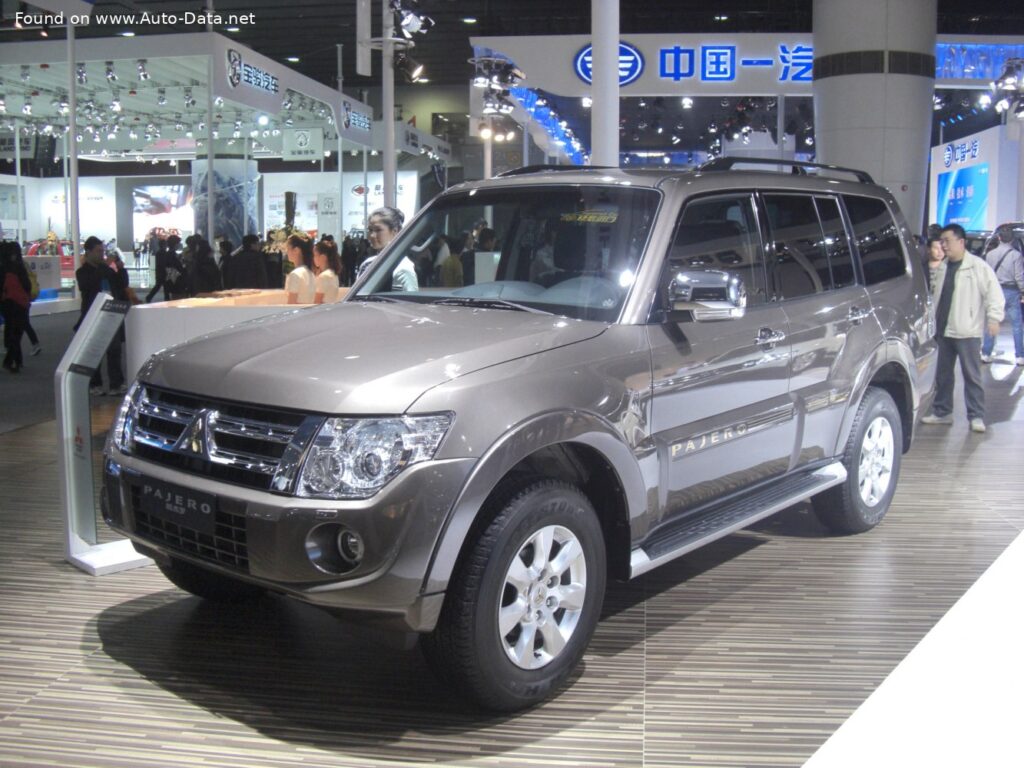
The Mitsubishi Pajero IV (facelift 2012) 3.2 DI-DC is a seven-seat SUV produced by Mitsubishi Motors between 2012 and 2015. This iteration represents a significant refresh of the fourth-generation Pajero, originally launched in 2006. While not officially sold in the United States, the Pajero held a prominent position in markets like Europe, Australia, and Asia as a robust and capable off-road vehicle, competing with models like the Toyota Land Cruiser Prado and Nissan Patrol. The facelift brought styling updates, improved efficiency, and refinements to the interior and technology. This model is known for its blend of off-road prowess and on-road comfort, making it a versatile choice for families and adventurers alike.
Mitsubishi Pajero IV (Facelift 2012): An Overview
The Pajero IV, even after the 2012 facelift, continued Mitsubishi’s long tradition of building durable and capable SUVs. The vehicle was designed with a body-on-frame construction, a hallmark of traditional off-road vehicles, providing excellent strength and articulation. The facelift focused on enhancing the vehicle’s appeal with revised front and rear styling, updated interior materials, and improvements to the powertrain for better fuel economy and reduced emissions. The 3.2 DI-DC engine, a diesel powerplant, was central to the Pajero’s appeal, offering a balance of power and efficiency for both on and off-road driving.
Engine & Performance
The heart of the 2012-2015 Mitsubishi Pajero IV 3.2 DI-DC is a 3.2-liter inline-four cylinder diesel engine, designated the 4M41. This engine produces 197 horsepower at 3800 rpm and 441 Nm (325.26 lb.-ft.) of torque at 2000 rpm. The engine utilizes a diesel commonrail fuel injection system and a turbocharger with an intercooler to optimize performance and efficiency. Power is delivered to all four wheels through a five-speed automatic transmission, providing smooth and convenient gear changes. The Pajero’s all-wheel-drive system offers various modes, including high-range and low-range gearing, along with a rear differential lock for enhanced traction in challenging terrain. Acceleration from 0 to 100 km/h (0-62 mph) takes approximately 11.1 seconds, while 0 to 60 mph is achieved in around 10.5 seconds. The vehicle has a maximum speed of 180 km/h (111.85 mph). The weight-to-power ratio is 11.5 kg/Hp, and the weight-to-torque ratio is 5.1 kg/Nm.
Design & Features
The Mitsubishi Pajero IV (facelift 2012) is a classic SUV in terms of its body-on-frame construction. It features a four-door layout with seating for up to seven passengers. The exterior design was updated with a revised front grille, headlights, and bumper, giving it a more modern and aggressive appearance. The interior offers a comfortable and spacious cabin with three rows of seats. Key features include air conditioning, power windows, power mirrors, and a sound system. Safety features, crucial for a family vehicle, include ABS (Anti-lock Braking System) and a robust chassis designed to protect occupants in the event of a collision. The Pajero’s large trunk space, with a maximum capacity of 1790 liters (63.21 cu. ft.), provides ample room for luggage and cargo. The vehicle’s suspension system, featuring double wishbones at the front and an independent multi-link setup at the rear, ensures a comfortable ride both on and off-road. The Pajero’s tires are sized 265/60 R18, mounted on 7.5J x 18 inch wheel rims.
Technical Specifications
| Brand | Mitsubishi |
| Model | Pajero |
| Generation | Pajero IV (facelift 2012) |
| Type (Engine) | 3.2 DI-DC (197 Hp) L 4×4 Automatic |
| Start of production | 2012 |
| End of production | 2015 |
| Powertrain Architecture | Internal Combustion engine |
| Body type | SUV |
| Seats | 7 |
| Doors | 4 |
| Fuel consumption (urban) | 10.1 l/100 km (23.3 US mpg / 28 UK mpg / 9.9 km/l) |
| Fuel consumption (extra urban) | 7.5 l/100 km (31.4 US mpg / 37.7 UK mpg / 13.3 km/l) |
| Fuel consumption (combined) | 8.5 l/100 km (27.7 US mpg / 33.2 UK mpg / 11.8 km/l) |
| CO2 emissions | 213 g/km |
| Fuel Type | Diesel |
| Acceleration 0 – 100 km/h | 11.1 sec |
| Acceleration 0 – 62 mph | 11.1 sec |
| Acceleration 0 – 60 mph | 10.5 sec |
| Maximum speed | 180 km/h (111.85 mph) |
| Weight-to-power ratio | 11.5 kg/Hp |
| Weight-to-torque ratio | 5.1 kg/Nm |
| Power | 197 Hp @ 3800 rpm |
| Torque | 441 Nm @ 2000 rpm (325.26 lb.-ft. @ 2000 rpm) |
| Engine layout | Front, Transverse |
| Engine Model/Code | 4M41 |
| Engine displacement | 3200 cm3 (195.28 cu. in.) |
| Number of cylinders | 4 |
| Engine configuration | Inline |
| Cylinder Bore | 98.5 mm (3.88 in.) |
| Piston Stroke | 105 mm (4.13 in.) |
| Compression ratio | 16:1 |
| Number of valves per cylinder | 4 |
| Fuel injection system | Diesel Commonrail |
| Engine aspiration | Turbocharger, Intercooler |
| Valvetrain | DOHC |
| Engine oil capacity | 9.8 l (10.36 US qt | 8.62 UK qt) |
| Coolant | 9 l (9.51 US qt | 7.92 UK qt) |
| Kerb Weight | 2265 kg (4993.47 lbs.) |
| Max. weight | 3030 kg (6680.01 lbs.) |
| Max load | 765 kg (1686.54 lbs.) |
| Trunk (boot) space – maximum | 1790 l (63.21 cu. ft.) |
| Fuel tank capacity | 88 l (23.25 US gal | 19.36 UK gal) |
| Length | 4900 mm (192.91 in.) |
| Width | 1875 mm (73.82 in.) |
| Height | 1890 mm (74.41 in.) |
| Wheelbase | 2780 mm (109.45 in.) |
| Front track | 1570 mm (61.81 in.) |
| Rear (Back) track | 1570 mm (61.81 in.) |
| Minimum turning circle | 11.4 m (37.4 ft.) |
| Drive wheel | All wheel drive (4×4) |
| Number of gears | 5 |
| Gearbox type | automatic transmission |
| Front suspension | Double wishbone |
| Rear suspension | Independent multi-link spring suspension with stabilizer |
| Front brakes | Ventilated discs |
| Rear brakes | Disc |
| Assisting systems | ABS (Anti-lock braking system) |
| Steering type | Steering rack and pinion |
| Power steering | Electric Steering |
| Tires size | 265/60 R18 |
| Wheel rims size | 7.5J x 18 |