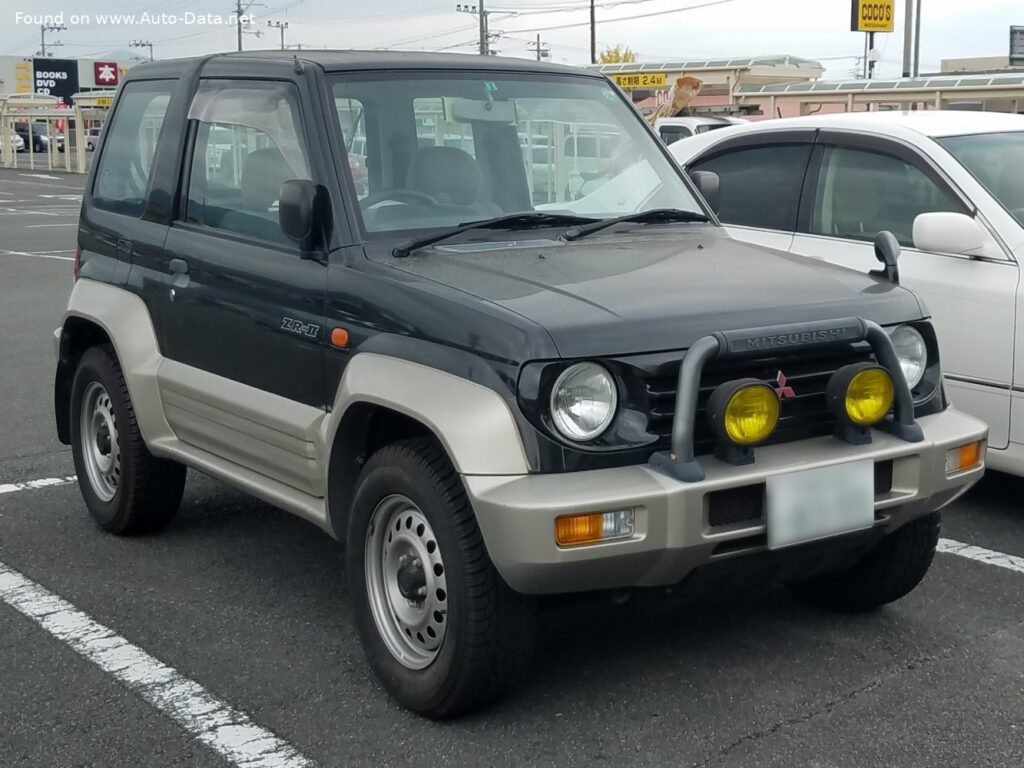
The Mitsubishi Pajero Junior 1.1, produced between 1995 and 1998, represents a unique and compact offering within the broader Pajero lineage. While the Pajero nameplate is well-known for its capable, full-size SUVs, the Junior was specifically designed for the Japanese domestic market (JDM) to fit within the country’s kei car regulations – a class of vehicles with restricted dimensions and engine displacement. This allowed for tax and insurance benefits for Japanese buyers. The Pajero Junior, despite its smaller stature, aimed to deliver the rugged styling and all-wheel-drive capability associated with the larger Pajero models, appealing to those seeking a versatile and practical vehicle for both urban and light off-road use. It was never officially sold in the United States.
Mitsubishi Pajero Junior: A Kei Car Crossover
The Pajero Junior occupied a niche segment, blending the aesthetics of a larger SUV with the practicality and affordability of a kei car. It distinguished itself from other kei cars with its more robust appearance and available four-wheel-drive system, features typically found on larger, more expensive vehicles. The vehicle’s three-door configuration and relatively compact dimensions made it well-suited for navigating narrow Japanese streets and parking in congested urban areas. The 1.1-liter engine, while modest in output by Western standards, was sufficient for its intended purpose and allowed the vehicle to qualify for favorable tax treatment in Japan.
Engine & Performance
Powering the Pajero Junior 1.1 is a 1.094-liter (66.76 cubic inches) inline-four cylinder gasoline engine. This naturally aspirated engine produces 80 horsepower at 6500 rpm and 98 Nm (72.28 lb.-ft.) of torque at 4000 rpm. The engine utilizes a multi-port fuel injection system and an overhead camshaft (OHC) valvetrain. While not a performance powerhouse, the engine provides adequate power for everyday driving and light off-road excursions. The power-to-weight ratio of 12 kg/Hp (83.3 Hp/tonne) and torque-to-weight ratio of 9.8 kg/Nm (102.1 Nm/tonne) contribute to a reasonably responsive driving experience. The engine is mated to a 3-speed automatic transmission, delivering power to all four wheels via an all-wheel-drive (4×4) system. The Pajero Junior achieves a maximum speed of 135 km/h (83.89 mph).
Design & Features
The Pajero Junior boasts a body-on-frame construction, contributing to its durability and off-road capability. Its three-door SUV body style provides seating for five passengers, although rear passenger space is limited due to the vehicle’s compact dimensions. The exterior design closely mimics that of the larger Pajero models, featuring a boxy silhouette, prominent wheel arches, and a relatively high ground clearance. The vehicle’s relatively short wheelbase of 2200 mm (86.61 in.) and overall length of 3500 mm (137.8 in.) enhance its maneuverability. Safety features for the era included an Anti-lock Braking System (ABS), a notable inclusion for a kei car. The suspension system consists of a double wishbone setup at the front and coil springs at the rear, providing a comfortable ride on paved roads and sufficient articulation for off-road driving. Hydraulic power steering assists with maneuverability, making it easier to navigate tight spaces.
Technical Specifications
| Brand | Mitsubishi |
| Model | Pajero |
| Generation | Pajero Junior |
| Type (Engine) | 1.1 (80 Hp) Automatic |
| Start of production | November, 1995 |
| End of production | May, 1998 |
| Powertrain Architecture | Internal Combustion engine |
| Body type | SUV |
| Seats | 5 |
| Doors | 3 |
| Fuel Type | Petrol (Gasoline) |
| Maximum speed | 135 km/h (83.89 mph) |
| Weight-to-power ratio | 12 kg/Hp, 83.3 Hp/tonne |
| Weight-to-torque ratio | 9.8 kg/Nm, 102.1 Nm/tonne |
| Power | 80 Hp @ 6500 rpm |
| Power per litre | 73.1 Hp/l |
| Torque | 98 Nm @ 4000 rpm (72.28 lb.-ft. @ 4000 rpm) |
| Engine layout | Front, Longitudinal |
| Engine displacement | 1094 cm3 (66.76 cu. in.) |
| Number of cylinders | 4 |
| Engine configuration | Inline |
| Cylinder Bore | 66 mm (2.6 in.) |
| Piston Stroke | 80 mm (3.15 in.) |
| Compression ratio | 9.5:1 |
| Number of valves per cylinder | 4 |
| Fuel injection system | Multi-port manifold injection |
| Engine aspiration | Naturally aspirated engine |
| Valvetrain | OHC |
| Kerb Weight | 960 kg (2116.44 lbs.) |
| Fuel tank capacity | 35 l (9.25 US gal | 7.7 UK gal) |
| Length | 3500 mm (137.8 in.) |
| Width | 1545 mm (60.83 in.) |
| Height | 1660 mm (65.35 in.) |
| Wheelbase | 2200 mm (86.61 in.) |
| Front track | 1310 mm (51.57 in.) |
| Rear (Back) track | 1320 mm (51.97 in.) |
| Minimum turning circle (turning diameter) | 9.6 m (31.5 ft.) |
| Drive wheel | All wheel drive (4×4) |
| Number of gears and type of gearbox | 3 gears, automatic transmission |
| Front suspension | Double wishbone |
| Rear suspension | Coil spring |
| Front brakes | Disc |
| Rear brakes | Drum |
| Assisting systems | ABS (Anti-lock braking system) |
| Steering type | Steering rack and pinion |
| Power steering | Hydraulic Steering |
| Tires size | 205/70 R15 |
| Wheel rims size | 15 |
The Mitsubishi Pajero Junior 1.1, while a niche vehicle primarily intended for the Japanese market, represents an interesting example of how manufacturers adapted to specific regulatory environments and consumer preferences. Its combination of SUV styling, all-wheel-drive capability, and compact dimensions made it a popular choice for those seeking a versatile and practical vehicle in Japan. Although never officially available in the US, the Pajero Junior remains a noteworthy model within the Pajero family and a testament to Mitsubishi’s engineering ingenuity.