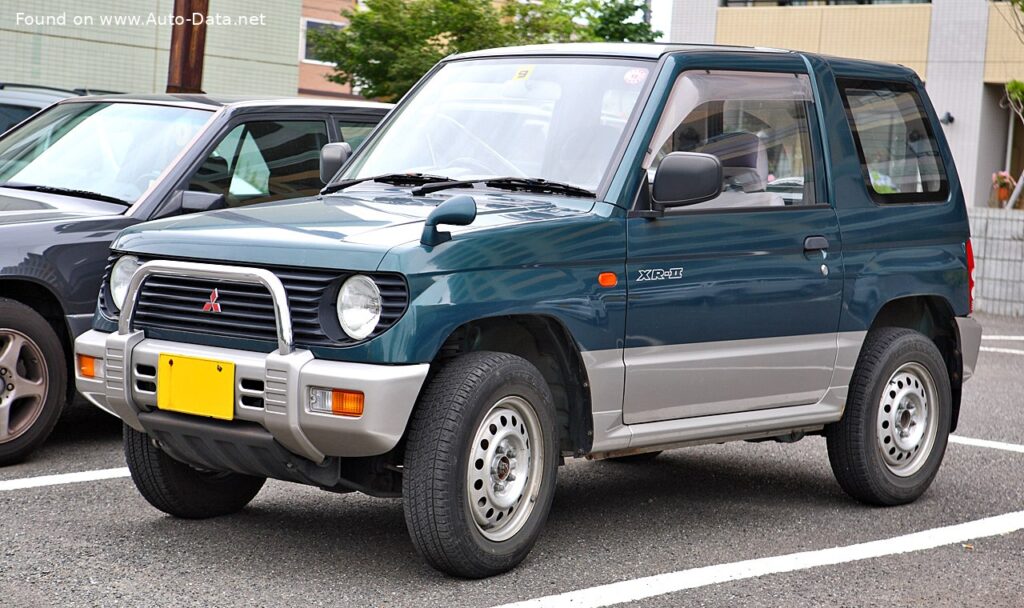
The Mitsubishi Pajero Mini 0.7 16V, produced between 1994 and 1998, represents a unique offering within the broader Pajero lineage. Unlike its larger siblings, which gained considerable recognition globally, the Pajero Mini was primarily designed and sold within the Japanese domestic market (JDM). This compact SUV catered to the specific needs of Japanese drivers navigating narrow urban streets and challenging mountain roads, falling into the “kei car” category – a segment defined by strict regulations on vehicle size and engine displacement. The Pajero Mini aimed to deliver the rugged capability and styling associated with the Pajero nameplate in a more manageable and affordable package. It served as an accessible entry point into the world of off-road vehicles for many Japanese consumers.
Mitsubishi Pajero Mini: A Kei Car Phenomenon
The Pajero Mini distinguished itself by offering genuine four-wheel drive capability within the constraints of the kei car class. This, combined with its distinctive styling – a miniaturized version of the full-size Pajero – made it a popular choice for those seeking a versatile and capable vehicle for both city driving and light off-road adventures. While not officially exported in large numbers, the Pajero Mini has gained a cult following among enthusiasts in other markets who appreciate its unique character and practicality. The vehicle’s success highlights Mitsubishi’s ability to adapt to specific market demands and create innovative solutions within regulatory frameworks.
Engine & Performance
Powering the Pajero Mini 0.7 16V is a 659 cc (40.21 cubic inches) inline-four cylinder gasoline engine. This engine, while small in displacement, produces 52 horsepower at 7000 rpm and 58 Nm (42.78 lb-ft) of torque at 4000 rpm. The engine features a multi-port fuel injection system and an overhead camshaft (OHC) valvetrain with four valves per cylinder, contributing to its relatively high power output for its size – 78.9 horsepower per liter. The engine is transversely mounted, optimizing space within the compact engine bay. Power is delivered to all four wheels via a five-speed manual transmission, providing drivers with precise control. The Pajero Mini achieves a maximum speed of 113 km/h (70.21 mph). Its weight-to-power ratio of 17.5 kg/Hp and weight-to-torque ratio of 15.7 kg/Nm demonstrate a reasonable level of performance considering its size and engine capacity. Fuel economy is respectable, with urban consumption rated at 7 liters per 100 km (33.6 US mpg) and extra-urban consumption at 4 liters per 100 km (58.8 US mpg).
Design & Features
The Mitsubishi Pajero Mini is a three-door SUV with seating for five passengers. Its design is a scaled-down interpretation of the larger Pajero, featuring a boxy silhouette, prominent wheel arches, and a robust front grille. The vehicle’s compact dimensions – 3295 mm (129.72 in) in length, 1395 mm (54.92 in) in width, and 1630 mm (64.17 in) in height – make it exceptionally maneuverable in tight spaces. The Pajero Mini boasts a relatively short wheelbase of 2200 mm (86.61 in) and track widths of 1190 mm (46.85 in) front and 1200 mm (47.24 in) rear, contributing to its stability. Safety features for the era included an Anti-lock Braking System (ABS), a notable inclusion for a vehicle in this class. The suspension system utilizes a double wishbone configuration at the front and coil springs at the rear, providing a comfortable ride and decent off-road capability. Hydraulic power steering enhances maneuverability, while 175/80 R15 tires provide adequate grip. The 35-liter (9.25 US gal) fuel tank offers a reasonable driving range.
Technical Specifications
| Brand | Mitsubishi |
| Model | Pajero |
| Generation | Pajero Mini |
| Type (Engine) | 0.7 16V (52 Hp) |
| Start of production | 1994 |
| End of production | 1998 |
| Powertrain Architecture | Internal Combustion engine |
| Body type | SUV |
| Seats | 5 |
| Doors | 3 |
| Fuel consumption (urban) | 7 l/100 km (33.6 US mpg) |
| Fuel consumption (extra urban) | 4 l/100 km (58.8 US mpg) |
| Fuel Type | Petrol (Gasoline) |
| Maximum speed | 113 km/h (70.21 mph) |
| Weight-to-power ratio | 17.5 kg/Hp |
| Weight-to-torque ratio | 15.7 kg/Nm |
| Power | 52 Hp @ 7000 rpm |
| Power per litre | 78.9 Hp/l |
| Torque | 58 Nm @ 4000 rpm (42.78 lb.-ft. @ 4000 rpm) |
| Engine layout | Front, Transverse |
| Engine displacement | 659 cm3 (40.21 cu. in.) |
| Number of cylinders | 4 |
| Engine configuration | Inline |
| Cylinder Bore | 60 mm (2.36 in.) |
| Piston Stroke | 58.3 mm (2.3 in.) |
| Compression ratio | 10:1 |
| Number of valves per cylinder | 4 |
| Fuel injection system | Multi-port manifold injection |
| Engine aspiration | Naturally aspirated engine |
| Valvetrain | OHC |
| Kerb Weight | 910 kg (2006.21 lbs.) |
| Fuel tank capacity | 35 l (9.25 US gal | 7.7 UK gal) |
| Length | 3295 mm (129.72 in.) |
| Width | 1395 mm (54.92 in.) |
| Height | 1630 mm (64.17 in.) |
| Wheelbase | 2200 mm (86.61 in.) |
| Front track | 1190 mm (46.85 in.) |
| Rear track | 1200 mm (47.24 in.) |
| Minimum turning circle | 9.6 m (31.5 ft.) |
| Drive wheel | All wheel drive (4×4) |
| Number of gears | 5 gears, manual transmission |
| Front suspension | Double wishbone |
| Rear suspension | Coil spring |
| Front brakes | Disc |
| Rear brakes | Drum |
| Assisting systems | ABS (Anti-lock braking system) |
| Steering type | Steering rack and pinion |
| Power steering | Hydraulic Steering |
| Tires size | 175/80 R15 |
In conclusion, the Mitsubishi Pajero Mini 0.7 16V represents a fascinating example of automotive engineering tailored to a specific market. Its combination of compact dimensions, four-wheel drive capability, and distinctive styling made it a popular choice in Japan and continues to attract enthusiasts worldwide. While not a high-performance vehicle, it offered a unique blend of practicality, affordability, and off-road potential within the constraints of the kei car class.