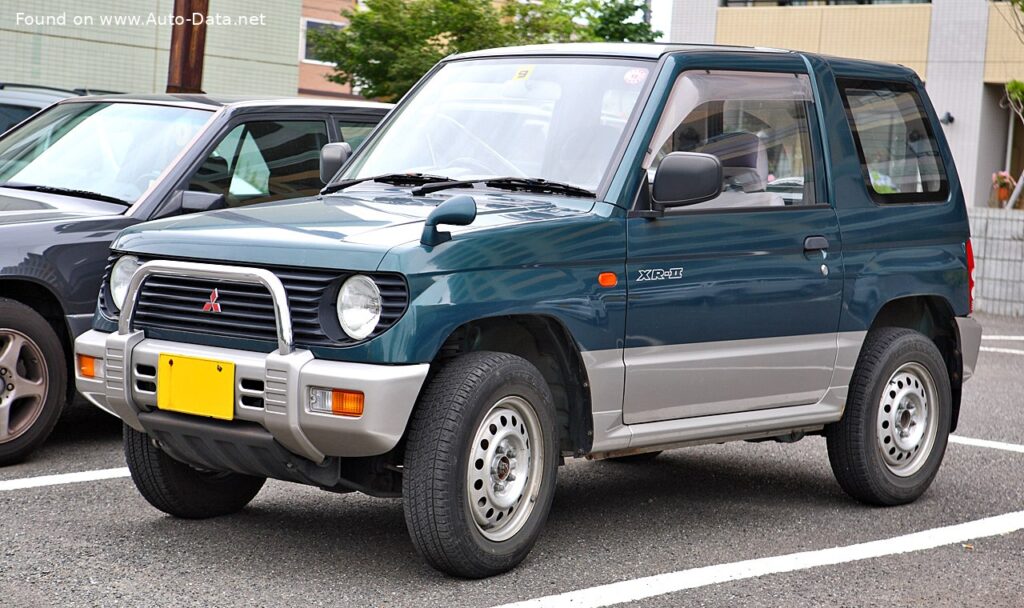
The Mitsubishi Pajero Mini 0.7 20V Turbo, produced between 1994 and 1998, represents a unique offering within the broader Pajero lineage. Unlike its larger siblings, the Pajero Mini was specifically designed to fit within the Japanese Kei car regulations, a class of vehicles defined by strict limitations on engine displacement and overall dimensions. This resulted in a compact, lightweight SUV that proved popular in Japan for its practicality, affordability, and off-road capability. While not officially sold in the United States, the Pajero Mini provides an interesting case study in automotive engineering tailored to specific market demands, and showcases Mitsubishi’s expertise in building capable four-wheel-drive vehicles.
Mitsubishi Pajero Mini: A Kei Car Phenomenon
The Pajero Mini occupied a niche segment in the Japanese automotive market. Kei cars, or “light automobiles,” benefit from reduced taxes and insurance costs, making them attractive to a wide range of buyers. However, these benefits come with restrictions. Engine displacement is capped at 660cc, and dimensions are limited to a maximum length of 3.4 meters, a width of 1.48 meters, and a height of 2.0 meters. Mitsubishi cleverly engineered the Pajero Mini to maximize its capabilities within these constraints, creating a vehicle that offered genuine SUV functionality in a diminutive package. The model served as an accessible entry point into the Pajero brand, known for its robust off-road performance in larger, more expensive models.
Engine & Performance
Powering the Pajero Mini is a 659cc (40.21 cubic inches) inline-four cylinder engine equipped with a turbocharger and multi-point fuel injection. This engine produced 64 horsepower at 7000 rpm and 97 Nm (71.54 lb-ft) of torque at 3500 rpm. While these figures may seem modest by modern standards, the Pajero Mini’s light weight – just 890 kg (1962.11 lbs) – resulted in a respectable power-to-weight ratio of 13.9 kg/Hp. This allowed for a top speed of 130 km/h (80.78 mph). The engine’s power per liter was a notable 97.1 Hp/l, demonstrating the effectiveness of the turbocharging system in extracting performance from the small displacement engine. The drivetrain consisted of a five-speed manual transmission and an all-wheel-drive system, providing enhanced traction in various conditions. Fuel economy was also a strong point, with urban consumption rated at 9 l/100 km (26.1 US mpg) and extra-urban consumption at 4 l/100 km (58.8 US mpg).
Design & Features
The Pajero Mini’s design closely mirrored that of its larger Pajero counterparts, albeit scaled down significantly. It featured a three-door body style with seating for five passengers. The exterior styling incorporated the signature Pajero elements, including a boxy silhouette, prominent wheel arches, and a relatively upright windscreen. The interior was functional and utilitarian, prioritizing practicality over luxury. Despite its compact size, the Pajero Mini offered a surprising amount of interior space, thanks to clever packaging and a relatively high roofline. Safety features for the time included an Anti-lock Braking System (ABS), which was becoming increasingly common on Japanese vehicles. The suspension system utilized a double wishbone setup at the front and coil springs at the rear, providing a comfortable ride and decent off-road capability. The steering employed a hydraulic power steering rack and pinion system for ease of maneuverability.
Technical Specifications
| Brand | Mitsubishi |
| Model | Pajero |
| Generation | Pajero Mini |
| Type (Engine) | 0.7 20V Turbo (64 Hp) |
| Start of production | 1994 |
| End of production | 1998 |
| Powertrain Architecture | Internal Combustion engine |
| Body type | SUV |
| Seats | 5 |
| Doors | 3 |
| Fuel consumption (urban) | 9 l/100 km (26.1 US mpg) |
| Fuel consumption (extra urban) | 4 l/100 km (58.8 US mpg) |
| Fuel Type | Petrol (Gasoline) |
| Maximum speed | 130 km/h (80.78 mph) |
| Weight-to-power ratio | 13.9 kg/Hp |
| Weight-to-torque ratio | 9.2 kg/Nm |
| Power | 64 Hp @ 7000 rpm |
| Torque | 97 Nm @ 3500 rpm (71.54 lb.-ft. @ 3500 rpm) |
| Engine layout | Front, Transverse |
| Engine displacement | 659 cm3 (40.21 cu. in.) |
| Number of cylinders | 4 |
| Engine configuration | Inline |
| Cylinder Bore | 60 mm (2.36 in.) |
| Piston Stroke | 58.3 mm (2.3 in.) |
| Compression ratio | 8.5:1 |
| Number of valves per cylinder | 5 |
| Fuel injection system | Multi-port manifold injection |
| Engine aspiration | Turbocharger |
| Valvetrain | DOHC |
| Kerb Weight | 890 kg (1962.11 lbs.) |
| Fuel tank capacity | 35 l (9.25 US gal | 7.7 UK gal) |
| Length | 3295 mm (129.72 in.) |
| Width | 1395 mm (54.92 in.) |
| Height | 1630 mm (64.17 in.) |
| Wheelbase | 2200 mm (86.61 in.) |
| Front track | 1190 mm (46.85 in.) |
| Rear track | 1200 mm (47.24 in.) |
| Minimum turning circle | 9.8 m (32.15 ft.) |
| Drive wheel | All wheel drive (4×4) |
| Number of gears | 5 |
| Gearbox type | Manual transmission |
| Front suspension | Double wishbone |
| Rear suspension | Coil spring |
| Front brakes | Disc |
| Rear brakes | Drum |
| Assisting systems | ABS (Anti-lock braking system) |
| Steering type | Steering rack and pinion |
| Power steering | Hydraulic Steering |
| Tires size | 175/80 R15 |
In conclusion, the Mitsubishi Pajero Mini 0.7 20V Turbo was a successful example of how to create a capable and practical SUV within the constraints of the Japanese Kei car regulations. Its combination of a turbocharged engine, all-wheel drive, and compact dimensions made it a popular choice for drivers seeking a versatile vehicle for both urban and off-road use. While never officially available in the US market, the Pajero Mini remains a fascinating and unique vehicle within the Mitsubishi lineage.