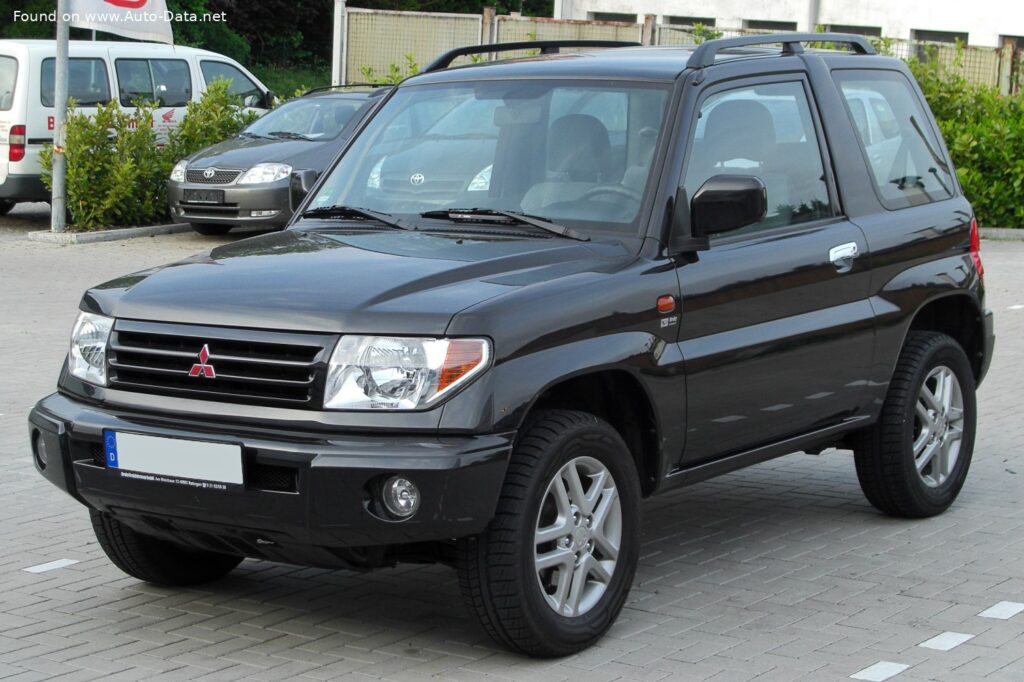
The Mitsubishi Pajero Pinin (H60) is a compact sport utility vehicle (SUV) produced by Mitsubishi Motors between 1999 and 2000. Positioned as a smaller, more affordable alternative to the full-size Pajero, the Pinin was primarily aimed at the European market, where demand for smaller, versatile SUVs was growing. It represented Mitsubishi’s attempt to capitalize on the increasing popularity of the SUV segment with a vehicle that offered all-wheel drive capability and a practical interior in a relatively compact package. While not officially sold in the United States, the Pinin provides an interesting case study in Mitsubishi’s global product strategy during the late 1990s.
Mitsubishi Pajero Pinin (H60): An Overview
The Pajero Pinin, designated as the H60 series, was essentially a rebadged and slightly modified version of the Mitsubishi RVR (known as the Outlander in some markets). The name “Pinin” was used specifically for the European market, leveraging the established Pajero brand recognition. The vehicle offered a three-door body style, seating for four passengers, and a focus on practicality and off-road capability within its size class. The 1.8 GDI variant, equipped with a 120 horsepower engine and automatic transmission, was a common configuration offered in Europe.
Engine & Performance
The 1999-2000 Mitsubishi Pajero Pinin 1.8 GDI was powered by the 4G93 1.8-liter inline-four cylinder gasoline engine. This engine featured Gasoline Direct Injection (GDI) technology, which improved fuel efficiency and power output compared to traditional port fuel injection systems. The engine produced 120 horsepower at 5250 rpm and 174 Nm (128.34 lb.-ft.) of torque at 3500 rpm. Power per liter was rated at 65.4 hp/l. This engine was coupled with a four-speed automatic transmission, delivering power to all four wheels via an all-wheel drive system. Acceleration from 0 to 100 km/h (0-62 mph) took 11.3 seconds, while 0-60 mph was achieved in approximately 10.7 seconds. The vehicle had a maximum speed of 163 km/h (101.28 mph). The weight-to-power ratio was 10.1 kg/Hp, and the weight-to-torque ratio was 7 kg/Nm.
Design & Features
The Pajero Pinin H60 featured a typical late-1990s SUV design, characterized by a boxy silhouette and relatively high ground clearance. Its three-door configuration prioritized compactness, making it easier to maneuver in urban environments. The interior was designed to be functional and durable, with seating for four passengers. Key features included an anti-lock braking system (ABS) for enhanced safety, hydraulic power steering for ease of handling, and a relatively spacious trunk area for its size. Trunk space ranged from a minimum of 165 liters (5.83 cu. ft.) to a maximum of 800 liters (28.25 cu. ft.) with the rear seats folded down. The vehicle’s suspension utilized an independent McPherson strut setup at the front and a coil spring arrangement at the rear, providing a balance between ride comfort and off-road capability. The Pinin rode on 215/65 R16 tires mounted on 16-inch wheel rims.
Technical Specifications
| Brand | Mitsubishi |
| Model | Pajero Pinin (H60) |
| Type (Engine) | 1.8 GDI (120 Hp) Automatic |
| Start of production | 1999 |
| End of production | 2000 |
| Powertrain Architecture | Internal Combustion engine |
| Body type | SUV |
| Seats | 4 |
| Doors | 3 |
| Fuel consumption (urban) | 11.5 l/100 km (20.5 US mpg / 24.6 UK mpg) |
| Fuel consumption (extra urban) | 8.1 l/100 km (29 US mpg / 34.9 UK mpg) |
| Fuel Type | Petrol (Gasoline) |
| Acceleration 0 – 100 km/h | 11.3 sec |
| Acceleration 0 – 62 mph | 11.3 sec |
| Acceleration 0 – 60 mph | 10.7 sec |
| Maximum speed | 163 km/h (101.28 mph) |
| Weight-to-power ratio | 10.1 kg/Hp |
| Weight-to-torque ratio | 7 kg/Nm |
| Power | 120 Hp @ 5250 rpm |
| Torque | 174 Nm @ 3500 rpm (128.34 lb.-ft. @ 3500 rpm) |
| Engine layout | Front, Longitudinal |
| Engine Model/Code | 4G93 |
| Engine displacement | 1834 cm3 (111.92 cu. in.) |
| Number of cylinders | 4 |
| Engine configuration | Inline |
| Cylinder Bore | 81 mm (3.19 in.) |
| Piston Stroke | 89 mm (3.5 in.) |
| Compression ratio | 12.1:1 |
| Number of valves per cylinder | 4 |
| Fuel injection system | Direct injection |
| Engine aspiration | Naturally aspirated |
| Valvetrain | DOHC |
| Kerb Weight | 1210 kg (2667.59 lbs.) |
| Max. weight | 1690 kg (3725.81 lbs.) |
| Max load | 480 kg (1058.22 lbs.) |
| Trunk (boot) space – minimum | 165 l (5.83 cu. ft.) |
| Trunk (boot) space – maximum | 800 l (28.25 cu. ft.) |
| Fuel tank capacity | 53 l (14 US gal | 11.66 UK gal) |
| Length | 3735 mm (147.05 in.) |
| Width | 1695 mm (66.73 in.) |
| Height | 1700 mm (66.93 in.) |
| Wheelbase | 2280 mm (89.76 in.) |
| Front track | 1435 mm (56.5 in.) |
| Rear (Back) track | 1445 mm (56.89 in.) |
| Minimum turning circle | 9.8 m (32.15 ft.) |
| Drive wheel | All wheel drive (4×4) |
| Number of gears | 4 |
| Gearbox type | Automatic transmission |
| Front suspension | Independent type McPherson |
| Rear suspension | Coil spring |
| Front brakes | Ventilated discs |
| Rear brakes | Disc |
| Assisting systems | ABS (Anti-lock braking system) |
| Steering type | Steering rack and pinion |
| Power steering | Hydraulic |
| Tires size | 215/65 R16 |
| Wheel rims size | 16 |
The Mitsubishi Pajero Pinin (H60) 1.8 GDI, while a relatively short-lived model, represents a significant example of Mitsubishi’s efforts to cater to the growing European SUV market. Its combination of compact dimensions, all-wheel drive capability, and efficient GDI engine made it a practical and appealing choice for buyers seeking a versatile vehicle for both urban and off-road driving.