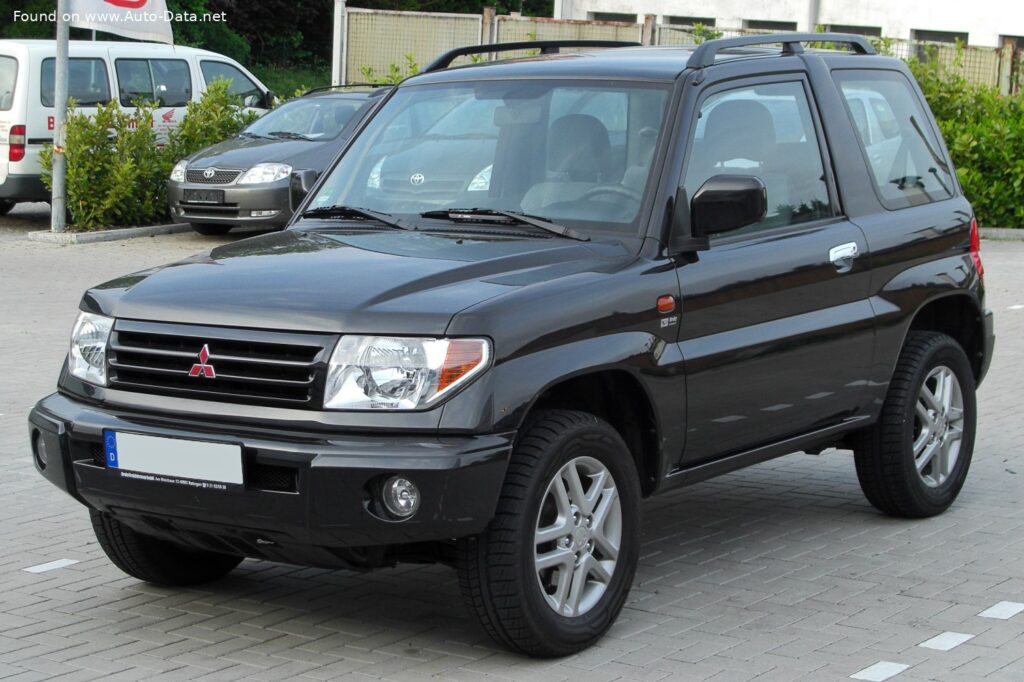
The Mitsubishi Pajero Pinin (H60) is a compact sport utility vehicle (SUV) produced by Mitsubishi Motors between 1999 and 2006. Positioned as a smaller, more affordable alternative to the full-size Pajero, the Pinin was primarily marketed in Europe, Japan, Australia, and other international markets. It was not officially sold in the United States. The Pinin aimed to capitalize on the growing popularity of compact SUVs, offering a blend of off-road capability, practicality, and a relatively accessible price point. The “Pinin” name itself is derived from the Italian word for pine, reflecting the vehicle’s intended use for outdoor adventures.
Mitsubishi Pajero Pinin (H60): An Overview
The H60 generation Pajero Pinin represented Mitsubishi’s attempt to broaden the appeal of the Pajero nameplate. While the larger Pajero was known for its robust off-road prowess and luxurious features, the Pinin focused on providing a more economical and maneuverable option for urban and light off-road use. Its three-door configuration and compact dimensions distinguished it from the five-door models prevalent in the SUV market at the time. The Pinin served as a bridge between smaller hatchbacks and larger, more expensive SUVs, appealing to buyers seeking a versatile vehicle for both daily commuting and weekend excursions.
Engine & Performance
The Pajero Pinin H60 was primarily powered by a 2.0-liter inline-four cylinder gasoline engine utilizing Mitsubishi’s GDI (Gasoline Direct Injection) technology. This engine produced 129 horsepower at 5000 rpm and 190 Nm (140.14 lb.-ft.) of torque at 3500 rpm. The GDI system improved fuel efficiency and power output compared to traditional port fuel injection. The engine’s longitudinal front-engine layout contributed to a balanced weight distribution, enhancing handling characteristics. Acceleration from 0 to 100 km/h (0-62 mph) took approximately 10.2 seconds, while 0 to 60 mph was achieved in 9.7 seconds. The vehicle had a maximum speed of 170 km/h (105.63 mph). A five-speed manual transmission was the standard gearbox, delivering power to all four wheels via an all-wheel-drive system. The weight-to-power ratio was 10.8 kg/Hp, and the weight-to-torque ratio was 7.3 kg/Nm.
Design & Features
The Pajero Pinin H60 featured a distinctive three-door body style, offering a relatively compact footprint for easy maneuverability in urban environments. The design incorporated rounded edges and a relatively high ground clearance, hinting at its off-road capabilities. Inside, the Pinin offered seating for five passengers, although rear passenger space was somewhat limited due to the shorter wheelbase. The interior was designed with practicality in mind, featuring durable materials and a functional layout. Standard safety features included an Anti-lock Braking System (ABS). The trunk space varied depending on the rear seats’ configuration, offering a minimum of 166 liters (5.86 cu. ft.) and a maximum of 801 liters (28.29 cu. ft.) with the rear seats folded down. The vehicle’s hydraulic power steering and spring strut front suspension, coupled with a coil spring rear suspension, provided a comfortable ride on both paved and unpaved surfaces.
Technical Specifications
| Brand | Mitsubishi |
| Model | Pajero |
| Generation | Pajero Pinin (H60) |
| Type | 2.0 GDI 16V (129 Hp) 3dr |
| Start of production | November, 1999 |
| End of production | 2006 |
| Powertrain Architecture | Internal Combustion engine |
| Body type | SUV |
| Seats | 5 |
| Doors | 3 |
| Fuel consumption (urban) | 12 l/100 km (19.6 US mpg, 23.5 UK mpg, 8.3 km/l) |
| Fuel consumption (extra urban) | 7.8 l/100 km (30.2 US mpg, 36.2 UK mpg, 12.8 km/l) |
| Fuel consumption (combined) | 9.3 l/100 km (25.3 US mpg, 30.4 UK mpg, 10.8 km/l) |
| Fuel Type | Petrol (Gasoline) |
| Acceleration 0 – 100 km/h | 10.2 sec |
| Acceleration 0 – 62 mph | 10.2 sec |
| Acceleration 0 – 60 mph | 9.7 sec |
| Maximum speed | 170 km/h (105.63 mph) |
| Weight-to-power ratio | 10.8 kg/Hp |
| Weight-to-torque ratio | 7.3 kg/Nm |
| Power | 129 Hp @ 5000 rpm |
| Power per litre | 64.5 Hp/l |
| Torque | 190 Nm @ 3500 rpm (140.14 lb.-ft. @ 3500 rpm) |
| Engine layout | Front, Longitudinal |
| Engine displacement | 1999 cm3 (121.99 cu. in.) |
| Number of cylinders | 4 |
| Engine configuration | Inline |
| Cylinder Bore | 81.5 mm (3.21 in.) |
| Piston Stroke | 95.8 mm (3.77 in.) |
| Compression ratio | 11:1 |
| Number of valves per cylinder | 4 |
| Fuel injection system | Direct injection |
| Engine aspiration | Naturally aspirated engine |
| Valvetrain | DOHC |
| Kerb Weight | 1394 kg (3073.24 lbs.) |
| Max. weight | 1725 kg (3802.97 lbs.) |
| Max load | 331 kg (729.73 lbs.) |
| Trunk (boot) space – minimum | 166 l (5.86 cu. ft.) |
| Trunk (boot) space – maximum | 801 l (28.29 cu. ft.) |
| Fuel tank capacity | 53 l (14 US gal | 11.66 UK gal) |
| Length | 3735 mm (147.05 in.) |
| Width | 1695 mm (66.73 in.) |
| Height | 1735 mm (68.31 in.) |
| Wheelbase | 2280 mm (89.76 in.) |
| Front track | 1435 mm (56.5 in.) |
| Rear (Back) track | 1445 mm (56.89 in.) |
| Minimum turning circle | 9.8 m (32.15 ft.) |
| Drive wheel | All wheel drive (4×4) |
| Number of gears | 5 gears, manual transmission |
| Front suspension | Spring Strut |
| Rear suspension | Coil spring |
| Front brakes | Ventilated discs |
| Rear brakes | Disc |
| Assisting systems | ABS (Anti-lock braking system) |
| Steering type | Steering rack and pinion |
| Power steering | Hydraulic Steering |
| Tires size | 215/65 R16 S |
The Mitsubishi Pajero Pinin (H60) offered a compelling package for buyers seeking a compact, capable, and relatively affordable SUV. While not sold in the US market, it enjoyed considerable success in other regions, establishing itself as a popular choice for those needing a versatile vehicle for both urban and off-road adventures.