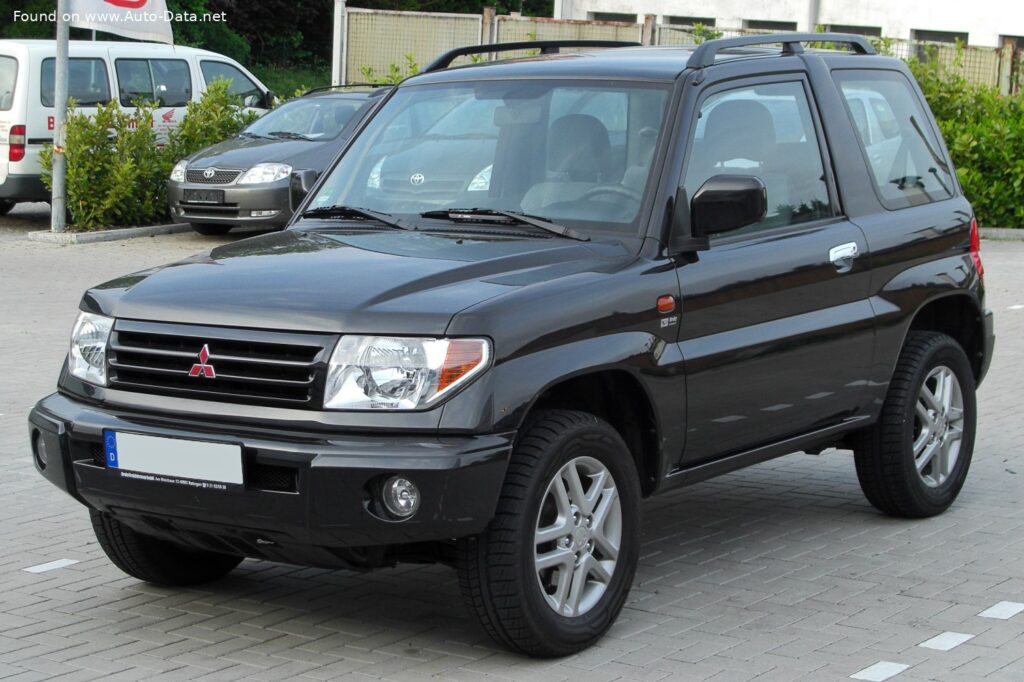
The Mitsubishi Pajero Pinin (H60) 2.0 GDI 16V (129 Hp) 5dr represents a significant chapter in the evolution of the compact sport utility vehicle, embodying Mitsubishi’s renowned expertise in off-road capability within a more urban-friendly package. Launched in November 1999 and produced until 2006, this generation of the Pajero Pinin, known as the Pajero iO in its home market of Japan and as the Montero iO in some other regions, was specifically designed to cater to markets primarily in Europe and Asia where smaller, more agile SUVs were gaining popularity. It offered a compelling blend of rugged utility, surprising off-road prowess inherited from its larger Pajero siblings, and the practicality suited for daily driving. Positioned as a mini-SUV, the Pajero Pinin aimed to attract buyers seeking the adventurous spirit of a traditional SUV without the bulk or higher running costs typically associated with full-size models, making it a versatile choice for both city dwellers and weekend adventurers.
The Mitsubishi Pajero Pinin (H60): A Compact Off-Roader for the Global Market
The Mitsubishi Pajero Pinin (H60) carved out a distinct niche within the highly competitive compact SUV segment during its production run. While its larger namesake, the full-size Pajero (Montero in North America), was celebrated for its Dakar Rally heritage and robust off-road capabilities, the Pinin offered a more approachable interpretation for a broader audience. Its design philosophy centered on delivering genuine SUV attributes—such as higher ground clearance and an advanced all-wheel-drive system—in a more maneuverable and fuel-efficient form factor. The “Pinin” suffix itself, derived from the Italian design house Pininfarina, hinted at a more refined aesthetic and a focus on European market tastes, contributing to its distinct identity. Despite not being officially sold in the United States, its influence and engineering principles resonate with the global shift towards smaller, more versatile SUVs that offer a balance between on-road comfort and light-duty off-road capability, a trend that continues to dominate the automotive landscape today.
The H60 generation was available in various configurations, but the 2.0 GDI 16V (129 Hp) 5dr model stood out as a well-rounded option, balancing performance with practicality. Its compact dimensions—a length of 158.86 inches, a width of 66.73 inches, and a height of 68.31 inches, all riding on a 96.46-inch wheelbase—made it remarkably agile in urban environments and easier to park than larger SUVs. This smaller footprint, combined with its robust construction, allowed the Pajero Pinin to navigate tight city streets with ease while still possessing the inherent strength expected of a Mitsubishi SUV. The vehicle’s market success in its primary regions underscored the demand for such a compact yet capable vehicle, demonstrating Mitsubishi’s foresight in diversifying its iconic Pajero lineup to meet evolving consumer needs.
Powertrain and Performance: The 2.0 GDI 16V Engine
Engine Architecture and Innovation
At the heart of the Mitsubishi Pajero Pinin (H60) 2.0 GDI 16V (129 Hp) 5dr lies a sophisticated 2.0-liter gasoline direct injection (GDI) engine, a technological highlight for its era. This naturally aspirated, inline-four cylinder engine, with a displacement of 1999 cubic centimeters (121.99 cubic inches), was engineered to deliver an optimal balance of power, efficiency, and responsiveness. Direct injection technology, still relatively novel in mainstream vehicles at the turn of the millennium, allowed for precise fuel delivery directly into the combustion chamber, leading to more efficient burning and enhanced power output compared to conventional port injection systems. The engine features a Double Overhead Camshaft (DOHC) valvetrain with 4 valves per cylinder, ensuring efficient airflow and combustion across the rev range. With a cylinder bore of 3.21 inches and a piston stroke of 3.77 inches, coupled with a compression ratio of 11:1, the engine was designed for spirited performance.
The GDI engine produces a respectable 129 horsepower at 5000 rpm, providing ample power for both highway cruising and tackling light off-road trails. Torque output stands at a robust 140.14 lb.-ft. at a relatively low 3500 rpm, which is crucial for an SUV as it aids in acceleration from a standstill, climbing inclines, and towing. The front, longitudinal engine layout further contributes to a balanced weight distribution and allows for optimal packaging of the all-wheel-drive system. Mitsubishi’s commitment to engineering a powerful yet efficient engine for the Pajero Pinin showcased its ability to integrate advanced powertrain technologies into its compact SUV offerings, setting a benchmark for the segment in its time.
Drivetrain and Driving Dynamics
The performance capabilities of the Pajero Pinin (H60) are further amplified by its well-matched drivetrain. Power is channeled through a precise 5-speed manual transmission, offering drivers engaging control over the engine’s output. A key differentiator for the Pajero Pinin in the compact SUV market was its standard all-wheel-drive (4×4) system. This advanced system, likely a simplified version of Mitsubishi’s Super Select 4WD-i, provided excellent traction and stability on varied surfaces, from slippery city streets to challenging unpaved roads. The ability to engage four-wheel drive modes, including a low-range option in some markets, underscored its serious off-road credentials, a rarity in its class.
In terms of acceleration, the Pajero Pinin 2.0 GDI is capable of reaching 60 mph from a standstill in 10.3 seconds, with a top speed of 105.63 mph. These figures, while not sports car-like, are more than adequate for a compact SUV of its vintage, providing confidence for merging onto highways and overtaking. Fuel economy, a significant consideration for any vehicle, particularly in the compact SUV segment, was commendable for its time thanks to the GDI technology. The combined fuel consumption is rated at 24.8 US mpg, with urban driving yielding 19.3 US mpg and extra-urban driving achieving an impressive 29.4 US mpg. This blend of accessible performance, robust all-wheel-drive capability, and reasonable fuel efficiency made the Pajero Pinin a highly practical and versatile vehicle for a wide range of uses.
Design, Features, and Practicality
Exterior and Interior Design
The Mitsubishi Pajero Pinin (H60) presented a distinctive and rugged yet refined exterior design that clearly identified it as part of the Pajero family, albeit in a more compact form. Its five-door SUV body type offered practicality and easy access for both passengers and cargo. The design featured clean lines, prominent wheel arches, and a spare tire mounted on the tailgate, all classic SUV cues that conveyed a sense of adventure and durability. Inside, the Pajero Pinin offered seating for five occupants, providing a comfortable and functional cabin environment. Despite its compact exterior dimensions, Mitsubishi engineered the interior to maximize space, ensuring adequate head and legroom for all passengers. The focus on practicality extended to its cargo capacity, with a minimum trunk space of 12.64 cubic feet, which could be expanded significantly to 40.89 cubic feet by folding down the rear seats. This flexibility made the Pajero Pinin highly adaptable for everything from grocery runs to hauling outdoor gear.
Chassis, Suspension, and Safety
Underpinning the Pajero Pinin (H60) was a chassis designed for both on-road comfort and off-road resilience. The suspension system featured a spring strut setup at the front and a coil spring arrangement at the rear. This configuration provided a compliant ride over varied surfaces while maintaining sufficient control for spirited driving. The vehicle was equipped with ventilated disc brakes at the front and disc brakes at the rear, ensuring reliable stopping power. An Anti-lock Braking System (ABS) was a standard assisting system, enhancing safety by preventing wheel lock-up during hard braking and allowing the driver to maintain steering control. Steering was handled by a rack and pinion system, complemented by hydraulic power steering, offering direct feedback and ease of maneuverability at low speeds. The vehicle rode on 215/65 R16 S tires, providing a good balance between on-road grip and off-road capability. With a kerb weight of 3265.05 lbs and a maximum weight of 4166.74 lbs, the Pajero Pinin was a sturdy and well-built vehicle, capable of handling a maximum load of 901.69 lbs. The 14 US gallon fuel tank capacity further extended its range, making it suitable for longer journeys. Overall, the Mitsubishi Pajero Pinin (H60) delivered a comprehensive package of design, features, and robust engineering, making it a compelling choice in the compact SUV segment.
Technical Specifications
| Feature | Value |
|---|---|
| Brand | Mitsubishi |
| Model | Pajero Pinin (H60) |
| Engine Type | 2.0 GDI 16V (129 Hp) 5dr |
| Production Start | November, 1999 |
| Production End | 2006 |
| Powertrain Architecture | Internal Combustion engine |
| Body Type | SUV |
| Seats | 5 |
| Doors | 5 |
| Fuel Consumption – Urban | 19.3 US mpg |
| Fuel Consumption – Extra Urban | 29.4 US mpg |
| Fuel Consumption – Combined | 24.8 US mpg |
| Fuel Type | Petrol (Gasoline) |
| Acceleration 0 – 60 mph | 10.3 sec |
| Maximum Speed | 105.63 mph |
| Weight-to-Power Ratio | 11.5 kg/Hp |
| Weight-to-Torque Ratio | 7.8 kg/Nm |
| Power | 129 Hp @ 5000 rpm |
| Power per liter | 64.5 Hp/l |
| Torque | 140.14 lb.-ft. @ 3500 rpm |
| Engine Layout | Front, Longitudinal |
| Engine Displacement | 121.99 cu. in. |
| Number of Cylinders | 4 |
| Engine Configuration | Inline |
| Cylinder Bore | 3.21 in. |
| Piston Stroke | 3.77 in. |
| Compression Ratio | 11:1 |
| Valves per Cylinder | 4 |
| Fuel Injection System | Direct injection |
| Engine Aspiration | Naturally aspirated engine |
| Valvetrain | DOHC |
| Kerb Weight | 3265.05 lbs |
| Max. Weight | 4166.74 lbs |
| Max Load | 901.69 lbs |
| Trunk Space – Minimum | 12.64 cu. ft. |
| Trunk Space – Maximum | 40.89 cu. ft. |
| Fuel Tank Capacity | 14 US gal |
| Length | 158.86 in. |
| Width | 66.73 in. |
| Height | 68.31 in. |
| Wheelbase | 96.46 in. |
| Front Track | 56.5 in. |
| Rear Track | 56.89 in. |
| Drive Wheel | All wheel drive (4×4) |
| Gearbox | 5 gears, manual transmission |
| Front Suspension | Spring Strut |
| Rear Suspension | Coil spring |
| Front Brakes | Ventilated discs |
| Rear Brakes | Disc |
| Assisting Systems | ABS (Anti-lock braking system) |
| Steering Type | Steering rack and pinion |
| Power Steering | Hydraulic Steering |
| Tires Size | 215/65 R16 S |