
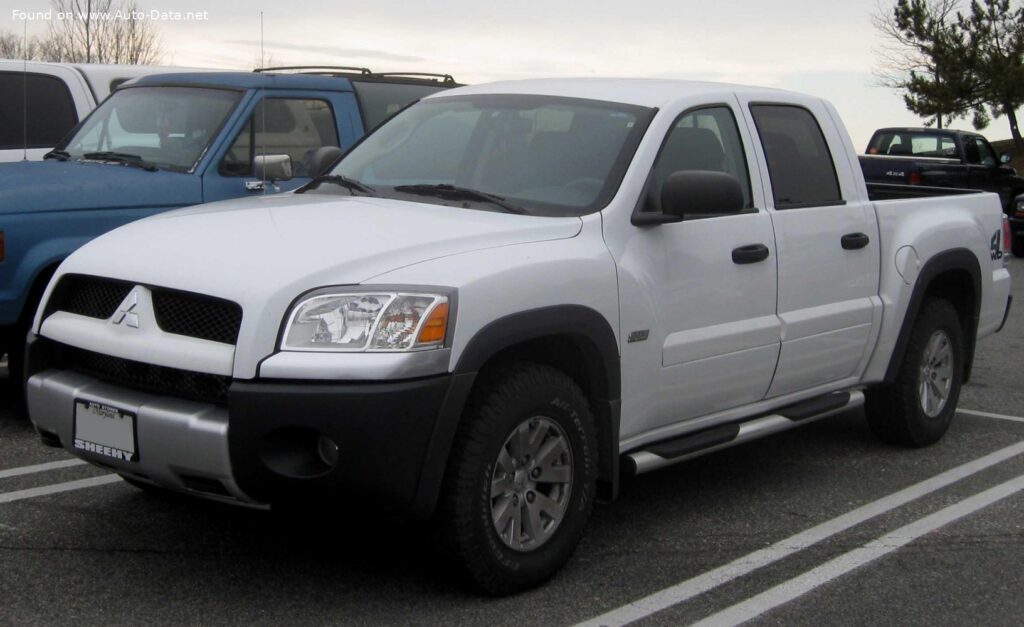
The Mitsubishi Raider, produced from 2006 to 2009, represented Mitsubishi’s entry into the competitive North American mid-size pickup truck segment during the mid-2000s. A strategic move by the Japanese automaker, the Raider was a badge-engineered version of the second-generation Dodge Dakota, a well-established and respected nameplate in the American truck market. This collaboration allowed Mitsubishi to quickly offer a full-size-capable mid-size truck without the extensive research and development costs associated with an entirely new platform. Positioned to cater to consumers seeking a robust, versatile, and relatively compact utility vehicle, the Raider aimed to leverage its Dodge Dakota underpinnings while offering a distinct, albeit subtle, Mitsubishi aesthetic and branding. The specific variant under review, the Mitsubishi Raider 3.7 LS V6 (210 Hp) Automatic, embodies the core characteristics of this generation, offering a blend of power, utility, and everyday usability for its target demographic.
Powertrain and Performance: The Mitsubishi Raider 3.7 LS V6
At the heart of the Mitsubishi Raider 3.7 LS V6 (210 Hp) Automatic lies a robust 3.7-liter V6 gasoline engine, a powerplant shared with its Dodge Dakota sibling. This naturally aspirated engine, designated with the model code EKG, was engineered to deliver a balance of power and torque suitable for a mid-size pickup, whether for daily commuting, light hauling, or recreational towing. It produces a respectable 210 horsepower at 5200 rpm, translating to a power density of 56.7 horsepower per liter. This output, while not class-leading, was competitive for its era and segment, providing ample motivation for the Raider’s intended purposes.
Crucially for a truck, the engine’s torque delivery is a significant factor. The 3.7-liter V6 generates 235 lb.-ft. of torque at a relatively accessible 3600 rpm. This strong low-to-mid-range torque is vital for towing and hauling, allowing the vehicle to accelerate with conviction even when loaded. The engine’s layout is a front, longitudinal configuration, a traditional setup for rear-wheel-drive trucks, which aids in weight distribution and powertrain packaging. Its V-engine configuration with six cylinders contributes to its smooth operation and compact design within the engine bay.
Technical specifications of the engine further reveal its design philosophy. With an engine displacement of 3701 cubic centimeters (225.85 cubic inches), it features a cylinder bore of 3.66 inches (93 mm) and a piston stroke of 3.57 inches (90.8 mm). The compression ratio stands at 9.7:1, indicative of its naturally aspirated design tailored for regular unleaded gasoline. Fuel delivery is handled by a multi-port manifold injection system, a proven and reliable method for precise fuel metering. The valvetrain utilizes a Single Overhead Camshaft (SOHC) design with two valves per cylinder, a configuration known for its simplicity, reliability, and good low-end torque characteristics, which are often prioritized in utility vehicles over high-revving performance.
Power is transmitted to the rear wheels via a 4-speed automatic transmission. While modern trucks often feature more gears, a 4-speed automatic was a common and durable choice for mid-size pickups during the Raider’s production run. This transmission was well-matched to the engine’s torque curve, providing smooth shifts and reliable operation for everyday driving and light-duty work. The drivetrain architecture, with the internal combustion engine driving the rear wheels, reinforces its truck heritage and capability, particularly for tasks involving traction or towing.
Design, Features, and Utility of the Mitsubishi Raider
The Mitsubishi Raider, as a pickup truck, was designed with practicality and utility at its forefront. Its body type is a traditional pickup, offered in a 4-door configuration, providing seating for up to five occupants. This Crew Cab-style setup made the Raider a versatile choice for both work and family duties, offering the passenger comfort of an SUV combined with the open-bed utility of a truck. The design of the Raider, while closely related to the Dodge Dakota, featured a distinct front fascia and unique badging to differentiate it within the Mitsubishi lineup, aligning it with the brand’s global design language where possible.
Dimensions of the Raider underscore its mid-size classification, balancing maneuverability with cargo capacity. It measures 219.88 inches (5585 mm) in length, 71.89 inches (1826 mm) in width, and 68.58 inches (1742 mm) in height. The substantial wheelbase of 131.3 inches (3335 mm) contributes to a stable ride, especially when carrying loads or towing. The front track is 64.17 inches (1630 mm) and the rear track is 62.44 inches (1586 mm), providing a solid stance on the road. Despite its size, the minimum turning circle of 43.96 feet (13.4 meters) suggests reasonable maneuverability for a vehicle of its class, aiding in urban environments and tight parking spaces.
Inside, the Raider offered a functional cabin designed for durability and ease of use, typical of a pickup truck from its era. While specific interior features varied by trim level, the focus would have been on robust materials and straightforward ergonomics. Safety features for the 2006-2009 model years included standard front airbags, and potentially optional side airbags depending on the trim. The braking system employed ventilated discs at the front for effective stopping power and drum brakes at the rear, a common and cost-effective setup for mid-size trucks, providing reliable performance under various conditions.
Suspension components were engineered to handle varying loads and road conditions. The front suspension utilized a double wishbone setup, known for its ability to provide precise handling and a comfortable ride. The rear suspension featured a dependent suspension system with two longitudinal semi-elliptic leaf springs, a time-tested and robust design for pickup trucks, specifically chosen for its load-carrying capability and durability. Steering was managed by a rack and pinion system, offering direct feedback and control to the driver.
The cargo capacity of the Mitsubishi Raider was a key selling point. The trunk (bed) space offered a minimum volume of 29.98 cubic feet (849 liters), expanding to a maximum of 46.62 cubic feet (1320 liters). This versatile cargo area allowed owners to transport a wide range of items, from tools and equipment to recreational gear, cementing its utility as a true pickup truck. The Raider, therefore, carved out a niche as a practical and dependable option for consumers who appreciated the Mitsubishi brand and sought a capable mid-size truck with proven mechanicals.
Technical Specifications: Mitsubishi Raider 3.7 LS V6 (210 Hp) Automatic
| Brand | Mitsubishi |
| Model | Raider |
| Generation | Raider |
| Type (Engine) | 3.7 LS V6 (210 Hp) Automatic |
| Start of Production | 2006 year |
| End of Production | 2009 year |
| Powertrain Architecture | Internal Combustion engine |
| Body Type | Pick-up |
| Seats | 5 |
| Doors | 4 |
| Fuel Type | Petrol (Gasoline) |
| Power | 210 Hp @ 5200 rpm. |
| Power per Liter | 56.7 Hp/l |
| Torque | 235 Nm @ 3600 rpm. (173.33 lb.-ft. @ 3600 rpm.) |
| Engine Layout | Front, Longitudinal |
| Engine Model/Code | EKG |
| Engine Displacement | 3701 cm3 (225.85 cu. in.) |
| Number of Cylinders | 6 |
| Engine Configuration | V-engine |
| Cylinder Bore | 93 mm (3.66 in.) |
| Piston Stroke | 90.8 mm (3.57 in.) |
| Compression Ratio | 9.7:1 |
| Number of Valves per Cylinder | 2 |
| Fuel Injection System | Multi-port manifold injection |
| Engine Aspiration | Naturally aspirated engine |
| Valvetrain | SOHC |
| Engine Oil Capacity | 4.7 l (4.97 US qt) |
| Trunk (Bed) Space – Minimum | 849 l (29.98 cu. ft.) |
| Trunk (Bed) Space – Maximum | 1320 l (46.62 cu. ft.) |
| Length | 5585 mm (219.88 in.) |
| Width | 1826 mm (71.89 in.) |
| Height | 1742 mm (68.58 in.) |
| Wheelbase | 3335 mm (131.3 in.) |
| Front Track | 1630 mm (64.17 in.) |
| Rear (Back) Track | 1586 mm (62.44 in.) |
| Minimum Turning Circle | 13.4 m (43.96 ft.) |
| Drivetrain Architecture | Internal combustion engine (ICE) drives the rear wheels of the vehicle. |
| Drive Wheel | Rear wheel drive |
| Number of Gears and Type of Gearbox | 4 gears, automatic transmission |
| Front Suspension | Double wishbone |
| Rear Suspension | Dependent suspension of two longitudinal semi-elliptic leaf springs |
| Front Brakes | Ventilated discs |
| Rear Brakes | Drum |
| Steering Type | Steering rack and pinion |
