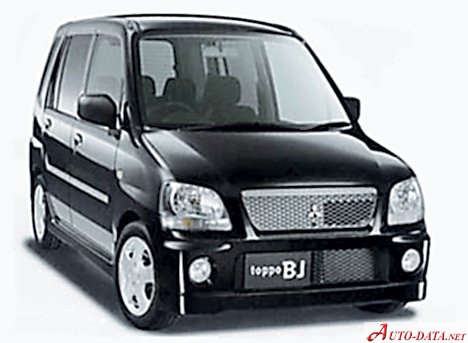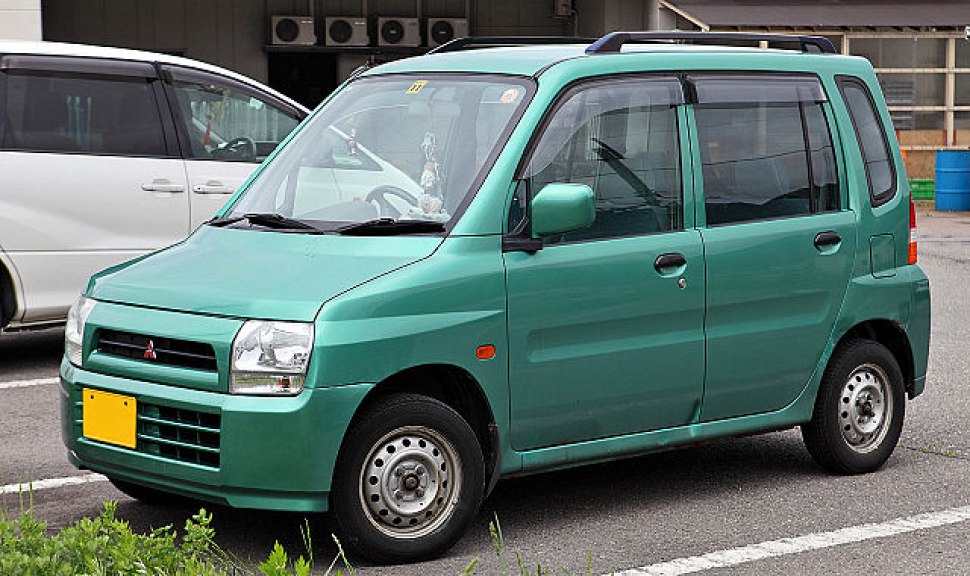
The Mitsubishi Toppo 657 B, produced from 1990 to 1999, was a compact hatchback primarily aimed at the Japanese domestic market (JDM). Positioned as an affordable and practical city car, the Toppo occupied a niche similar to the Suzuki Alto or Daihatsu Mira. While not officially sold in the United States, understanding its specifications provides insight into the kei car and microcar segments popular in Asia. The 657 B designation refers to the engine displacement, and this particular variant offered a modest 40 horsepower with an automatic transmission, prioritizing fuel efficiency and ease of use over outright performance. It represented Mitsubishi’s entry into the highly competitive small car market, offering a functional and economical transportation solution.
Mitsubishi Toppo 657 B: A Detailed Overview
The Mitsubishi Toppo, in its various iterations, spanned several generations. The model detailed here, the 657 B, falls within the broader Toppo lineage, representing a specific configuration focused on affordability and practicality. It was designed to navigate the congested urban environments of Japan, where small size and fuel economy are paramount. The Toppo competed with other kei cars and microcars, offering a balance of features and price that appealed to a wide range of buyers. Its three-door hatchback configuration and compact dimensions made it easy to maneuver and park in tight spaces.
Engine & Performance
The heart of the Mitsubishi Toppo 657 B is a 657cc inline three-cylinder engine. This naturally aspirated engine produces 40 horsepower at 6000 rpm and 51 Nm (37.62 lb-ft) of torque at 4000 rpm. While these figures are modest by modern standards, they were adequate for its intended purpose – urban commuting. The engine’s power-to-weight ratio is 16.8 kg/Hp, or 59.7 Hp/tonne, indicating a light and nimble vehicle. The torque-to-weight ratio is 13.1 kg/Nm, or 76.1 Nm/tonne. Power per liter is a respectable 60.9 Hp/l. The engine is paired with a three-speed automatic transmission, simplifying operation and making it accessible to a broader range of drivers. Fuel delivery is managed by a carburetor, a common technology for vehicles of this era, prioritizing simplicity and cost-effectiveness over the precision of fuel injection. The front-engine, front-wheel-drive layout contributes to its predictable handling and efficient use of space.
Design & Features
The Mitsubishi Toppo 657 B is a three-door hatchback, offering seating for five passengers. Its compact dimensions – 3295 mm (129.72 in) in length, 1395 mm (54.92 in) in width, and 1765 mm (69.49 in) in height – define its city-focused design. The wheelbase measures 2260 mm (88.98 in), and the front and rear tracks are both 1215 mm (47.83 in). The kerb weight of 670 kg (1477.1 lbs) further enhances its agility. The Toppo’s design prioritizes functionality over aesthetics, with a focus on maximizing interior space within its small footprint. Safety features for the time included disc brakes on the front wheels and drum brakes on the rear, along with an Anti-lock Braking System (ABS), which was becoming increasingly common in the early 1990s. The steering system utilizes a rack and pinion setup, providing responsive and precise control. It rides on R12 tires with 12-inch wheel rims. The 32-liter (8.45 US gal) fuel tank provides a reasonable range for urban driving.
Technical Specifications
| Brand | Mitsubishi |
| Model | Toppo |
| Generation | Toppo |
| Type (Engine) | 657 B (40 Hp) Automatic |
| Start of production | 1990 year |
| End of production | 1999 year |
| Powertrain Architecture | Internal Combustion engine |
| Body type | Hatchback |
| Seats | 5 |
| Doors | 3 |
| Fuel Type | Petrol (Gasoline) |
| Weight-to-power ratio | 16.8 kg/Hp |
| Weight-to-torque ratio | 13.1 kg/Nm |
| Power | 40 Hp @ 6000 rpm |
| Power per litre | 60.9 Hp/l |
| Torque | 51 Nm @ 4000 rpm |
| Torque (lb-ft) | 37.62 lb.-ft. @ 4000 rpm |
| Engine layout | Front, Transverse |
| Engine displacement | 657 cm3 |
| Engine displacement (cu. in.) | 40.09 cu. in. |
| Number of cylinders | 3 |
| Engine configuration | Inline |
| Cylinder Bore | 65 mm |
| Cylinder Bore (in.) | 2.56 in. |
| Piston Stroke | 66 mm |
| Piston Stroke (in.) | 2.6 in. |
| Compression ratio | 9.8:1 |
| Number of valves per cylinder | 2 |
| Fuel injection system | Carburettor |
| Engine aspiration | Naturally aspirated engine |
| Valvetrain | OHC |
| Kerb Weight | 670 kg |
| Kerb Weight (lbs.) | 1477.1 lbs. |
| Fuel tank capacity | 32 l |
| Fuel tank capacity (US gal) | 8.45 US gal |
| Fuel tank capacity (UK gal) | 7.04 UK gal |
| Length | 3295 mm |
| Length (in.) | 129.72 in. |
| Width | 1395 mm |
| Width (in.) | 54.92 in. |
| Height | 1765 mm |
| Height (in.) | 69.49 in. |
| Wheelbase | 2260 mm |
| Wheelbase (in.) | 88.98 in. |
| Front track | 1215 mm |
| Front track (in.) | 47.83 in. |
| Rear track | 1215 mm |
| Rear track (in.) | 47.83 in. |
| Drivetrain Architecture | ICE, Front wheel drive |
| Drive wheel | Front wheel drive |
| Number of gears | 3 |
| Gearbox type | automatic transmission |
| Front suspension | Spring Strut |
| Rear suspension | Coil spring |
| Front brakes | Disc |
| Rear brakes | Drum |
| Assisting systems | ABS (Anti-lock braking system) |
| Steering type | Steering rack and pinion |
| Tires size | R12 |
| Wheel rims size | 12 |
In conclusion, the Mitsubishi Toppo 657 B was a product of its time and market. While not a performance vehicle, it fulfilled its role as an affordable, practical, and fuel-efficient city car in Japan. Its compact size, simple mechanicals, and automatic transmission made it an accessible option for a wide range of drivers, and it remains a representative example of the microcar segment that thrived in Asia during the 1990s.