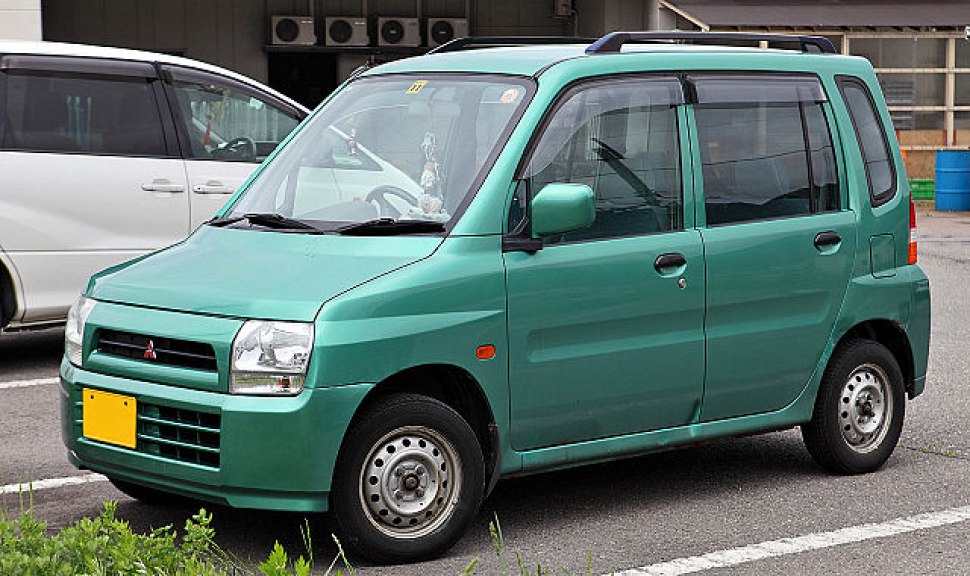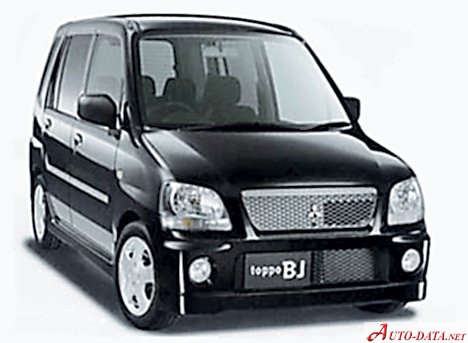
The Mitsubishi Toppo, specifically the BJ generation produced between 2000 and 2004, represents a unique offering within the Japanese Kei car class, though it was not officially sold in the United States. This compact minivan was designed to maximize interior space within the strict dimensional and engine size regulations of the Kei car category in Japan. The Toppo BJ 0.7 i 20V, equipped with a 64 horsepower engine, served as a practical and economical transportation solution for urban dwellers and small families in the Japanese market. Its focus was on efficient packaging, ease of maneuverability, and affordability, characteristics highly valued in densely populated Japanese cities.
Mitsubishi Toppo (BJ) 0.7 i 20V: An Overview
The Toppo name has a long history within Mitsubishi’s lineup, dating back to the 1960s. The BJ generation, introduced in 2000, marked a significant redesign, emphasizing a more modern aesthetic and improved interior functionality. While not exported to North America, the Toppo competed with other Kei car minivans from manufacturers like Daihatsu and Suzuki, offering a similar blend of practicality and economy. The 0.7 i 20V variant, with its 659cc turbocharged engine, was a popular choice, balancing performance with fuel efficiency. The Toppo BJ was primarily aimed at buyers seeking a small, versatile vehicle for navigating tight urban environments and accommodating a small family.
Engine & Performance
The heart of the Mitsubishi Toppo BJ 0.7 i 20V is a 659cc (40.21 cubic inches) inline-four cylinder engine. Despite its small displacement, the engine utilizes a turbocharger and multi-point fuel injection to produce 64 horsepower at 6500 rpm and 98 Nm (72.28 lb-ft) of torque at 3000 rpm. This configuration results in a power-to-weight ratio of 13.1 kg/Hp and a torque-to-weight ratio of 8.6 kg/Nm. The engine’s power per liter is an impressive 97.1 Hp/l, showcasing the effectiveness of the turbocharging system. Power is delivered to the front wheels via a five-speed manual transmission. The Toppo’s relatively light curb weight of 840 kg (1851.88 lbs) contributes to its nimble handling and acceptable acceleration for its class. While not a performance vehicle, the Toppo BJ offered sufficient power for everyday driving and urban commuting.
Design & Features
The Mitsubishi Toppo BJ is a five-door minivan designed to maximize interior space within the Kei car regulations. Its compact dimensions – 3395 mm (133.66 in) in length, 1475 mm (58.07 in) in width, and 1740 mm (68.5 in) in height – make it easy to maneuver in crowded city streets. The vehicle comfortably seats five passengers. The exterior design is functional and unassuming, prioritizing practicality over stylistic flourishes. Key features included a relatively spacious interior for its size, sliding rear doors for easy access, and a focus on maximizing cargo space. Safety features, while limited by the era and vehicle class, included an Anti-lock Braking System (ABS). The suspension utilizes coil springs on both the front and rear axles, providing a comfortable ride. The steering system is a rack and pinion setup with hydraulic power steering, enhancing maneuverability. The Toppo BJ rode on 165/60 R14 tires.
Technical Specifications
| Brand | Mitsubishi |
| Model | Toppo |
| Generation | Toppo (BJ) |
| Type (Engine) | 0.7 i 20V (64 Hp) |
| Start of production | 2000 year |
| End of production | 2004 year |
| Powertrain Architecture | Internal Combustion engine |
| Body type | Minivan |
| Seats | 5 |
| Doors | 5 |
| Fuel Type | Petrol (Gasoline) |
| Weight-to-power ratio | 13.1 kg/Hp |
| Weight-to-torque ratio | 8.6 kg/Nm |
| Power | 64 Hp @ 6500 rpm |
| Power per litre | 97.1 Hp/l |
| Torque | 98 Nm @ 3000 rpm |
| Torque (lb.-ft.) | 72.28 lb.-ft. @ 3000 rpm |
| Engine layout | Front, Transverse |
| Engine displacement | 659 cm3 |
| Engine displacement (cu. in.) | 40.21 cu. in. |
| Number of cylinders | 4 |
| Engine configuration | Inline |
| Cylinder Bore | 60 mm |
| Cylinder Bore (in.) | 2.36 in. |
| Piston Stroke | 58.3 mm |
| Piston Stroke (in.) | 2.3 in. |
| Compression ratio | 8.5:1 |
| Number of valves per cylinder | 5 |
| Fuel injection system | Multi-port manifold injection |
| Engine aspiration | Turbocharger |
| Kerb Weight | 840 kg |
| Kerb Weight (lbs.) | 1851.88 lbs. |
| Max. weight | 1060 kg |
| Max. weight (lbs.) | 2336.9 lbs. |
| Max load | 220 kg |
| Max load (lbs.) | 485.02 lbs. |
| Fuel tank capacity | 30 l |
| Fuel tank capacity (US gal) | 7.93 US gal |
| Fuel tank capacity (UK gal) | 6.6 UK gal |
| Length | 3395 mm |
| Length (in.) | 133.66 in. |
| Width | 1475 mm |
| Width (in.) | 58.07 in. |
| Height | 1740 mm |
| Height (in.) | 68.5 in. |
| Wheelbase | 2340 mm |
| Wheelbase (in.) | 92.13 in. |
| Front track | 1300 mm |
| Front track (in.) | 51.18 in. |
| Rear (Back) track | 1295 mm |
| Rear (Back) track (in.) | 50.98 in. |
| Drivetrain Architecture | The Internal combustion engine (ICE) drives the front wheels of the vehicle. |
| Drive wheel | Front wheel drive |
| Number of gears and type of gearbox | 5 gears, manual transmission |
| Front suspension | Coil spring |
| Rear suspension | Coil spring |
| Front brakes | Ventilated discs |
| Rear brakes | Drum |
| Assisting systems | ABS (Anti-lock braking system) |
| Steering type | Steering rack and pinion |
| Power steering | Hydraulic Steering |
| Tires size | 165/60 R14 |
In conclusion, the Mitsubishi Toppo BJ 0.7 i 20V was a well-engineered and practical Kei car minivan designed for the specific needs of the Japanese market. While not available in the United States, it represents a significant example of efficient vehicle packaging and engineering within the constraints of the Kei car regulations. Its combination of a turbocharged engine, compact dimensions, and functional design made it a popular choice for urban commuters and small families in Japan.