
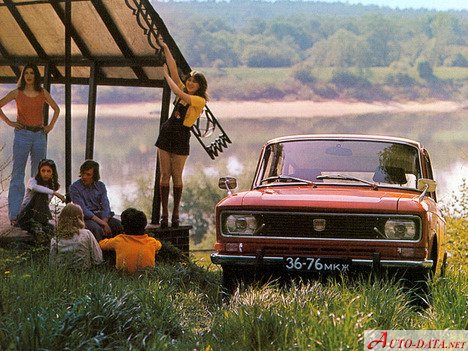
The Moskvich 2137 Combi was a station wagon produced by the Soviet automobile manufacturer AZLK (Avtozavod imeni Lenina, or Lenin Automotive Plant) from 1976 to 1987. Part of the larger Moskvich series, the 2137 Combi, often simply referred to as the “Kombi,” was designed to provide practical transportation for families and was a common sight on the roads of the Soviet Union and its satellite states. While never officially exported to the United States, the Moskvich represents a significant example of automotive engineering and design from the Eastern Bloc, reflecting the technological capabilities and priorities of the era. It filled a crucial niche in the Soviet market, offering a relatively affordable and spacious vehicle for everyday use.
Moskvich 2137 Combi: A Soviet Workhorse
The 2137 Combi was a direct derivative of the Moskvich 2137 sedan, sharing its core mechanical components. It was intended to address the demand for a more versatile vehicle capable of carrying both passengers and cargo. The “Combi” designation signified its station wagon body style, offering increased luggage capacity compared to the sedan. The vehicle’s design was heavily influenced by contemporary Western European models, particularly those from Simca and Opel, though adapted to Soviet manufacturing capabilities and material availability. The 2137 Combi was not simply a utilitarian vehicle; it represented a degree of modernization and aspiration within the Soviet automotive industry.
Engine & Performance
The Moskvich 2137 Combi was powered by a 1.5-liter (1479 cc) inline-four cylinder engine, designated the UZA M-412. This engine produced 75 horsepower at 5800 rpm and 108 Nm (79.66 lb-ft) of torque at 3800 rpm. While not a powerhouse, the engine provided adequate performance for the vehicle’s intended purpose. Power delivery was relatively smooth, though acceleration was modest, taking approximately 24 seconds to reach 100 km/h (62 mph) and 22.8 seconds to reach 60 mph. The engine featured a carburettor fuel injection system and a compression ratio of 8.8:1. The engine’s longitudinal front-engine layout and rear-wheel drive configuration were typical for vehicles of its era. The power-to-weight ratio was 14.9 kg/Hp, and the torque-to-weight ratio was 10.4 kg/Nm. Fuel economy was rated at 8.8 liters per 100 kilometers (26.7 US mpg) in urban conditions.
Design & Features
The Moskvich 2137 Combi featured a classic station wagon body style with five doors and seating for five passengers. Its design was characterized by relatively simple, functional lines. The vehicle’s exterior styling was typical of the 1970s and 80s, with a boxy silhouette and prominent chrome trim. Interior appointments were basic but functional, prioritizing durability and practicality over luxury. The dashboard featured a straightforward layout with essential gauges and controls. Safety features were limited by the standards of the time, typically including seatbelts and a basic braking system. The front suspension utilized coil springs, while the rear suspension employed leaf springs, a common configuration for vehicles designed to carry heavier loads. Brakes were disc on the front and drum on the rear. The vehicle’s 46-liter (12.15 US gal) fuel tank provided a reasonable driving range.
Technical Specifications
| Brand | Moskvich |
| Model | 2137 Kombi |
| Generation | 2137 Combi |
| Type (Engine) | 1.5 (75 Hp) |
| Start of production | 1976 |
| End of production | 1987 |
| Powertrain Architecture | Internal Combustion engine |
| Body type | Station wagon (estate) |
| Seats | 5 |
| Doors | 5 |
| Fuel consumption (urban) | 8.8 l/100 km (26.7 US mpg) |
| Fuel Type | Petrol (Gasoline) |
| Acceleration 0 – 100 km/h | 24 sec |
| Acceleration 0 – 62 mph | 24 sec |
| Acceleration 0 – 60 mph | 22.8 sec |
| Maximum speed | 135 km/h (83.89 mph) |
| Weight-to-power ratio | 14.9 kg/Hp |
| Weight-to-torque ratio | 10.4 kg/Nm |
| Power | 75 Hp @ 5800 rpm |
| Power per litre | 50.7 Hp/l |
| Torque | 108 Nm @ 3800 rpm (79.66 lb.-ft. @ 3800 rpm) |
| Engine layout | Front, Longitudinal |
| Engine Model/Code | UZA M-412 |
| Engine displacement | 1479 cm3 (90.25 cu. in.) |
| Number of cylinders | 4 |
| Engine configuration | Inline |
| Cylinder Bore | 82 mm (3.23 in.) |
| Piston Stroke | 70 mm (2.76 in.) |
| Compression ratio | 8.8:1 |
| Number of valves per cylinder | 2 |
| Fuel injection system | Carburettor |
| Engine aspiration | Naturally aspirated |
| Kerb Weight | 1120 kg (2469.18 lbs.) |
| Fuel tank capacity | 46 l (12.15 US gal | 10.12 UK gal) |
| Length | 4210 mm (165.75 in.) |
| Width | 1550 mm (61.02 in.) |
| Height | 1270 mm (50 in.) |
| Wheelbase | 2400 mm (94.49 in.) |
| Front track | 1270 mm (50 in.) |
| Rear track | 1270 mm (50 in.) |
| Drivetrain Architecture | Rear wheel drive |
| Number of gears | 5 gears, manual transmission |
| Front suspension | Coil spring |
| Rear suspension | Leaf spring |
| Front brakes | Disc |
| Rear brakes | Drum |
| Steering type | Worm-reduction unit |
| Tires size | 165/80 R13 |
The Moskvich 2137 Combi, while not a technologically advanced vehicle by Western standards, played a significant role in providing affordable and practical transportation to families in the Soviet Union and Eastern Europe. Its robust construction, relatively simple mechanics, and spacious interior made it a popular choice for everyday use. The 2137 Combi remains a nostalgic symbol of a bygone era, representing a unique chapter in automotive history.
