
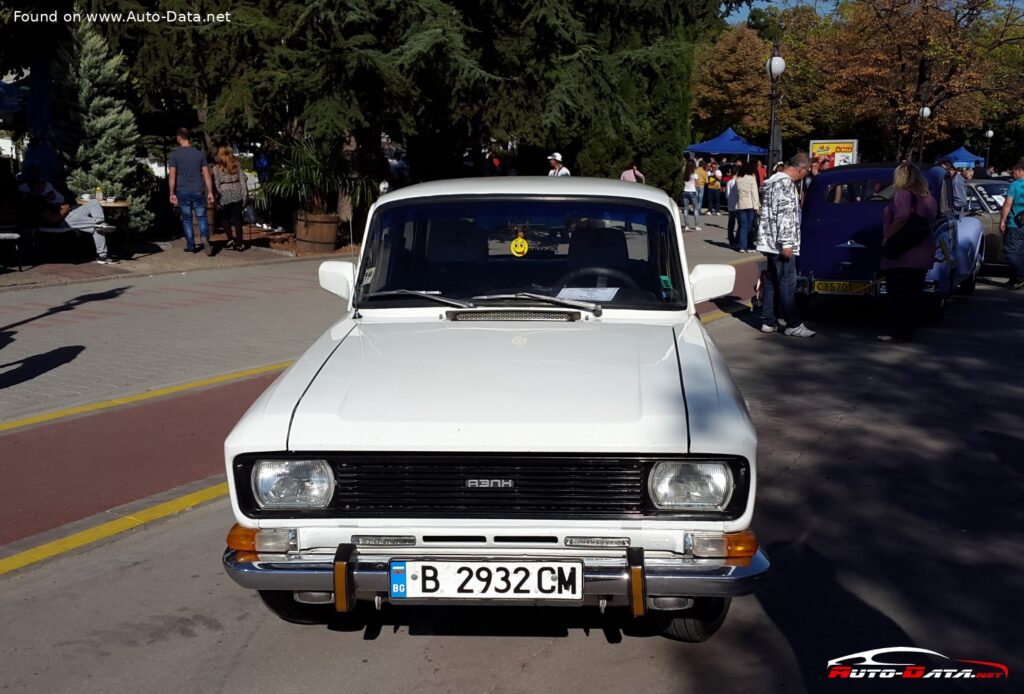
The Moskvich 21406 is a compact sedan produced by the Soviet automotive manufacturer AZLK (Avtozavod imeni Likhacheva) from 1978 to 1988. Representing a significant modernization of the earlier Moskvich 2140 series, the 21406 was intended to address shortcomings in comfort, reliability, and aesthetics. While never officially exported to the United States, the Moskvich held a prominent position in the Eastern European automotive market, serving as a practical and affordable transportation option for families and individuals in the Soviet Union and its satellite states. The 21406, powered by a 1.5-liter engine producing 68 horsepower, represents a snapshot of Soviet automotive engineering during the late Cold War era.
Moskvich 21406: A Soviet Automotive Staple
The Moskvich 21406 was part of a lineage of vehicles produced by AZLK, a factory originally established to build Opel models under license in the 1930s. Following World War II, and with increasing political isolation, Soviet automotive design began to diverge, incorporating indigenous engineering solutions and adapting existing designs. The 21406 was a direct evolution of the 2140, featuring updated styling, improved interior appointments, and a slightly more powerful engine. It was a common sight on the roads of the Soviet Union and Eastern Bloc countries, fulfilling a crucial role in personal transportation.
Engine & Performance
The Moskvich 21406 was equipped with an inline-four cylinder, naturally aspirated 1.5-liter (1479 cm3 or 90.25 cu. in.) gasoline engine. This engine produced 68 horsepower at 5800 rpm and 108 Nm (79.66 lb.-ft.) of torque at 3800 rpm. While modest by modern standards, this output was typical for vehicles in its class and market segment during the late 1970s and 1980s. The engine featured a carburetor fuel injection system and a compression ratio of approximately 8.5:1. Power delivery was relatively linear, but acceleration was slow, with a 0-60 mph time of around 18.1 seconds and a 0-100 km/h time of 19 seconds. The top speed was approximately 140 km/h (86.99 mph). The engine’s power-to-weight ratio was 15.9 kg/Hp, and the torque-to-weight ratio was 10 kg/Nm. The engine was longitudinally mounted at the front of the vehicle, driving the rear wheels.
Design & Features
The Moskvich 21406 was a four-door, five-seater sedan with a traditional body-on-frame construction. Its styling reflected the design trends of the era, with a boxy silhouette, prominent chrome trim, and relatively large windows. While not particularly aerodynamic, the design prioritized practicality and interior space. The interior was spartan but functional, featuring cloth upholstery, basic instrumentation, and limited amenities. Safety features were minimal by contemporary standards, consisting primarily of drum brakes on all four wheels and a basic steering system. The trunk offered a generous 600 liters (21.19 cu. ft.) of storage space. The vehicle’s suspension utilized a double wishbone setup at the front and a rigid axle suspension at the rear, providing a relatively comfortable ride on the often-poor road surfaces prevalent in its primary markets. The steering employed a worm-reduction unit.
Technical Specifications
| Brand | Moskvich |
| Model | 21406 |
| Generation | 21406 |
| Type (Engine) | 1.5 (68 Hp) |
| Start of production | 1978 |
| End of production | 1988 |
| Powertrain Architecture | Internal Combustion engine |
| Body type | Sedan |
| Seats | 5 |
| Doors | 4 |
| Fuel consumption (extra urban) | 7.4 l/100 km (31.8 US mpg, 38.2 UK mpg, 13.5 km/l) |
| Fuel consumption (combined) | 10.2 l/100 km (23.1 US mpg, 27.7 UK mpg, 9.8 km/l) |
| Fuel Type | Petrol (Gasoline) |
| Acceleration 0 – 100 km/h | 19 sec |
| Acceleration 0 – 62 mph | 19 sec |
| Acceleration 0 – 60 mph | 18.1 sec |
| Maximum speed | 140 km/h (86.99 mph) |
| Weight-to-power ratio | 15.9 kg/Hp, 63 Hp/tonne |
| Weight-to-torque ratio | 10 kg/Nm, 100 Nm/tonne |
| Power | 68 Hp @ 5800 rpm |
| Power per litre | 46 Hp/l |
| Torque | 108 Nm @ 3800 rpm (79.66 lb.-ft. @ 3800 rpm) |
| Engine layout | Front, Longitudinal |
| Engine displacement | 1479 cm3 (90.25 cu. in.) |
| Number of cylinders | 4 |
| Engine configuration | Inline |
| Cylinder Bore | 82 mm (3.23 in.) |
| Piston Stroke | 70 mm (2.76 in.) |
| Number of valves per cylinder | 2 |
| Fuel injection system | Carburettor |
| Engine aspiration | Naturally aspirated engine |
| Kerb Weight | 1080 kg (2380.99 lbs.) |
| Trunk (boot) space – minimum | 600 l (21.19 cu. ft.) |
| Fuel tank capacity | 46 l (12.15 US gal | 10.12 UK gal) |
| Length | 4250 mm (167.32 in.) |
| Width | 1550 mm (61.02 in.) |
| Height | 1480 mm (58.27 in.) |
| Wheelbase | 2400 mm (94.49 in.) |
| Front track | 1270 mm (50 in.) |
| Rear (Back) track | 1270 mm (50 in.) |
| Drivetrain Architecture | Rear wheel drive |
| Drive wheel | Rear wheel drive |
| Number of gears and type of gearbox | 4 gears, manual transmission |
| Front suspension | Double wishbone |
| Rear suspension | Rigid axle suspension |
| Front brakes | Drum |
| Rear brakes | Drum |
| Steering type | Worm-reduction unit |
| Tires size | 165/80 R13 |
The Moskvich 21406, while not a technological marvel, represented a significant step forward for Soviet automotive manufacturing. Its durability, affordability, and practicality made it a popular choice for drivers in the Eastern Bloc, and it remains a nostalgic symbol of a bygone era. Though never sold in the US market, understanding its design and engineering provides insight into the unique challenges and innovations of the Soviet automotive industry.
