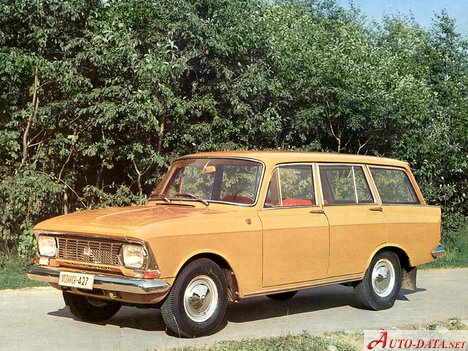
The Moskvich 427 is a Soviet-built station wagon that was produced from 1967 to 1975. Representing a significant step forward for the Soviet automotive industry, the 427 was intended to modernize personal transport options for the population. While not exported in large numbers to the West, the Moskvich 427 played a crucial role in providing a relatively affordable and practical vehicle within the Eastern Bloc and remains a notable example of Cold War-era automotive engineering. It was a popular choice for families and those needing a versatile vehicle for both urban and rural use.
Moskvich 427: A Soviet Station Wagon
The Moskvich 427 was part of a broader effort by the Soviet Union to increase automobile production and improve the quality of vehicles available to its citizens. It built upon the foundations laid by earlier Moskvich models, incorporating updated styling and mechanical components. The 427 was designed to be a robust and reliable vehicle, capable of withstanding the often-harsh road conditions prevalent in the Soviet Union. Its station wagon body style offered increased cargo capacity, making it a practical choice for a wide range of users.
Engine & Performance
The Moskvich 427 was powered by a 1.5-liter (1479 cm3 or 90.25 cu. in.) inline four-cylinder engine, designated the UZA M-412. This engine produced 75 horsepower at 5800 rpm and 108 Nm (79.66 lb.-ft.) of torque at 3800 rpm. While not a high-performance vehicle by Western standards, the engine provided adequate power for everyday driving. The engine featured a compression ratio of 8.8:1 and utilized a carburetor fuel injection system. The engine’s power per liter was 50.7 Hp/l. Power was delivered to the rear wheels via a four-speed manual transmission. The vehicle had a top speed of 130 km/h (80.78 mph). The weight-to-power ratio was 14.2 kg/Hp, and the weight-to-torque ratio was 9.9 kg/Nm.
Design & Features
The Moskvich 427 featured a classic station wagon (estate) body style with five doors and seating for five passengers. Its design was influenced by contemporary Western European vehicles, although it retained a distinctly Soviet aesthetic. The vehicle’s exterior was characterized by its relatively simple lines and functional design. Inside, the 427 offered a basic but practical interior. The dashboard was straightforward, with essential gauges and controls. The focus was on durability and ease of maintenance rather than luxury or advanced features. The front suspension utilized coil springs, while the rear suspension employed leaf springs – a common configuration for vehicles of this era. Braking was provided by disc brakes on the front wheels and drum brakes on the rear. The steering system was a worm-reduction unit. The vehicle’s tires were sized 165/80 R13.
Technical Specifications
| Brand | Moskvich |
| Model | 427 |
| Generation | 427 |
| Type (Engine) | 1.5 (75 Hp) |
| Start of production | 1967 |
| End of production | 1975 |
| Powertrain Architecture | Internal Combustion engine |
| Body type | Station wagon (estate) |
| Seats | 5 |
| Doors | 5 |
| Fuel consumption (extra urban) | 8.8 l/100 km (26.7 US mpg, 32.1 UK mpg, 11.4 km/l) |
| Fuel consumption (combined) | 10 l/100 km (23.5 US mpg, 28.2 UK mpg, 10 km/l) |
| Fuel Type | Petrol (Gasoline) |
| Maximum speed | 130 km/h (80.78 mph) |
| Weight-to-power ratio | 14.2 kg/Hp |
| Weight-to-torque ratio | 9.9 kg/Nm |
| Power | 75 Hp @ 5800 rpm |
| Power per litre | 50.7 Hp/l |
| Torque | 108 Nm @ 3800 rpm (79.66 lb.-ft. @ 3800 rpm) |
| Engine layout | Front, Longitudinal |
| Engine Model/Code | UZA M-412 |
| Engine displacement | 1479 cm3 (90.25 cu. in.) |
| Number of cylinders | 4 |
| Engine configuration | Inline |
| Cylinder Bore | 82 mm (3.23 in.) |
| Piston Stroke | 70 mm (2.76 in.) |
| Compression ratio | 8.8:1 |
| Number of valves per cylinder | 2 |
| Fuel injection system | Carburettor |
| Engine aspiration | Naturally aspirated engine |
| Kerb Weight | 1065 kg (2347.92 lbs.) |
| Fuel tank capacity | 46 l (12.15 US gal | 10.12 UK gal) |
| Length | 4090 mm (161.02 in.) |
| Width | 1550 mm (61.02 in.) |
| Height | 1485 mm (58.46 in.) |
| Wheelbase | 2400 mm (94.49 in.) |
| Front track | 1247 mm (49.09 in.) |
| Rear track | 1237 mm (48.7 in.) |
| Minimum turning circle | 10.5 m (34.45 ft.) |
| Drivetrain Architecture | Rear wheel drive, Internal Combustion engine |
| Drive wheel | Rear wheel drive |
| Number of gears and type of gearbox | 4 gears, manual transmission |
| Front suspension | Coil spring |
| Rear suspension | Leaf spring |
| Front brakes | Disc |
| Rear brakes | Drum |
| Steering type | Worm-reduction unit |
| Tires size | 165/80 R13 |
The Moskvich 427, while not a technologically advanced vehicle, represented a significant achievement for the Soviet automotive industry. It provided a practical and relatively affordable transportation solution for families and individuals during a period of limited consumer choice. Today, the 427 is a sought-after classic car among collectors and enthusiasts, offering a glimpse into a bygone era of automotive history.