
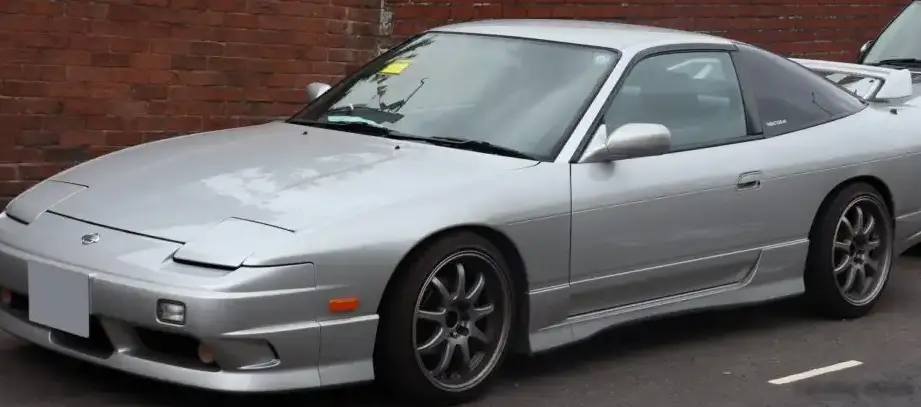
The Nissan 180SX, produced between 1989 and 1998, was a compact, rear-wheel-drive sports coupe designed to offer an affordable and engaging driving experience. Positioned as a successor to the Nissan Skyline RS, the 180SX aimed to capture the spirit of traditional Japanese sports cars while offering modern styling and technology. The 1.8-liter turbocharged variant, producing 169 horsepower, represented a key offering within the 180SX lineup, balancing performance with relative affordability and accessibility. It was primarily marketed towards younger enthusiasts seeking a customizable and capable platform for spirited driving and drifting, particularly within the Japanese domestic market (JDM).
Technical Specifications
| Brand | Nissan |
| Model | 180 SX |
| Generation | 180 SX |
| Type (Engine) | 1.8 turbo (169 Hp) |
| Start of production | 1989 year |
| End of production | 1998 year |
| Powertrain Architecture | Internal Combustion engine |
| Body type | Coupe |
| Seats | 4 |
| Doors | 3 |
| Fuel Type | Petrol (Gasoline) |
| Power | 169 Hp @ 6400 rpm |
| Power per litre | 93.4 Hp/l |
| Torque | 224 Nm @ 4000 rpm |
| Torque (lb-ft) | 165.21 lb.-ft. @ 4000 rpm |
| Engine layout | Front, Longitudinal |
| Engine Model/Code | CA18DET |
| Engine displacement | 1809 cm3 |
| Engine displacement (cu. in.) | 110.39 cu. in. |
| Number of cylinders | 4 |
| Engine configuration | Inline |
| Cylinder Bore | 83 mm |
| Cylinder Bore (in.) | 3.27 in. |
| Piston Stroke | 83.6 mm |
| Piston Stroke (in.) | 3.29 in. |
| Compression ratio | 8.5:1 |
| Number of valves per cylinder | 4 |
| Fuel injection system | Multi-port manifold injection |
| Engine aspiration | Turbocharger |
| Valvetrain | DOHC |
| Engine oil capacity | 3.7 l |
| Engine oil capacity (US qt) | 3.91 US qt |
| Engine oil capacity (UK qt) | 3.26 UK qt |
| Fuel tank capacity | 60 l |
| Fuel tank capacity (US gal) | 15.85 US gal |
| Fuel tank capacity (UK gal) | 13.2 UK gal |
| Length | 4520 mm |
| Length (in.) | 177.95 in. |
| Width | 1695 mm |
| Width (in.) | 66.73 in. |
| Height | 1290 mm |
| Height (in.) | 50.79 in. |
| Wheelbase | 2475 mm |
| Wheelbase (in.) | 97.44 in. |
| Minimum turning circle | 9.4 m |
| Minimum turning circle (ft) | 30.84 ft |
| Drivetrain Architecture | Rear wheel drive |
| Number of gears | 5 |
| Gearbox type | Manual transmission |
| Front suspension | Spring Strut |
| Rear suspension | Spring Strut |
| Front brakes | Ventilated discs |
| Rear brakes | Disc |
| Assisting systems | ABS (Anti-lock braking system) |
| Power steering | Hydraulic Steering |
Powertrain & Engine Architecture
The heart of the 180SX 1.8 turbo was the CA18DET engine, a 1.8-liter inline-four cylinder powerplant. This engine featured a cast iron block and an aluminum cylinder head, incorporating a single overhead camshaft (SOHC) design for each bank of cylinders (DOHC). The CA18DET utilized a Garrett CT20 turbocharger, intercooled to reduce intake air temperatures and improve efficiency. Fuel delivery was managed by a multi-port fuel injection system, providing precise fuel metering for optimal combustion. The engine’s 8.5:1 compression ratio was a compromise between performance and reliability, allowing for the use of readily available gasoline grades. The five-speed manual transmission was the standard offering, providing direct engagement and control for the driver. The transmission featured a rear-wheel-drive configuration, contributing to the car’s balanced handling characteristics.
Driving Characteristics
The 169 horsepower and 165 lb-ft of torque produced by the CA18DET engine provided the 180SX with respectable acceleration and a lively driving experience. While not as potent as the higher-spec 200SX models with the SR20DET engine, the 1.8 turbo offered a more accessible entry point into the world of rear-wheel-drive sports cars. The turbocharger provided a noticeable boost in power during mid-range acceleration, making it well-suited for both street driving and spirited canyon runs. The five-speed manual transmission allowed drivers to fully exploit the engine’s powerband, while the rear-wheel-drive layout contributed to a neutral and predictable handling balance. Compared to the SR20DET-powered variants, the CA18DET offered a slightly more linear power delivery, making it more forgiving for less experienced drivers. However, it lacked the ultimate performance potential of the larger engine.
Equipment & Trim Levels
The 180SX 1.8 turbo typically came equipped with a relatively basic, yet functional interior. Standard features included cloth upholstery, power windows, and a basic audio system. Air conditioning was often an optional extra. The dashboard layout was straightforward and driver-focused, with clearly marked gauges and controls. Higher trim levels, when available, might have included features such as upgraded audio systems, power mirrors, and more premium interior materials. The focus of the 180SX was on providing a pure driving experience, rather than luxurious amenities.
Chassis & Braking
The 180SX featured a MacPherson strut suspension system at both the front and rear, providing a good balance of ride comfort and handling performance. The front suspension incorporated coil springs and stabilizer bar, while the rear suspension utilized coil springs and a trailing arm design. Braking duties were handled by ventilated discs at the front and solid discs at the rear. Anti-lock braking system (ABS) was available as an option, enhancing braking performance and stability. The chassis was relatively lightweight, contributing to the car’s nimble handling characteristics. The rear-wheel-drive layout and well-tuned suspension made the 180SX a popular choice for drifting enthusiasts.
Market Reception & Comparison
The Nissan 180SX 1.8 turbo was generally well-received by automotive critics and enthusiasts alike. It was praised for its engaging driving dynamics, affordable price point, and potential for customization. Compared to other sports coupes of its era, such as the Mazda MX-5 Miata, the 180SX offered a more powerful engine and a rear-wheel-drive layout. However, it lacked the Miata’s refined handling and open-top experience. Within the 180SX lineup, the 1.8 turbo variant represented a good compromise between performance and affordability, appealing to a wider range of buyers than the more expensive and powerful 200SX models. Fuel economy was reasonable for a turbocharged sports car, and reliability was generally good, although the turbocharger could require maintenance over time.
Legacy
The Nissan 180SX has developed a strong following among car enthusiasts, particularly in the drifting community. Its rear-wheel-drive layout, lightweight chassis, and readily available turbocharged engine make it an ideal platform for drifting. Today, well-maintained examples of the 180SX 1.8 turbo are becoming increasingly collectible. The CA18DET engine, while not as highly regarded as the SR20DET, is still considered a capable and reliable powerplant. Parts availability can be a challenge, but a thriving aftermarket supports the 180SX, offering a wide range of performance upgrades and customization options. The 180SX remains a testament to Nissan’s commitment to producing affordable and engaging sports cars.
