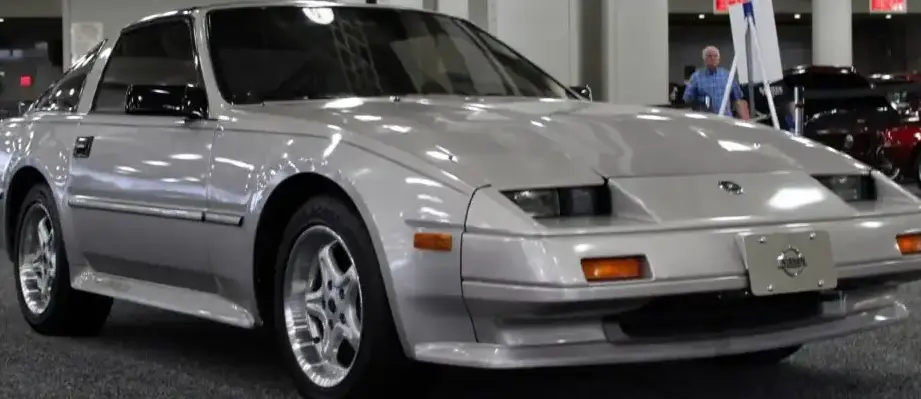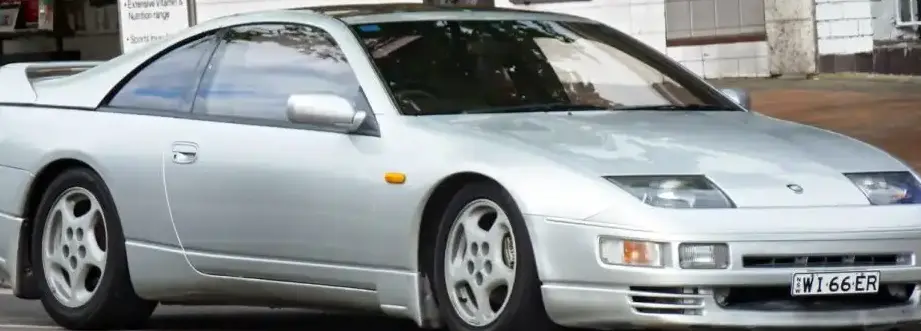
The Nissan 300ZX (Z32) 3.0 Twin Turbo Automatic, produced from 1990 to 1995, represents the pinnacle of Nissan’s sports car engineering during that era. Positioned as the flagship variant of the Z32 generation, it offered a significant performance upgrade over the naturally aspirated and single-turbo models. The Z32 was the last iteration of the Z-car until the 350Z arrived in 2002, and the twin-turbo automatic model was the most expensive and technologically advanced offering. It aimed to compete directly with established grand tourers from Porsche and Mazda, offering a blend of performance, luxury, and advanced technology for the American market, where it found its largest customer base.
Technical Specifications
| Brand | Nissan |
| Model | 300 ZX |
| Generation | 300 ZX (Z32) |
| Type (Engine) | 3.0 Twin Turbo (283 Hp) Automatic |
| Start of production | 1990 year |
| End of production | 1995 year |
| Powertrain Architecture | Internal Combustion engine |
| Body type | Coupe |
| Seats | 4 |
| Doors | 2 |
| Fuel consumption (economy) – combined | 11.2 l/100 km |
| Fuel consumption (economy) – combined | 21 US mpg |
| Fuel consumption (economy) – combined | 25.2 UK mpg |
| Fuel consumption (economy) – combined | 8.9 km/l |
| Fuel Type | Petrol (Gasoline) |
| Acceleration 0 – 100 km/h | 5.9 sec |
| Acceleration 0 – 62 mph | 5.9 sec |
| Acceleration 0 – 60 mph | 5.6 sec |
| Maximum speed | 250 km/h |
| Maximum speed | 155.34 mph |
| Weight-to-power ratio | 5.8 kg/Hp |
| Weight-to-power ratio | 172.1 Hp/tonne |
| Weight-to-torque ratio | 4.4 kg/Nm |
| Weight-to-torque ratio | 228.1 Nm/tonne |
| Power | 283 Hp @ 6400 rpm |
| Power per litre | 95.6 Hp/l |
| Torque | 375 Nm @ 3600 rpm |
| Torque | 276.59 lb.-ft. @ 3600 rpm |
| Engine layout | Front, Longitudinal |
| Engine Model/Code | VG30DETT |
| Engine displacement | 2960 cm3 |
| Engine displacement | 180.63 cu. in. |
| Number of cylinders | 6 |
| Engine configuration | V-engine |
| Cylinder Bore | 87 mm |
| Cylinder Bore | 3.43 in. |
| Piston Stroke | 83 mm |
| Piston Stroke | 3.27 in. |
| Compression ratio | 8.5:1 |
| Number of valves per cylinder | 4 |
| Fuel injection system | Multi-port manifold injection |
| Engine aspiration | Turbocharger |
| Valvetrain | DOHC |
| Engine oil capacity | 3.4 l |
| Engine oil capacity | 3.59 US qt | 2.99 UK qt |
| Coolant | 9 l |
| Coolant | 9.51 US qt | 7.92 UK qt |
| Kerb Weight | 1644 kg |
| Kerb Weight | 3624.4 lbs. |
| Max. weight | 2015 kg |
| Max. weight | 4442.31 lbs. |
| Max load | 371 kg |
| Max load | 817.91 lbs. |
| Trunk (boot) space – minimum | 326 l |
| Trunk (boot) space – minimum | 11.51 cu. ft. |
| Fuel tank capacity | 70 l |
| Fuel tank capacity | 18.49 US gal | 15.4 UK gal |
| Length | 4520 mm |
| Length | 177.95 in. |
| Width | 1800 mm |
| Width | 70.87 in. |
| Height | 1255 mm |
| Height | 49.41 in. |
| Wheelbase | 2570 mm |
| Wheelbase | 101.18 in. |
| Front track | 1495 mm |
| Front track | 58.86 in. |
| Rear (Back) track | 1555 mm |
| Rear (Back) track | 61.22 in. |
| Drivetrain Architecture | The Internal combustion engine (ICE) drives the rear wheels of the vehicle. |
| Drive wheel | Rear wheel drive |
| Number of gears and type of gearbox | 4 gears, automatic transmission |
| Front suspension | Wishbone |
| Rear suspension | Spring Strut |
| Front brakes | Ventilated discs |
| Rear brakes | Ventilated discs |
| Assisting systems | ABS (Anti-lock braking system) |
| Steering type | Steering rack and pinion |
| Power steering | Hydraulic Steering |
| Tires size | 225/50 R16; 245/45 R16 |
| Wheel rims size | 16 |
Powertrain & Engine Architecture
The heart of the 300ZX Twin Turbo Automatic is the VG30DETT 3.0-liter V6 engine. This engine featured dual Garrett T25 turbochargers, intercoolers, and a sophisticated electronically controlled boost system. The VG30DETT utilized multi-port fuel injection and a double overhead camshaft (DOHC) valvetrain with four valves per cylinder. The engine code ‘DETT’ signifies ‘Dual Exhaust Turbocharged’. The automatic transmission was a 4-speed unit, specifically designed to handle the engine’s substantial torque output. While not as quick as the 5-speed manual, the automatic offered a more relaxed driving experience, appealing to buyers prioritizing comfort and ease of use. The transmission featured electronically controlled lock-up torque converter for improved fuel efficiency at highway speeds.
Driving Characteristics
The 300ZX Twin Turbo Automatic delivered impressive performance for its time. Acceleration from 0-60 mph was consistently achieved in around 5.6 to 5.9 seconds, and it could reach a top speed of 155 mph. However, the automatic transmission did introduce a slight delay in response compared to the manual version. The gear ratios were tuned for a balance between acceleration and cruising comfort. Turbo lag was present, but the sequential turbo system minimized it, providing a more linear power delivery than single-turbo setups. The car felt planted and stable at high speeds, thanks to its well-tuned suspension and relatively low center of gravity.
Equipment & Trim Levels
The Twin Turbo Automatic typically came standard with leather upholstery, power-adjustable seats, air conditioning, a premium sound system, and power windows and locks. Optional extras included a Bose stereo system, sunroof, and electronically adjustable dampers. The interior was designed with a driver-focused layout, featuring analog gauges and a comprehensive digital display providing information on engine parameters, vehicle speed, and other vital data. The automatic transmission models often featured woodgrain trim accents, enhancing the luxurious feel of the cabin.
Chassis & Braking
The Z32 chassis was a monocoque construction, utilizing a combination of steel and aluminum to achieve a balance of rigidity and weight savings. The suspension featured independent wishbone suspension in the front and a multi-link setup in the rear. The Twin Turbo models were equipped with larger brakes than the base models, featuring ventilated discs on all four wheels and an Anti-lock Braking System (ABS) as standard. The steering was a rack-and-pinion system with hydraulic power assistance, providing precise and responsive handling.
Market Reception & Comparison
The 300ZX Twin Turbo Automatic received generally positive reviews from automotive critics. It was praised for its performance, handling, and advanced technology. However, some critics noted the slight performance disadvantage compared to the manual transmission version. Compared to the naturally aspirated and single-turbo models, the Twin Turbo offered a significant performance boost, but at a higher price point. It competed directly with the Mazda RX-7 Turbo and Porsche 944 Turbo, offering a compelling alternative with its blend of performance, luxury, and reliability.
Legacy
The Nissan 300ZX Twin Turbo Automatic has become a highly sought-after collector’s car. The VG30DETT engine, while complex, is generally considered reliable when properly maintained. However, the turbochargers and associated components require regular inspection and potential replacement over time. The automatic transmission, while durable, can be expensive to repair if issues arise. Today, well-maintained examples command premium prices in the used car market, reflecting the car’s iconic status and enduring appeal. The Z32, and particularly the Twin Turbo Automatic, represents a high point in Japanese sports car engineering, and a testament to Nissan’s commitment to innovation and performance.