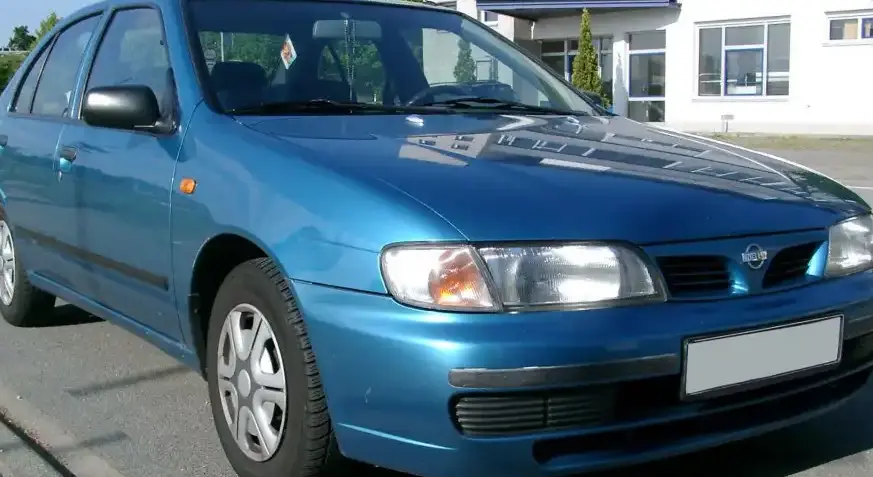
Technical Specifications
| Brand | Nissan |
| Model | Almera |
| Generation | Almera I (N15) |
| Type (Engine) | 1.6 (99 Hp) |
| Start of production | 1995 |
| End of production | 2000 |
| Powertrain Architecture | Internal Combustion engine |
| Body type | Sedan |
| Seats | 5 |
| Doors | 4 |
| Fuel consumption (urban) | 9.3 l/100 km (25.3 US mpg) |
| Fuel consumption (extra urban) | 6.1 l/100 km (38.6 US mpg) |
| Fuel Type | Petrol (Gasoline) |
| Acceleration 0 – 100 km/h | 11 sec |
| Acceleration 0 – 62 mph | 11 sec |
| Acceleration 0 – 60 mph | 10.5 sec |
| Maximum speed | 180 km/h (111.85 mph) |
| Weight-to-power ratio | 10.9 kg/Hp |
| Weight-to-torque ratio | 7.9 kg/Nm |
| Power | 99 Hp @ 6000 rpm |
| Power per litre | 62 Hp/l |
| Torque | 136 Nm @ 4000 rpm (100.31 lb.-ft. @ 4000 rpm) |
| Engine layout | Front, Transverse |
| Engine Model/Code | GA16DE |
| Engine displacement | 1597 cm3 (97.45 cu. in.) |
| Number of cylinders | 4 |
| Engine configuration | Inline |
| Cylinder Bore | 76 mm (2.99 in.) |
| Piston Stroke | 88 mm (3.46 in.) |
| Compression ratio | 9.8:1 |
| Number of valves per cylinder | 4 |
| Fuel injection system | Multi-port manifold injection |
| Engine aspiration | Naturally aspirated engine |
| Valvetrain | DOHC |
| Engine oil capacity | 3.2 l (3.38 US qt | 2.82 UK qt) |
| Coolant capacity | 5.9 l (6.23 US qt | 5.19 UK qt) |
| Kerb Weight | 1080 kg (2380.99 lbs.) |
| Max. weight | 1595 kg (3516.37 lbs.) |
| Max load | 515 kg (1135.38 lbs.) |
| Trunk (boot) space – minimum | 440 l (15.54 cu. ft.) |
| Fuel tank capacity | 50 l (13.21 US gal | 11 UK gal) |
| Length | 4320 mm (170.08 in.) |
| Width | 1690 mm (66.54 in.) |
| Height | 1395 mm (54.92 in.) |
| Wheelbase | 2535 mm (99.8 in.) |
| Front track | 1470 mm (57.87 in.) |
| Rear (Back) track | 1435 mm (56.5 in.) |
| Drivetrain Architecture | Front wheel drive |
| Number of gears and type of gearbox | 5 gears, manual transmission |
| Front suspension | Wishbone |
| Rear suspension | Rigid axle suspension |
| Front brakes | Ventilated discs |
| Rear brakes | Drum |
| Assisting systems | ABS (Anti-lock braking system) |
| Steering type | Steering rack and pinion |
| Power steering | Hydraulic Steering |
| Tires size | 175/65 R14 |
The Nissan Almera I (N15) 1.6, produced between 1995 and 2000, was a significant model in Nissan’s lineup, designed to compete in the increasingly popular compact car segment. Based on the Nissan B platform – also used for the Pulsar and Sentra – the N15 Almera aimed to provide a practical and spacious interior within a relatively compact footprint. The 1.6-liter engine, producing 99 horsepower, was a popular choice for buyers prioritizing fuel efficiency and affordability. This variant occupied a middle ground in the Almera range, offering an upgrade over the base 1.4L engine while remaining more accessible than the sportier 1.6 SR or the larger 2.0L options.
Powertrain & Engine Architecture
At the heart of the Almera I 1.6 is the GA16DE engine, a 1.6-liter inline-four cylinder gasoline engine. This engine features a single overhead camshaft (SOHC) design, though some later iterations incorporated dual overhead camshafts (DOHC). The GA16DE utilizes multi-point fuel injection, delivering fuel directly to each intake port to optimize combustion efficiency. Its 9.8:1 compression ratio contributed to a balance between power output and fuel economy. The engine’s 99 horsepower and 136 Nm (100 lb-ft) of torque were sufficient for everyday driving needs, but didn’t offer particularly sporty performance. While typically paired with a five-speed manual transmission, a four-speed automatic transmission was also available, and is the focus of this discussion. The automatic transmission, while offering convenience, resulted in a slight reduction in both acceleration and fuel economy compared to the manual version. It employed standard torque converter technology and was engineered for smooth and dependable operation.
Driving Characteristics
The Almera I 1.6 equipped with the automatic transmission delivered a comfortable, though not particularly exhilarating, driving experience. Acceleration from 0-60 mph took approximately 10.5 to 11 seconds, placing it in line with other compact cars of the era. The automatic transmission’s gear ratios were optimized for fuel efficiency rather than outright performance, resulting in a somewhat relaxed pace. The engine felt somewhat strained during more aggressive acceleration, and overtaking required careful consideration. However, for typical city and highway driving, the powertrain provided adequate power. The steering was light and responsive, making it easy to maneuver in urban environments. The suspension, while not overly sophisticated, offered a reasonably comfortable ride, effectively absorbing most road imperfections.
Equipment & Trim Levels
The 1.6L Almera generally came with a basic level of standard equipment. Base models included power steering, central locking, and electric front windows. Higher trim levels, such as the SE or S, added features like alloy wheels, air conditioning, an upgraded stereo system, and enhanced interior trim. Interior upholstery was typically cloth, with a simple and functional dashboard layout. Optional extras included a sunroof, rear electric windows, and more sophisticated audio systems. The automatic transmission was often bundled with certain convenience features, making it a slightly more premium offering than the base manual model.
Chassis & Braking
The Almera I utilized a front-wheel-drive layout with a MacPherson strut front suspension and a torsion beam rear suspension. This configuration provided a good compromise between ride comfort and handling characteristics. Braking was handled by ventilated discs on the front wheels and drum brakes on the rear. Anti-lock Braking System (ABS) was available as an optional feature, enhancing safety by preventing wheel lockup during hard braking. The chassis was relatively lightweight, contributing to the car’s overall fuel efficiency. Stabilizer bars were fitted to both the front and rear axles to minimize body roll during cornering maneuvers.
Market Reception & Comparison
The Nissan Almera I 1.6 Automatic was generally well-received by automotive critics as a practical and reliable family car. It was praised for its spacious interior, comfortable ride quality, and respectable fuel efficiency. However, it was often criticized for its uninspired performance and somewhat unremarkable styling. Compared to other trims within the Almera lineup, the 1.6 Automatic offered a balance between performance and economy. The manual transmission version of the 1.6 provided slightly improved acceleration and fuel economy, while the 2.0L models delivered significantly more power but at a higher price point. When compared to competitors like the Ford Focus, Volkswagen Golf, and Opel/Vauxhall Astra, the Almera I 1.6 offered a competitive package, particularly in terms of value for money.
Legacy
The GA16DE engine, powering the Almera I 1.6, is renowned for its durability and reliability. With consistent and proper maintenance, these engines can reliably exceed 200,000 miles. The automatic transmission, while not as robust as some other units, is also generally considered dependable. Today, the Almera I 1.6 Automatic represents an affordable option in the used car market, appealing to buyers seeking a simple and trustworthy mode of transportation. Parts availability remains generally good, and maintenance costs are relatively low. While it may not offer the excitement of more contemporary vehicles, the Almera I 1.6 stands as a testament to Nissan’s commitment to producing practical and reliable automobiles.