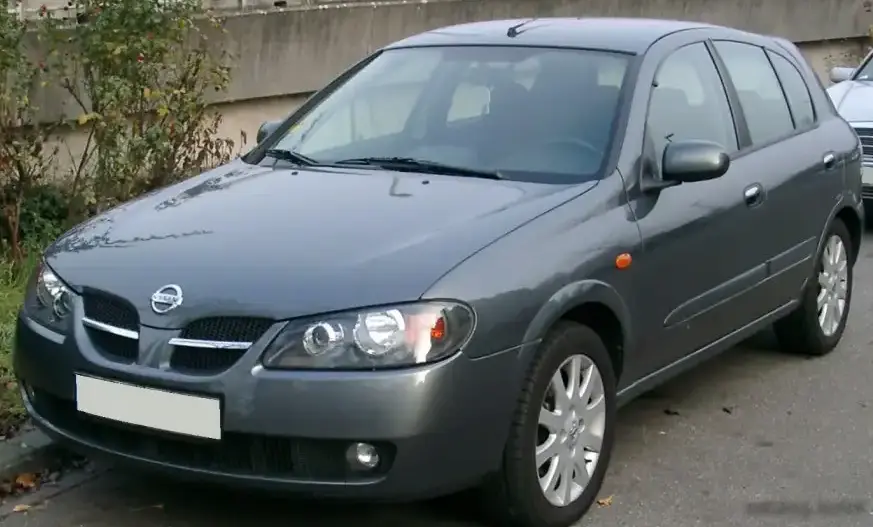
Technical Specifications
| Brand | Nissan |
| Model | Almera |
| Generation | Almera II Hatchback (N16, facelift 2003) |
| Type (Engine) | 1.5 16V (98 Hp) |
| Start of production | 2003 |
| End of production | 2006 |
| Powertrain Architecture | Internal Combustion engine |
| Body type | Hatchback |
| Seats | 5 |
| Doors | 3/5 |
| Fuel consumption (urban) | 8.6 l/100 km (27.4 US mpg, 32.8 UK mpg, 11.6 km/l) |
| Fuel consumption (extra urban) | 5.5 l/100 km (42.8 US mpg, 51.4 UK mpg, 18.2 km/l) |
| Fuel consumption (combined) | 6.6 l/100 km (35.6 US mpg, 42.8 UK mpg, 15.2 km/l) |
| Fuel Type | Petrol (Gasoline) |
| Acceleration 0 – 100 km/h | 13.1 sec |
| Acceleration 0 – 62 mph | 13.1 sec |
| Acceleration 0 – 60 mph | 12.4 sec |
| Maximum speed | 177 km/h (109.98 mph) |
| Weight-to-power ratio | 11.3 kg/Hp, 88.3 Hp/tonne |
| Weight-to-torque ratio | 8.2 kg/Nm, 122.5 Nm/tonne |
| Power | 98 Hp @ 6000 rpm |
| Power per litre | 65.5 Hp/l |
| Torque | 136 Nm @ 4000 rpm (100.31 lb.-ft. @ 4000 rpm) |
| Engine layout | Front, Transverse |
| Engine Model/Code | QG15DE |
| Engine displacement | 1497 cm3 (91.35 cu. in.) |
| Number of cylinders | 4 |
| Engine configuration | Inline |
| Cylinder Bore | 73.6 mm (2.9 in.) |
| Piston Stroke | 88 mm (3.46 in.) |
| Compression ratio | 9.9:1 |
| Number of valves per cylinder | 4 |
| Fuel injection system | Multi-port manifold injection |
| Engine aspiration | Naturally aspirated engine |
| Valvetrain | DOHC |
| Engine oil capacity | 2.9 l (3.06 US qt | 2.55 UK qt) |
| Coolant capacity | 6.7 l (7.08 US qt | 5.9 UK qt) |
| Kerb Weight | 1110 kg (2447.13 lbs.) |
| Max. weight | 1710 kg (3769.9 lbs.) |
| Max load | 600 kg (1322.77 lbs.) |
| Trunk (boot) space – minimum | 355 l (12.54 cu. ft.) |
| Trunk (boot) space – maximum | 1020 l (36.02 cu. ft.) |
| Fuel tank capacity | 60 l (15.85 US gal | 13.2 UK gal) |
| Length | 4184 mm (164.72 in.) |
| Width | 1706 mm (67.17 in.) |
| Height | 1448 mm (57.01 in.) |
| Wheelbase | 2535 mm (99.8 in.) |
| Front track | 1470 mm (57.87 in.) |
| Rear (Back) track | 1455 mm (57.28 in.) |
| Ride height (ground clearance) | 140 mm (5.51 in.) |
| Drivetrain Architecture | Front wheel drive |
| Drive wheel | Front wheel drive |
| Number of gears and type of gearbox | 5 gears, manual transmission |
| Front suspension | Spring Strut |
| Rear suspension | Rigid axle suspension |
| Front brakes | Ventilated discs |
| Rear brakes | Disc |
| Assisting systems | ABS (Anti-lock braking system) |
| Steering type | Steering rack and pinion |
| Power steering | Hydraulic Steering |
| Tires size | 185/65 R15 |
| Wheel rims size | 15 |
The Nissan Almera II, specifically the N16 series hatchback produced from 2003 to 2006, represented Nissan’s entry into the competitive European compact hatchback segment. The 1.5 16V variant, producing 98 horsepower, was a key model within the Almera II range, positioned as an affordable and economical option for buyers prioritizing fuel efficiency and practicality over outright performance. This facelifted version of the N16, introduced in 2003, featured subtle styling revisions and refinements to the interior compared to the earlier models. It aimed to appeal to a broad customer base seeking a reliable and reasonably priced family car.
Powertrain & Engine Architecture
The heart of the Almera II 1.5 16V is the QG15DE engine, a 1.5-liter inline-four cylinder gasoline engine. This engine is part of Nissan’s QG series, known for its relatively simple design and focus on reliability. The ‘DE’ designation indicates Nissan’s Dual Elevator variable valve timing system, which optimizes valve timing for improved fuel efficiency and low-end torque. The QG15DE utilizes multi-point fuel injection, delivering fuel directly to each intake port. The engine’s 16-valve configuration (four valves per cylinder) contributes to its breathing efficiency. The 5-speed manual transmission was the standard offering, providing a balance between fuel economy and driver control. The transmission’s gear ratios were tuned for everyday driving, prioritizing smooth shifts and reasonable acceleration rather than sporty performance.
Driving Characteristics
The 98 horsepower output of the 1.5L engine translates to modest, but adequate, performance. Acceleration from 0-60 mph takes around 12.4 seconds, and the top speed is approximately 109.98 mph. In real-world driving, the Almera II 1.5 feels best suited to urban and suburban environments. The engine provides sufficient power for merging onto highways and overtaking slower traffic, but it requires downshifting for more spirited maneuvers. Compared to higher-output versions of the Almera II, such as those equipped with the 1.8L engine, the 1.5L feels noticeably less responsive. However, the 1.5L’s lighter weight and more economical engine contribute to better fuel economy. The manual transmission offers a more engaging driving experience than the optional automatic, allowing for greater control over the engine’s power band.
Equipment & Trim Levels
The Almera II 1.5 16V typically came equipped with a reasonable level of standard features. These included power steering, central locking, electric front windows, and an adjustable steering column. Air conditioning was often an optional extra. Interior upholstery was typically cloth, with a functional and durable design. Higher trim levels offered upgrades such as alloy wheels, a CD player, and more premium interior materials. The dashboard layout was straightforward and easy to use, prioritizing practicality over aesthetic flair.
Chassis & Braking
The Almera II’s chassis utilizes a MacPherson strut front suspension and a rigid axle rear suspension. This setup provides a comfortable ride quality, although it doesn’t offer the same level of handling precision as more sophisticated suspension designs. The front brakes are ventilated discs, providing adequate stopping power, while the rear brakes are discs. Anti-lock Braking System (ABS) was standard, enhancing safety by preventing wheel lockup during hard braking. The steering is rack and pinion, offering a reasonably direct feel.
Market Reception & Comparison
The Nissan Almera II 1.5 16V was generally well-received as a practical and affordable family car. Critics praised its fuel efficiency and reliability, but noted its lack of outright performance. Compared to rivals such as the Ford Focus and Volkswagen Golf, the Almera II offered a more budget-friendly option, but lacked the same level of refinement and driving dynamics. The 1.8L Almera II offered a noticeable performance upgrade, but at a higher price point. The 1.5L model appealed to buyers prioritizing economy and practicality, while the 1.8L catered to those seeking a more engaging driving experience.
Legacy
The QG15DE engine, found in the Almera II 1.5, is known for its durability and relatively low maintenance costs. While not a particularly exciting engine, it has proven to be a reliable workhorse. Today, used examples of the Almera II 1.5 are readily available and often represent a very affordable entry point into car ownership. Common issues are generally limited to age-related wear and tear, such as suspension components and exhaust systems. The Almera II 1.5 remains a popular choice for budget-conscious buyers seeking a dependable and economical hatchback.