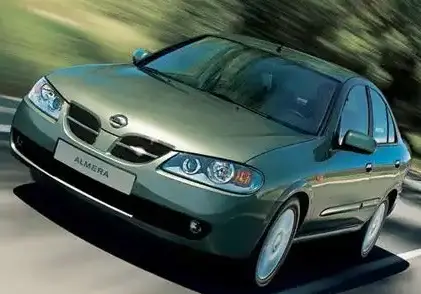
The Nissan Almera II, specifically the N16 series produced from 2003 to 2006, represented Nissan’s entry into the compact sedan market in Europe and several other international markets. The 1.5 16V variant, producing 98 horsepower, was a key model within the Almera II range, positioned as an affordable and economical option for buyers prioritizing fuel efficiency and practicality over outright performance. This facelifted version of the N16, introduced in 2003, featured subtle styling updates and refinements compared to the original release, aiming to enhance its appeal in a competitive segment. It was primarily sold in Europe, Asia, and Australia, and was not officially offered in the North American market.
Technical Specifications
| Brand | Nissan |
| Model | Almera |
| Generation | Almera II (N16, facelift 2003) |
| Type (Engine) | 1.5 16V (98 Hp) |
| Start of production | 2003 |
| End of production | 2006 |
| Powertrain Architecture | Internal Combustion engine |
| Body type | Sedan |
| Seats | 5 |
| Doors | 4 |
| Fuel consumption (urban) | 8.6 l/100 km (27.4 US mpg) |
| Fuel consumption (extra urban) | 5.5 l/100 km (42.8 US mpg) |
| Fuel consumption (combined) | 6.6 l/100 km (35.6 US mpg) |
| Fuel Type | Petrol (Gasoline) |
| Acceleration 0 – 100 km/h | 13.1 sec |
| Acceleration 0 – 62 mph | 13.1 sec |
| Acceleration 0 – 60 mph | 12.4 sec |
| Maximum speed | 177 km/h (109.98 mph) |
| Weight-to-power ratio | 11.3 kg/Hp |
| Weight-to-torque ratio | 8.1 kg/Nm |
| Power | 98 Hp @ 6000 rpm |
| Torque | 136 Nm @ 4000 rpm (100.31 lb.-ft. @ 4000 rpm) |
| Engine layout | Front, Transverse |
| Engine Model/Code | QG15DE |
| Engine displacement | 1497 cm3 (91.35 cu. in.) |
| Number of cylinders | 4 |
| Engine configuration | Inline |
| Cylinder Bore | 73.6 mm (2.9 in.) |
| Piston Stroke | 88 mm (3.46 in.) |
| Compression ratio | 9.9:1 |
| Number of valves per cylinder | 4 |
| Fuel injection system | Multi-port manifold injection |
| Engine aspiration | Naturally aspirated |
| Valvetrain | DOHC |
| Engine oil capacity | 2.9 l (3.06 US qt | 2.55 UK qt) |
| Coolant capacity | 6.7 l (7.08 US qt | 5.9 UK qt) |
| Kerb Weight | 1105 kg (2436.11 lbs.) |
| Max. weight | 1690 kg (3725.81 lbs.) |
| Max load | 585 kg (1289.7 lbs.) |
| Trunk (boot) space – minimum | 393 l (13.88 cu. ft.) |
| Fuel tank capacity | 60 l (15.85 US gal | 13.2 UK gal) |
| Length | 4425 mm (174.21 in.) |
| Width | 1695 mm (66.73 in.) |
| Height | 1445 mm (56.89 in.) |
| Wheelbase | 2535 mm (99.8 in.) |
| Front track | 1470 mm (57.87 in.) |
| Rear track | 1450 mm (57.09 in.) |
| Ride height (ground clearance) | 165 mm (6.5 in.) |
| Drivetrain Architecture | Front wheel drive |
| Number of gears | 5 |
| Gearbox type | Manual transmission |
| Front suspension | Spring Strut |
| Rear suspension | Rigid axle suspension |
| Front brakes | Disc |
| Rear brakes | Disc |
| Steering type | Steering rack and pinion |
| Power steering | Hydraulic |
| Tires size | 185/65 R15 |
| Wheel rims size | 15 |
Powertrain & Engine Architecture
The heart of the Almera II 1.5 16V is the QG15DE engine, a 1.5-liter inline-four cylinder gasoline engine. This engine is part of Nissan’s QG engine family, known for its relatively simple design and focus on reliability. The “DE” designation indicates Nissan’s Dual Elevator variable valve timing system, which optimizes valve timing for improved fuel efficiency and low-end torque. The QG15DE utilizes multi-point fuel injection, delivering fuel directly to each intake port. The engine’s 16 valves (four per cylinder) are actuated by a double overhead camshaft (DOHC) configuration. The 98 horsepower output is achieved at 6000 rpm, with peak torque of 136 Nm (100.31 lb-ft) arriving at 4000 rpm. The engine was typically paired with a 5-speed manual transmission, although a 4-speed automatic transmission was also available, impacting performance and fuel economy. The automatic transmission was a conventional hydraulic unit, offering smooth but not particularly sporty shifts.
Driving Characteristics
The 1.5-liter engine and 5-speed manual transmission combination in the Almera II provided adequate, but not exhilarating, performance. Acceleration from 0-60 mph took around 12.4 seconds, making it suitable for everyday commuting and urban driving. The automatic transmission version was noticeably slower. The engine felt relatively responsive at lower RPMs thanks to the variable valve timing, but power tapered off significantly as the revs climbed. The gear ratios were tuned for fuel economy rather than outright speed. Compared to the more powerful 1.8-liter variants, the 1.5L felt less capable on highways and when carrying a full load of passengers. However, the 1.5L offered a smoother and more relaxed driving experience, particularly in city traffic.
Equipment & Trim Levels
The Almera II 1.5 16V typically came with a reasonable level of standard equipment, reflecting its position as a mainstream compact sedan. Standard features generally included power steering, central locking, electric front windows, and an AM/FM radio. Higher trim levels, such as the ‘Visia’ or ‘Acenta’ (depending on the market), added features like air conditioning, alloy wheels, and a more comprehensive audio system. Optional extras included a sunroof, rear electric windows, and upgraded upholstery. Interior materials were generally durable but not luxurious, focusing on practicality and longevity. The dashboard layout was functional and straightforward, prioritizing ease of use.
Chassis & Braking
The Almera II utilized a relatively conventional chassis setup. Front suspension consisted of MacPherson strut springs, while the rear employed a torsion beam axle. This configuration provided a comfortable ride quality, although handling was not particularly sporty. The steering was hydraulic power-assisted, offering light and easy maneuverability. Braking was handled by disc brakes on all four wheels, providing adequate stopping power for the vehicle’s weight and performance. Anti-lock Braking System (ABS) was often available as an option, or standard on higher trim levels. Stabilizer bars were fitted to both the front and rear axles to reduce body roll during cornering.
Market Reception & Comparison
The Nissan Almera II 1.5 16V was generally well-received as a practical and economical compact sedan. Critics praised its fuel efficiency and comfortable ride, but noted its lack of dynamic flair. Compared to rivals like the Ford Focus, Volkswagen Golf, and Opel/Vauxhall Astra, the Almera II was often seen as less engaging to drive. However, it offered a competitive price point and a reputation for reliability. The 1.5L engine offered better fuel economy than the 1.8L, but at the cost of performance. The automatic transmission version, while convenient, further reduced performance and increased fuel consumption.
Legacy
The Nissan Almera II 1.5 16V has proven to be a relatively reliable vehicle in the used car market. The QG15DE engine is known for its durability, and with regular maintenance, can provide many years of service. Common issues are typically related to age and wear, such as oil leaks and worn suspension components. Parts availability is generally good, and repair costs are reasonable. While not a particularly sought-after model by enthusiasts, the Almera II 1.5 16V remains a viable and affordable option for buyers seeking a dependable and economical compact sedan.