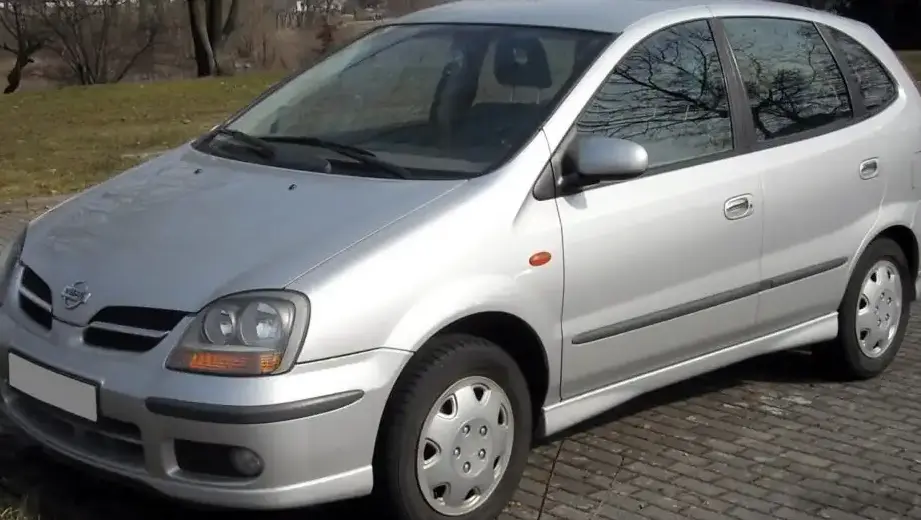
Technical Specifications
| Brand | Nissan |
| Model | Almera |
| Generation | Almera Tino |
| Type (Engine) | 2.2 Di (114 Hp) |
| Start of production | 2000 |
| End of production | 2003 |
| Powertrain Architecture | Internal Combustion engine |
| Body type | Minivan |
| Seats | 5 |
| Doors | 5 |
| Fuel consumption (urban) | 8.3 l/100 km (28.3 US mpg) |
| Fuel consumption (extra urban) | 5.3 l/100 km (44.4 US mpg) |
| Fuel consumption (combined) | 6.4 l/100 km (36.8 US mpg) |
| Fuel Type | Diesel |
| Acceleration 0 – 100 km/h | 12.2 sec |
| Acceleration 0 – 62 mph | 12.2 sec |
| Acceleration 0 – 60 mph | 11.6 sec |
| Maximum speed | 180 km/h (111.85 mph) |
| Weight-to-power ratio | 13 kg/Hp |
| Weight-to-torque ratio | 6.3 kg/Nm |
| Power | 114 Hp @ 4000 rpm |
| Torque | 235 Nm @ 2000 rpm (173.33 lb.-ft. @ 2000 rpm) |
| Engine layout | Front, Transverse |
| Engine Model/Code | YD22DDTi |
| Engine displacement | 2184 cm3 (133.28 cu. in.) |
| Number of cylinders | 4 |
| Engine configuration | Inline |
| Cylinder Bore | 86 mm (3.39 in.) |
| Piston Stroke | 94 mm (3.7 in.) |
| Compression ratio | 18:1 |
| Number of valves per cylinder | 4 |
| Fuel injection system | Direct injection |
| Engine aspiration | Turbocharger, Intercooler |
| Valvetrain | DOHC |
| Kerb Weight | 1480 kg (3262.84 lbs.) |
| Max. weight | 1940 kg (4276.97 lbs.) |
| Max load | 460 kg (1014.13 lbs.) |
| Trunk (boot) space – minimum | 440 l (15.54 cu. ft.) |
| Trunk (boot) space – maximum | 1950 l (68.86 cu. ft.) |
| Fuel tank capacity | 60 l (15.85 US gal) |
| Length | 4264 mm (167.87 in.) |
| Width | 1758 mm (69.21 in.) |
| Height | 1608 mm (63.31 in.) |
| Wheelbase | 2535 mm (99.8 in.) |
| Front track | 1535 mm (60.43 in.) |
| Rear track | 1510 mm (59.45 in.) |
| Ride height (ground clearance) | 150 mm (5.91 in.) |
| Drivetrain Architecture | Front wheel drive |
| Number of gears | 5 |
| Gearbox type | Manual transmission |
| Front suspension | Wishbone |
| Rear suspension | Spring Strut |
| Front brakes | Ventilated discs |
| Rear brakes | Disc |
| Assisting systems | ABS (Anti-lock braking system) |
| Steering type | Steering rack and pinion |
| Power steering | Hydraulic |
| Tires size | 205/55 R16 |
| Wheel rims size | 16 |
The Nissan Almera Tino 2.2 Di, launched in 2000, was a five-door compact minivan designed to appeal to buyers seeking a versatile and practical vehicle. Built on the Nissan S platform (shared with the Almera hatchback and Sentra), the Tino distinguished itself with its taller roofline and more spacious interior. The 2.2 Di variant, powered by the YD22DDTi engine, was a key offering in the range, providing a diesel-powered option for those prioritizing fuel economy and low-end torque. This model aimed to compete with other European compact MPVs like the Renault Scenic and Citroën Xsara Picasso.
Powertrain & Engine Architecture
The heart of the Almera Tino 2.2 Di is the YD22DDTi engine, a 2.2-liter inline-four cylinder diesel. This engine utilizes direct fuel injection, a technology that improves combustion efficiency and reduces emissions. The YD22DDTi is a turbocharged engine, employing an intercooler to further enhance performance by cooling the intake air. The engine features a double overhead camshaft (DOHC) valvetrain, optimizing airflow into and out of the cylinders. The 18:1 compression ratio is typical for a direct injection diesel, contributing to its efficiency. The engine is transversely mounted in the front of the vehicle, driving the front wheels. The five-speed manual transmission was the standard offering for this variant, providing a balance between fuel economy and driver control. The gear ratios were tuned for maximizing torque at lower speeds, suitable for everyday driving and load-carrying.
Driving Characteristics
The Almera Tino 2.2 Di, with its 114 horsepower and 235 Nm (173 lb-ft) of torque, offered adequate performance for its intended purpose. Acceleration from 0 to 60 mph took around 11.6 seconds, and it had a top speed of 111.85 mph. While not a particularly sporty vehicle, the diesel engine provided strong low-end torque, making it easy to accelerate from a standstill or overtake at lower speeds. The five-speed manual transmission allowed drivers to maintain optimal engine speed for various driving conditions. Compared to the petrol-powered Tino models, the 2.2 Di offered superior fuel economy, but lacked the same level of outright acceleration. The manual transmission provided a more engaging driving experience than the optional automatic transmission available on other Tino trims.
Equipment & Trim Levels
The Almera Tino 2.2 Di typically came with a reasonable level of standard equipment. This included power steering, central locking, electric front windows, and an adjustable steering column. Interior upholstery was typically cloth, with a functional and durable design. Higher trim levels offered options such as air conditioning, alloy wheels, a CD player, and rear electric windows. The dashboard layout was straightforward and user-friendly, prioritizing practicality over luxury. Safety features included ABS brakes and driver and passenger airbags.
Chassis & Braking
The Almera Tino 2.2 Di utilized a front independent suspension with wishbones and a rear spring strut suspension. This setup provided a comfortable ride quality, absorbing bumps and irregularities in the road surface. The front brakes were ventilated discs, offering good stopping power, while the rear brakes were solid discs. The hydraulic power steering provided light and precise steering control. The vehicle’s weight of approximately 1480 kg (3262.84 lbs) was relatively moderate for its class, contributing to its manageable handling characteristics.
Market Reception & Comparison
The Nissan Almera Tino 2.2 Di was generally well-received by automotive critics as a practical and fuel-efficient family vehicle. It was praised for its spacious interior, comfortable ride, and reasonable price point. However, some critics noted that the engine could be somewhat noisy and lacked the refinement of some of its competitors. Compared to the petrol-powered Tino models, the 2.2 Di offered significantly better fuel economy, making it a popular choice for drivers covering long distances. In terms of reliability, the YD22DDTi engine proved to be generally robust, although regular maintenance was essential to prevent issues with the turbocharger and fuel injection system.
Legacy
The Nissan Almera Tino 2.2 Di has become a relatively affordable and practical used car option. The YD22DDTi engine, when properly maintained, can offer long-term reliability. However, potential buyers should be aware of the potential for issues with the turbocharger and fuel injection system, and ensure that the vehicle has been regularly serviced. The Tino’s spacious interior and versatile seating configuration continue to appeal to small families and those seeking a practical and economical vehicle. While it may not be as popular as some of its competitors, the Almera Tino 2.2 Di remains a viable option for those seeking a dependable and affordable compact minivan.