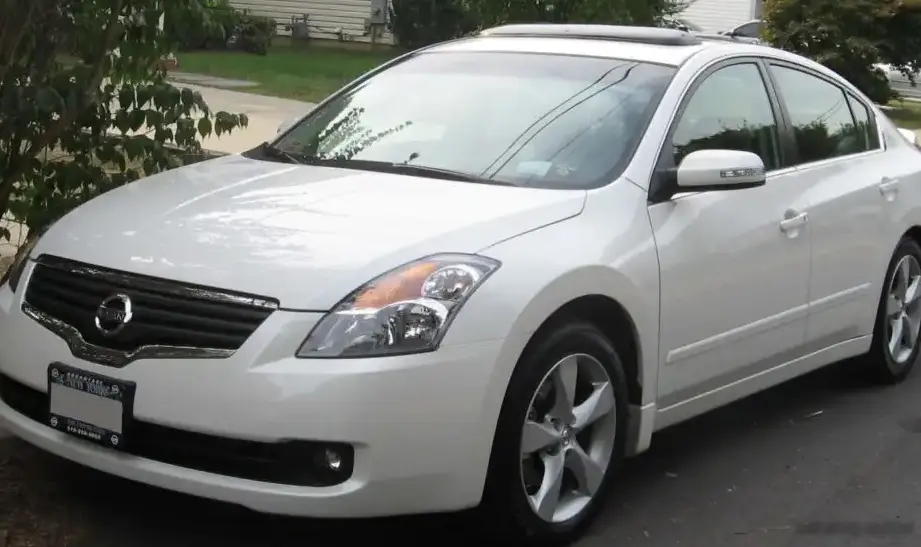
The Nissan Altima V 3.5, produced between 2012 and 2015, represented the performance-oriented top trim level of the fourth-generation Altima (L33) sedan. Positioned as a direct competitor to mid-size sedans like the Honda Accord and Toyota Camry, the Altima V 3.5 aimed to attract buyers seeking a more engaging driving experience without sacrificing the practicality and comfort expected of the class. This variant distinguished itself with a potent 3.5-liter V6 engine paired exclusively with a Continuously Variable Transmission (CVT), offering a blend of power and efficiency. It occupied the premium segment of the Altima lineup, sitting above the base 2.5-liter four-cylinder models.
Technical Specifications
| Brand | Nissan |
| Model | Altima |
| Generation | Altima V |
| Type (Engine) | 3.5 (270 Hp) CVT |
| Start of production | 2012 |
| End of production | 2015 |
| Powertrain Architecture | Internal Combustion engine |
| Body type | Sedan |
| Seats | 5 |
| Doors | 4 |
| Fuel consumption (urban) | 10.7 l/100 km (22 US mpg, 26.4 UK mpg, 9.3 km/l) |
| Fuel consumption (extra urban) | 7.6 l/100 km (30.9 US mpg, 37.2 UK mpg, 13.2 km/l) |
| Fuel Type | Petrol (Gasoline) |
| Acceleration 0 – 100 km/h | 5.7 sec |
| Acceleration 0 – 62 mph | 5.7 sec |
| Acceleration 0 – 60 mph | 5.4 sec |
| Maximum speed | 235 km/h (146.02 mph) |
| Weight-to-power ratio | 5.5 kg/Hp, 180.7 Hp/tonne |
| Weight-to-torque ratio | 4.4 kg/Nm, 227.6 Nm/tonne |
| Power | 270 Hp @ 6000 rpm |
| Power per litre | 77.2 Hp/l |
| Torque | 340 Nm @ 4400 rpm (250.77 lb.-ft. @ 4400 rpm) |
| Engine layout | Front, Transverse |
| Engine Model/Code | VQ35DE |
| Engine displacement | 3498 cm3 (213.46 cu. in.) |
| Number of cylinders | 6 |
| Engine configuration | V-engine |
| Cylinder Bore | 95.5 mm (3.76 in.) |
| Piston Stroke | 81.4 mm (3.2 in.) |
| Compression ratio | 10.3:1 |
| Number of valves per cylinder | 4 |
| Fuel injection system | Multi-port manifold injection |
| Engine aspiration | Naturally aspirated engine |
| Engine oil capacity | 4.8 l (5.07 US qt | 4.22 UK qt) |
| Coolant | 9.2 l (9.72 US qt | 8.09 UK qt) |
| Kerb Weight | 1494 kg (3293.71 lbs.) |
| Max. weight | 1987 kg (4380.59 lbs.) |
| Max load | 493 kg (1086.88 lbs.) |
| Trunk (boot) space – maximum | 436 l (15.4 cu. ft.) |
| Fuel tank capacity | 68 l (17.96 US gal | 14.96 UK gal) |
| Length | 4864 mm (191.5 in.) |
| Width | 1828 mm (71.97 in.) |
| Height | 1471 mm (57.91 in.) |
| Wheelbase | 2776 mm (109.29 in.) |
| Front track | 1584 mm (62.36 in.) |
| Rear (Back) track | 1584 mm (62.36 in.) |
| Ride height (ground clearance) | 137 mm (5.39 in.) |
| Drivetrain Architecture | The Internal combustion engine (ICE) drives the front wheels of the vehicle. |
| Drive wheel | Front wheel drive |
| Number of gears and type of gearbox | 1 gears, automatic transmission CVT |
| Front brakes | Ventilated discs |
| Rear brakes | Disc |
| Tires size | 235/45 R18 |
| Wheel rims size | 18 |
Powertrain & Engine Architecture
The heart of the Altima V 3.5 was the VQ35DE 3.5-liter V6 engine. This engine, a member of Nissan’s highly regarded VQ family, was known for its smooth operation, robust construction, and relatively high output. The VQ35DE featured a 60-degree V-angle, aluminum alloy block and cylinder heads, and dual overhead camshafts (DOHC) with four valves per cylinder. It utilized a multi-port fuel injection system, delivering fuel directly into the intake ports. The engine produced 270 horsepower at 6000 rpm and 258 lb-ft of torque at 4400 rpm. The engine’s design prioritized a broad torque curve, providing ample power across a wide range of engine speeds. Paired with this engine was Nissan’s Xtronic CVT (Continuously Variable Transmission). This transmission lacked traditional gears, instead using a belt and pulley system to provide an infinite number of gear ratios, optimizing fuel efficiency and providing smooth acceleration.
Driving Characteristics
The Altima V 3.5 offered a noticeably more spirited driving experience compared to the base four-cylinder models. The V6 engine delivered strong acceleration, achieving 0-60 mph times in approximately 5.4 seconds. The CVT, while prioritizing efficiency, was programmed to mimic traditional gear shifts under hard acceleration, providing a more engaging feel. However, some drivers found the CVT’s operation to be less responsive than a traditional automatic transmission. The suspension was tuned for a balance between comfort and handling, providing a reasonably controlled ride without being overly harsh. The steering was light and precise, making the Altima easy to maneuver in city traffic.
Equipment & Trim Levels
The Altima V 3.5 typically came standard with a generous array of features, including leather upholstery, heated front seats, a power-adjustable driver’s seat, a premium audio system (often Bose), and automatic climate control. Optional extras included navigation, a sunroof, and advanced safety features like blind-spot monitoring and lane departure warning. The exterior styling of the V 3.5 was often distinguished by unique alloy wheel designs and subtle chrome accents. Interior trim options were generally limited to darker color schemes, reflecting the more premium nature of the trim level.
Chassis & Braking
The Altima V 3.5 utilized a front-wheel-drive layout with an independent MacPherson strut suspension in the front and a multi-link suspension in the rear. This suspension setup provided a good balance of ride comfort and handling. Braking duties were handled by ventilated front discs and solid rear discs. The braking system was generally considered adequate for the vehicle’s performance, providing confident stopping power in most driving situations. The standard tire size was 235/45R18, providing a good compromise between grip and ride comfort.
Market Reception & Comparison
The Altima V 3.5 was generally well-received by automotive critics, who praised its powerful engine, comfortable ride, and spacious interior. However, some reviewers noted that the CVT transmission could feel less engaging than traditional automatic transmissions. Compared to the base 2.5-liter Altima, the V 3.5 offered significantly more performance, but at a higher price point and with slightly lower fuel economy. Against competitors like the Honda Accord V6 and Toyota Camry V6, the Altima V 3.5 offered a competitive combination of power, features, and value.
Legacy
The VQ35DE engine, in general, has proven to be a remarkably durable and reliable powerplant. The Altima V 3.5 is no exception, with many examples still on the road today. The CVT transmission, while generally reliable, requires regular fluid changes to maintain optimal performance. On the used car market, the Altima V 3.5 commands a slightly higher price than the base four-cylinder models, reflecting its superior performance and features. It remains a popular choice for buyers seeking a comfortable, reliable, and reasonably powerful mid-size sedan.