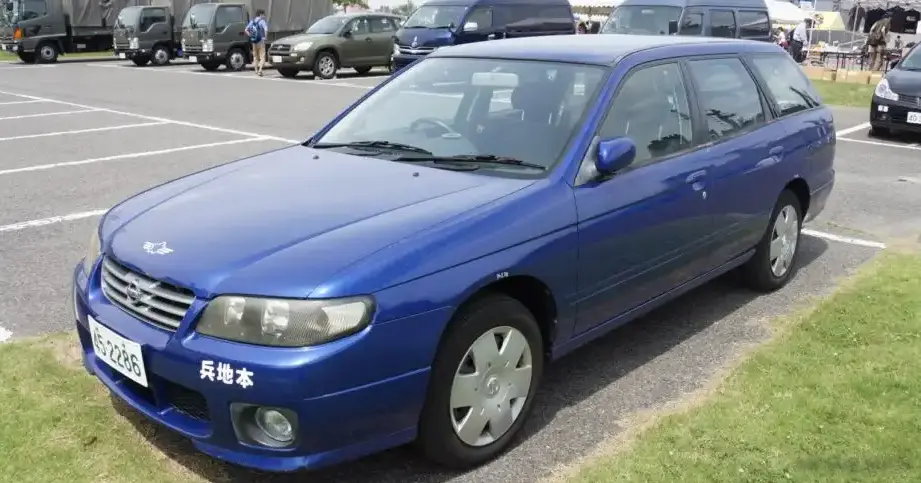
The Nissan Avenir (W11) 2.0i 16V Automatic, produced between 1999 and 2005, represented a comfortable and practical offering in the mid-size station wagon segment. Positioned as a family-oriented vehicle, the Avenir aimed to provide a spacious interior and reliable transportation. It was primarily marketed in Japan and select export markets, offering a blend of practicality and Nissan’s engineering. This particular variant, equipped with the SR20DE engine and a four-speed automatic transmission, occupied a middle ground within the Avenir lineup, offering a balance between performance and fuel efficiency compared to lower and higher-powered options.
Technical Specifications
| Brand | Nissan |
| Model | Avenir |
| Generation | Avenir (W11) |
| Type (Engine) | 2.0i 16V (145 Hp) Automatic |
| Start of production | 1999 |
| End of production | 2005 |
| Powertrain Architecture | Internal Combustion engine |
| Body type | Station wagon (estate) |
| Seats | 5 |
| Doors | 5 |
| Fuel consumption (combined) | 8.1 l/100 km (29 US mpg, 34.9 UK mpg, 12.3 km/l) |
| Fuel Type | Petrol (Gasoline) |
| Weight-to-power ratio | 9.4 kg/Hp, 105.8 Hp/tonne |
| Weight-to-torque ratio | 7.7 kg/Nm, 130.7 Nm/tonne |
| Power | 145 Hp @ 6400 rpm |
| Power per litre | 72.6 Hp/l |
| Torque | 179 Nm @ 4800 rpm (132.02 lb.-ft. @ 4800 rpm) |
| Engine layout | Front, Transverse |
| Engine Model/Code | SR20DE |
| Engine displacement | 1998 cm3 (121.93 cu. in.) |
| Number of cylinders | 4 |
| Engine configuration | Inline |
| Cylinder Bore | 86 mm (3.39 in.) |
| Piston Stroke | 86 mm (3.39 in.) |
| Compression ratio | 10:1 |
| Number of valves per cylinder | 4 |
| Fuel injection system | Multi-port manifold injection |
| Engine aspiration | Naturally aspirated engine |
| Valvetrain | DOHC |
| Kerb Weight | 1370 kg (3020.33 lbs.) |
| Fuel tank capacity | 60 l (15.85 US gal | 13.2 UK gal) |
| Length | 4650 mm (183.07 in.) |
| Width | 1695 mm (66.73 in.) |
| Height | 1490 mm (58.66 in.) |
| Wheelbase | 2620 mm (103.15 in.) |
| Front track | 1475 mm (58.07 in.) |
| Rear track | 1475 mm (58.07 in.) |
| Ride height (ground clearance) | 150 mm (5.91 in.) |
| Drivetrain Architecture | The Internal combustion engine (ICE) drives the front wheels of the vehicle. |
| Drive wheel | Front wheel drive |
| Number of gears and type of gearbox | 4 gears, automatic transmission |
| Front suspension | Coil spring |
| Rear suspension | Coil spring |
| Front brakes | Ventilated discs |
| Rear brakes | Disc |
| Assisting systems | ABS (Anti-lock braking system) |
| Steering type | Steering rack and pinion |
| Power steering | Hydraulic Steering |
| Tires size | 185/65 R15 |
Powertrain & Engine Architecture
The heart of the Avenir 2.0i Automatic is the SR20DE engine, a 1.998-liter inline-four cylinder powerplant. This engine is a naturally aspirated design, utilizing multi-port fuel injection and a double overhead camshaft (DOHC) valvetrain with four valves per cylinder. The SR20DE was a well-regarded engine known for its reliability and smooth power delivery. The 10:1 compression ratio contributed to its respectable output for its displacement. Paired with this engine is a four-speed automatic transmission. While not offering the most modern gear count, this transmission was chosen for its smoothness and ease of use, aligning with the Avenir’s focus on comfortable family transportation. The transmission’s gear ratios were tuned for relaxed cruising and adequate acceleration, prioritizing fuel economy over outright performance.
Driving Characteristics
The 145 horsepower and 179 Nm (132 lb-ft) of torque produced by the SR20DE/automatic transmission combination resulted in a driving experience geared towards practicality rather than sportiness. Acceleration was adequate for everyday driving, but noticeably slower than Avenir models equipped with manual transmissions or the larger 2.5-liter engine. The automatic transmission, while smooth, did exhibit some typical torque converter lag, particularly during quick acceleration. The gear ratios were spaced to favor fuel efficiency, meaning the engine often operated at lower RPMs during highway cruising. Compared to the manual transmission versions, the automatic Avenir felt less engaging, but offered a more relaxed and convenient driving experience, especially in urban traffic.
Equipment & Trim Levels
The 2.0i Automatic trim level of the Avenir typically included features such as power windows, power door locks, air conditioning, and an AM/FM radio with a cassette player (later models may have included a CD player). Interior upholstery was generally cloth, with options for upgraded materials available. Higher trim levels offered features like alloy wheels, a sunroof, and more advanced audio systems. The dashboard layout was functional and straightforward, prioritizing ease of use over stylistic flair. Optional extras included features like a navigation system (a rarity for the time) and upgraded sound systems.
Chassis & Braking
The Avenir W11 utilized a front-engine, front-wheel-drive layout. Suspension consisted of coil springs all around, providing a comfortable ride quality. The front suspension featured MacPherson struts, while the rear employed a multi-link setup. Braking duties were handled by ventilated discs at the front and solid discs at the rear. Anti-lock Braking System (ABS) was standard, enhancing safety. The chassis was designed to prioritize ride comfort and stability, rather than sporty handling. Stabilizer bars were included to reduce body roll during cornering, but the Avenir was not intended to be a performance vehicle.
Market Reception & Comparison
The Nissan Avenir 2.0i Automatic was generally well-received as a practical and reliable family wagon. Critics praised its spacious interior, comfortable ride, and fuel efficiency. However, some reviewers noted that the automatic transmission and 2.0-liter engine lacked the punch of the larger-engined or manual transmission models. Compared to competitors like the Toyota Caldina and Honda Accord Wagon, the Avenir offered a competitive level of features and practicality. Fuel economy was comparable to other vehicles in its class, averaging around 8.1 l/100km. Reliability was generally good, with the SR20DE engine proving to be a durable and long-lasting unit.
Legacy
The Nissan Avenir W11, particularly the 2.0i Automatic variant, has developed a reputation as a dependable and affordable used car. The SR20DE engine is known for its longevity, and parts availability remains relatively good. While not a particularly sought-after model by enthusiasts, the Avenir offers a practical and comfortable transportation solution for those seeking a spacious station wagon. The automatic transmission, while not the most technologically advanced, has proven to be reasonably reliable with proper maintenance. Today, these vehicles are often found in the hands of families or individuals seeking a simple, reliable, and affordable vehicle for everyday use. The Avenir represents a period when Nissan focused on building practical and dependable vehicles for the mass market.