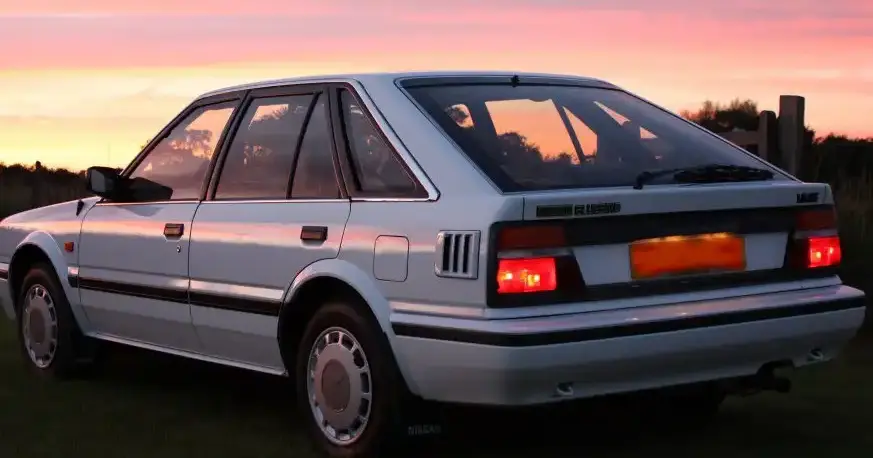
The Nissan Bluebird U13, manufactured between 1991 and 1995, marked a significant step forward in Nissan’s established Bluebird series. This generation, known as the U13, was primarily developed for the Japanese domestic market (JDM) with limited exports, offering a combination of comfort, practicality, and increasingly advanced technology. The 2.0i variant, featuring a 145 horsepower engine paired with an automatic transmission, held a mid-range position within the U13 lineup, appealing to buyers who desired a balance between performance and driving convenience. It was positioned above the lower-displacement models and below the more performance-focused or luxury-appointed trims.
Technical Specifications
| Brand | Nissan |
| Model | Bluebird |
| Generation | Bluebird (U13) |
| Type | 2.0i (145 Hp) Automatic |
| Start of production | 1991 |
| End of production | 1995 |
| Powertrain Architecture | Internal Combustion engine |
| Body type | Sedan |
| Seats | 5 |
| Doors | 4 |
| Fuel Type | Petrol (Gasoline) |
| Weight-to-power ratio | 8.5 kg/Hp, 117.9 Hp/tonne |
| Weight-to-torque ratio | 6.9 kg/Nm, 144.7 Nm/tonne |
| Power | 145 Hp @ 6400 rpm |
| Power per litre | 72.6 Hp/l |
| Torque | 178 Nm @ 4800 rpm (131.29 lb.-ft. @ 4800 rpm) |
| Engine layout | Front, Transverse |
| Engine displacement | 1998 cm3 (121.93 cu. in.) |
| Number of cylinders | 4 |
| Engine configuration | Inline |
| Cylinder Bore | 86 mm (3.39 in.) |
| Piston Stroke | 86 mm (3.39 in.) |
| Compression ratio | 9.5:1 |
| Number of valves per cylinder | 4 |
| Fuel injection system | Multi-port manifold injection |
| Engine aspiration | Naturally aspirated engine |
| Kerb Weight | 1230 kg (2711.69 lbs.) |
| Fuel tank capacity | 60 l (15.85 US gal | 13.2 UK gal) |
| Length | 4585 mm (180.51 in.) |
| Width | 1695 mm (66.73 in.) |
| Height | 1405 mm (55.31 in.) |
| Wheelbase | 2620 mm (103.15 in.) |
| Front track | 1465 mm (57.68 in.) |
| Rear track | 1455 mm (57.28 in.) |
| Ride height (ground clearance) | 145 mm (5.71 in.) |
| Drivetrain Architecture | The Internal combustion engine (ICE) drives the front wheels of the vehicle. |
| Drive wheel | Front wheel drive |
| Number of gears and type of gearbox | 4 gears, automatic transmission |
| Front brakes | Ventilated discs |
| Rear brakes | Disc |
| Steering type | Steering rack and pinion |
| Tires size | 195/65 R14 |
| Wheel rims size | 14 |
Powertrain & Engine Architecture
The Nissan Bluebird 2.0i was powered by the SR20DE engine, a 1998cc inline-four cylinder engine. This engine employed a multi-port fuel injection system, delivering fuel directly to each cylinder to enhance efficiency and responsiveness. The SR20DE featured a single overhead camshaft (SOHC) design with four valves per cylinder, contributing to its respectable power output for its displacement. The engine’s 9.5:1 compression ratio was typical for naturally aspirated engines of the period, striking a balance between performance and fuel economy. The automatic transmission was a four-speed unit, engineered to provide smooth and convenient gear changes. While it didn’t offer the driver engagement of a manual transmission, it catered to buyers who prioritized comfort and ease of driving.
Driving Characteristics
The combination of 145 horsepower and 178 Nm (131.29 lb-ft) of torque from the SR20DE, coupled with the four-speed automatic transmission, resulted in a driving experience that was best described as competent and refined. Acceleration was adequate for everyday driving, but it wasn’t particularly sporty. The automatic transmission’s gear ratios were optimized for fuel efficiency and smooth cruising, rather than rapid acceleration. Compared to the manual transmission versions of the Bluebird 2.0i, the automatic offered slightly slower acceleration times. However, the automatic provided a more relaxed driving experience, especially in congested urban traffic. The power delivery was linear, making the car predictable and easy to control.
Equipment & Trim Levels
The 2.0i Automatic trim level of the Bluebird U13 generally included standard features such as power windows, power steering, central locking, and an AM/FM radio. Higher trim levels offered optional features like air conditioning, upgraded upholstery (typically cloth or velour), and a more advanced audio system. The interior design was functional and well-constructed, reflecting the Japanese emphasis on quality and attention to detail. The dashboard layout was straightforward, with clearly marked controls. Additional optional extras could include alloy wheels, a sunroof, and enhanced sound systems.
Chassis & Braking
The Bluebird U13 utilized a front-engine, front-wheel-drive layout. The suspension system consisted of MacPherson struts at the front and a multi-link suspension at the rear, providing a comfortable ride and reasonable handling characteristics. The braking system featured ventilated discs at the front and solid discs at the rear, offering sufficient stopping power for the vehicle’s weight and performance. The steering was rack and pinion, delivering precise and responsive steering feel. The 195/65 R14 tires provided a good compromise between ride comfort and grip.
Market Reception & Comparison
The Nissan Bluebird U13 2.0i Automatic was generally well-received by both automotive critics and consumers. It was praised for its reliability, comfortable ride, and fuel efficiency. Compared to other models within the Bluebird lineup, the 2.0i Automatic offered a balanced combination of performance and practicality. The smaller-displacement models were more fuel-efficient but lacked the power of the 2.0i, while the higher-performance versions were more expensive and less comfortable. In terms of fuel economy, the 2.0i Automatic typically achieved around 25-30 miles per gallon in mixed driving conditions.
Legacy
The Nissan Bluebird U13, and particularly the 2.0i Automatic variant, has proven to be a remarkably durable and reliable vehicle. Numerous examples are still in operation today, a testament to Nissan’s engineering quality. The SR20DE engine is well-known for its longevity and relatively straightforward maintenance requirements. In the used car market, the Bluebird U13 is often sought after by enthusiasts and those seeking an affordable and dependable vehicle. While it may not boast the same level of modern technology as contemporary cars, its simplicity and reliability make it an appealing choice for those looking for a classic Japanese sedan. The U13 represents a sweet spot for many, offering a blend of classic styling, reasonable running costs, and a reputation for lasting a long time with proper care.