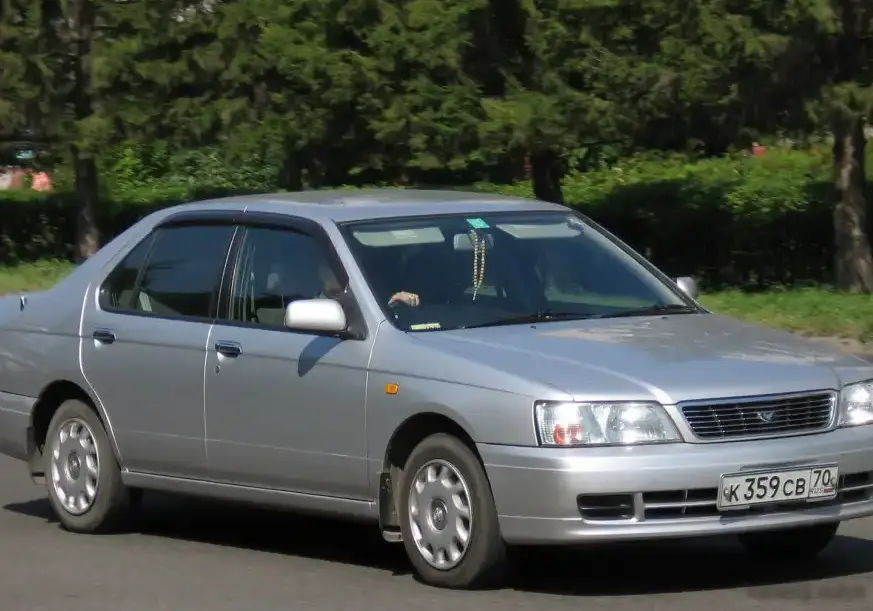
The Nissan Bluebird U14 1.8 Le Grand Automatic, produced between 1996 and 1998, represented a comfortable and well-equipped mid-range offering within the broader U14 Bluebird generation. Positioned above the base models but below the more performance-oriented variants, the 1.8 Le Grand catered to buyers seeking a balance of practicality, refinement, and reasonable fuel economy. The U14 Bluebird was primarily marketed in Japan and select Asian markets, serving as a popular family sedan known for its reliability and spacious interior. This variant aimed to provide a smooth driving experience with the convenience of an automatic transmission, appealing to a wider demographic than the manual transmission options.
Technical Specifications
| Brand | Nissan |
| Model | Bluebird |
| Generation | Bluebird (U14) |
| Type | 1.8 Le grand (125 Hp) Automatic |
| Start of production | 1996 |
| End of production | 1998 |
| Powertrain Architecture | Internal Combustion engine |
| Body type | Sedan |
| Seats | 5 |
| Doors | 4 |
| Fuel consumption (urban) | 9.7-12.8 l/100 km (24.2 – 18.4 US mpg, 29.1 – 22.1 UK mpg, 10.3 – 7.8 km/l) |
| Fuel consumption (extra urban) | 6.4-8.4 l/100 km (36.8 – 28 US mpg, 44.1 – 33.6 UK mpg, 15.6 – 11.9 km/l) |
| Fuel consumption (combined) | 8.8 l/100 km (26.7 US mpg, 32.1 UK mpg, 11.4 km/l) |
| Fuel Type | Petrol (Gasoline) |
| Acceleration 0 – 100 km/h | 11.5 sec |
| Acceleration 0 – 62 mph | 11.5 sec |
| Acceleration 0 – 60 mph | 10.9 sec |
| Maximum speed | 187 km/h (116.2 mph) |
| Weight-to-power ratio | 9.5 kg/Hp, 105 Hp/tonne |
| Weight-to-torque ratio | 7.6 kg/Nm, 131.9 Nm/tonne |
| Power | 125 Hp @ 6000 rpm |
| Power per litre | 68 Hp/l |
| Torque | 157 Nm @ 4800 rpm (115.8 lb.-ft. @ 4800 rpm) |
| Engine layout | Front, Transverse |
| Engine Model/Code | SR18DE |
| Engine displacement | 1838 cm3 (112.16 cu. in.) |
| Number of cylinders | 4 |
| Engine configuration | Inline |
| Cylinder Bore | 82.5 mm (3.25 in.) |
| Piston Stroke | 86 mm (3.39 in.) |
| Compression ratio | 9.5:1 |
| Number of valves per cylinder | 4 |
| Fuel injection system | Multi-port manifold injection |
| Engine aspiration | Naturally aspirated engine |
| Valvetrain | DOHC |
| Kerb Weight | 1190 kg (2623.5 lbs.) |
| Fuel tank capacity | 60 l (15.85 US gal | 13.2 UK gal) |
| Length | 4565 mm (179.72 in.) |
| Width | 1695 mm (66.73 in.) |
| Height | 1395 mm (54.92 in.) |
| Wheelbase | 2600 mm (102.36 in.) |
| Front track | 1465 mm (57.68 in.) |
| Rear track | 1455 mm (57.28 in.) |
| Ride height (ground clearance) | 140 mm (5.51 in.) |
| Drag coefficient (Cd) | 0.32 |
| Minimum turning circle | 10.4 m (34.12 ft.) |
| Drivetrain Architecture | Front wheel drive |
| Number of gears | 4 |
| Gearbox type | Automatic transmission |
| Front brakes | Ventilated discs |
| Rear brakes | Drum |
| Steering type | Steering rack and pinion |
| Tires size | 175/70 R14 |
| Wheel rims size | 14 |
Powertrain & Engine Architecture
The heart of the Bluebird 1.8 Le Grand Automatic was the SR18DE engine, a 1.8-liter inline-four cylinder powerplant. This engine utilized a multi-port fuel injection system, delivering fuel directly to each cylinder for improved efficiency and responsiveness. The SR18DE featured a double overhead camshaft (DOHC) valvetrain, optimizing airflow into and out of the cylinders, contributing to its 125 horsepower output at 6000 rpm and 157 Nm (115.8 lb-ft) of torque at 4800 rpm. The engine’s transverse mounting within the front-wheel-drive configuration maximized interior space. Paired with the SR18DE was a four-speed automatic transmission. While not offering the sportiness of a manual gearbox, this transmission prioritized smooth shifts and ease of use, aligning with the Le Grand’s comfort-oriented positioning. The transmission’s gear ratios were tuned for balanced acceleration and fuel efficiency, though it wasn’t designed for particularly brisk performance.
Driving Characteristics
The 1.8L automatic Bluebird offered a comfortable and predictable driving experience. Acceleration from a standstill to 60 mph took approximately 10.9 seconds, and it reached a top speed of 116.2 mph. Compared to the manual transmission versions of the same engine, the automatic suffered a slight performance penalty due to the inherent losses within the torque converter. However, the automatic provided a more relaxed driving experience, particularly in urban traffic. The four-speed automatic’s gear ratios were spaced to provide adequate acceleration in most situations, but downshifts could sometimes feel sluggish when attempting quick overtaking maneuvers. The suspension was tuned for comfort, absorbing bumps and imperfections in the road effectively, though this came at the expense of ultimate handling precision.
Equipment & Trim Levels
The Le Grand trim level offered a step up in features compared to the base Bluebird models. Standard equipment typically included power windows, power steering, air conditioning, and a basic audio system. Interior upholstery was usually cloth, with a focus on durability and comfort. Optional extras could include alloy wheels, a more advanced audio system with a cassette player, and upgraded interior trim. The dashboard layout was functional and straightforward, prioritizing ease of use over stylistic flair. The Le Grand trim aimed to provide a well-rounded package of features without the added cost of the higher-end models.
Chassis & Braking
The U14 Bluebird utilized a front-wheel-drive chassis with independent suspension at the front and a semi-independent torsion beam suspension at the rear. The front suspension featured MacPherson struts, while the rear torsion beam provided a balance of comfort and stability. Braking duties were handled by ventilated disc brakes at the front and drum brakes at the rear. This configuration was typical for vehicles in this class and weight category during the mid-1990s. The steering system employed a rack-and-pinion setup, providing reasonably precise steering feel. The 175/70 R14 tires offered a good compromise between ride comfort and grip.
Market Reception & Comparison
The Nissan Bluebird 1.8 Le Grand Automatic was generally well-received in its target markets. Critics praised its comfortable ride, spacious interior, and reputation for reliability. However, some reviewers noted that the engine and automatic transmission combination lacked the performance of the manual transmission or higher-output engine options. Compared to the more powerful 2.0-liter variants, the 1.8 Le Grand offered lower running costs and a more relaxed driving experience. Fuel economy was a strong point, with combined figures around 26.7 US mpg. The Bluebird competed with other popular family sedans such as the Toyota Corolla, Honda Civic, and Mitsubishi Galant.
Legacy
The SR18DE engine, when properly maintained, proved to be a durable and reliable unit. The four-speed automatic transmission, while not the most technologically advanced, also demonstrated reasonable longevity. Today, the U14 Bluebird 1.8 Le Grand Automatic can be found in the used car market, often at affordable prices. These vehicles are typically sought after by buyers looking for a dependable and economical mode of transportation. While not a particularly collectible model, the Bluebird U14 represents a solid example of Japanese automotive engineering from the 1990s, known for its practicality and long-term reliability. Parts availability can be a concern in some regions, but the engine’s robust design often allows for continued operation with regular maintenance.