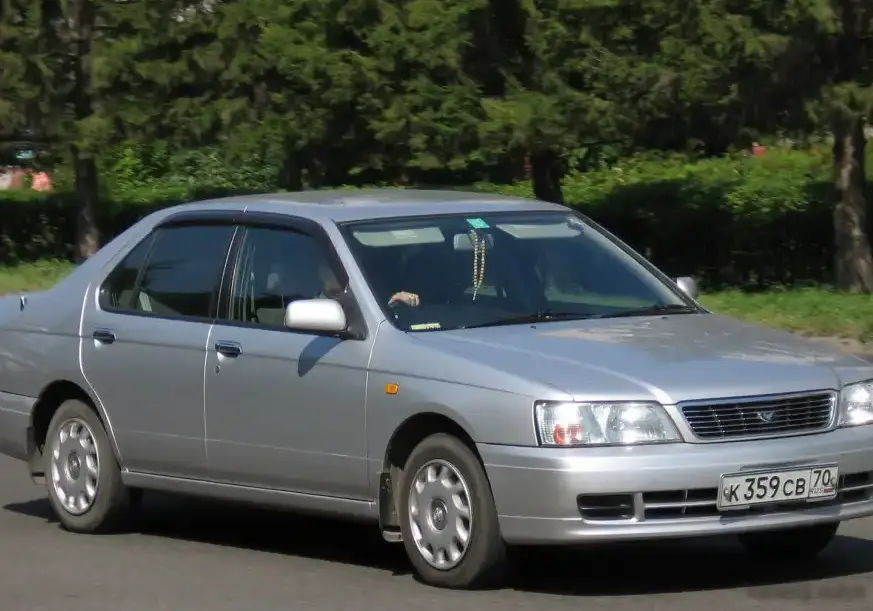
The Nissan Bluebird U14 2.0i, produced between 1997 and 1998, represented a refinement of Nissan’s long-running Bluebird lineage. Positioned as a mid-range offering within the U14 generation, this variant combined a 2.0-liter inline-four engine with a Continuously Variable Transmission (CVT). The U14 Bluebird was primarily marketed in Japan and select Asian markets, offering a comfortable and relatively efficient family sedan. It aimed to bridge the gap between more basic models and the more luxurious Primera, offering a balance of features and performance. This particular 2.0i CVT configuration was designed to appeal to buyers prioritizing smooth driving experience and fuel economy over outright performance.
Technical Specifications
| Brand | Nissan |
| Model | Bluebird |
| Generation | Bluebird (U14) |
| Type (Engine) | 2.0i (145 Hp) CVT |
| Start of production | 1997 |
| End of production | 1998 |
| Powertrain Architecture | Internal Combustion engine |
| Body type | Sedan |
| Seats | 5 |
| Doors | 4 |
| Fuel consumption (urban) | 11.4-15 l/100 km (20.6 – 15.7 US mpg, 24.8 – 18.8 UK mpg, 8.8 – 6.7 km/l) |
| Fuel consumption (extra urban) | 7.1-9.4 l/100 km (33.1 – 25 US mpg, 39.8 – 30.1 UK mpg, 14.1 – 10.6 km/l) |
| Fuel consumption (combined) | 10.1 l/100 km (23.3 US mpg, 28 UK mpg, 9.9 km/l) |
| Fuel Type | Petrol (Gasoline) |
| Acceleration 0 – 100 km/h | 9.8 sec |
| Acceleration 0 – 62 mph | 9.8 sec |
| Acceleration 0 – 60 mph | 9.3 sec |
| Maximum speed | 198 km/h (123.03 mph) |
| Weight-to-power ratio | 8.5 kg/Hp, 117.9 Hp/tonne |
| Weight-to-torque ratio | 6.9 kg/Nm, 144.7 Nm/tonne |
| Power | 145 Hp @ 6400 rpm |
| Power per litre | 72.6 Hp/l |
| Torque | 178 Nm @ 4800 rpm (131.29 lb.-ft. @ 4800 rpm) |
| Engine layout | Front, Transverse |
| Engine Model/Code | SR20DE |
| Engine displacement | 1998 cm3 (121.93 cu. in.) |
| Number of cylinders | 4 |
| Engine configuration | Inline |
| Cylinder Bore | 86 mm (3.39 in.) |
| Piston Stroke | 86 mm (3.39 in.) |
| Compression ratio | 10:1 |
| Number of valves per cylinder | 4 |
| Fuel injection system | Multi-port manifold injection |
| Engine aspiration | Naturally aspirated engine |
| Valvetrain | DOHC |
| Kerb Weight | 1230 kg (2711.69 lbs.) |
| Fuel tank capacity | 60 l (15.85 US gal | 13.2 UK gal) |
| Length | 4565 mm (179.72 in.) |
| Width | 1695 mm (66.73 in.) |
| Height | 1395 mm (54.92 in.) |
| Wheelbase | 2600 mm (102.36 in.) |
| Front track | 1465 mm (57.68 in.) |
| Rear track | 1455 mm (57.28 in.) |
| Ride height (ground clearance) | 140 mm (5.51 in.) |
| Drag coefficient (Cd) | 0.32 |
| Minimum turning circle | 10.4 m (34.12 ft.) |
| Drivetrain Architecture | The Internal combustion engine (ICE) drives the front wheels of the vehicle. |
| Drive wheel | Front wheel drive |
| Number of gears and type of gearbox | 1 gears, automatic transmission CVT |
| Front brakes | Ventilated discs |
| Rear brakes | Drum |
| Steering type | Steering rack and pinion |
| Tires size | 185/65 R14 |
| Wheel rims size | 14 |
Powertrain & Engine Architecture
The heart of the Bluebird 2.0i was the SR20DE engine, a 1.998-liter inline-four cylinder powerplant. This engine utilized multi-port fuel injection and a double overhead camshaft (DOHC) valvetrain, contributing to its relatively smooth operation and respectable power output for its displacement. The SR20DE was a well-established engine within Nissan’s lineup, known for its durability and ease of maintenance. The key differentiating factor for this variant was the pairing with a Continuously Variable Transmission (CVT). Nissan’s CVT offered seamless gear changes and optimized engine speed for improved fuel efficiency. Unlike traditional automatic transmissions with fixed gear ratios, the CVT provided an infinite number of ratios within its operating range. This allowed the engine to consistently operate at its most efficient point, enhancing fuel economy and reducing emissions.
Driving Characteristics
The 2.0i CVT Bluebird offered a comfortable and refined driving experience. The CVT, while prioritizing efficiency, did result in a different driving feel compared to traditional automatics or manual transmissions. Acceleration from a standstill was smooth and linear, but lacked the immediate responsiveness of a geared transmission. The CVT’s programming aimed to mimic traditional gear shifts under heavier acceleration, but the sensation was distinctly different. The 9.8-second 0-60 mph time was respectable for its class, but noticeably slower than versions equipped with a manual transmission. The focus was clearly on providing a relaxed and effortless driving experience, making it well-suited for daily commuting and long-distance travel.
Equipment & Trim Levels
The 2.0i CVT trim typically included features such as power windows, power locks, air conditioning, and a basic audio system. Interior upholstery was generally cloth, with options for upgraded materials available. Dashboard design was functional and straightforward, prioritizing ease of use over stylistic flair. Optional extras could include alloy wheels, a sunroof, and a more advanced audio system with a CD player. The level of equipment placed this variant firmly in the mid-range of the Bluebird lineup, offering a good balance of comfort and convenience without the premium features found in higher-spec models.
Chassis & Braking
The U14 Bluebird utilized a front-wheel-drive layout with independent suspension in the front and a torsion beam rear suspension. The front brakes were ventilated discs, providing adequate stopping power, while the rear brakes were drums. This configuration was typical for vehicles in this class and price range during the late 1990s. Stabilizer bars were included both front and rear to reduce body roll during cornering. The suspension tuning prioritized ride comfort over sporty handling, resulting in a smooth and compliant ride quality.
Market Reception & Comparison
The Bluebird 2.0i CVT was generally well-received by consumers seeking a comfortable and reliable family sedan. Critics praised its fuel efficiency and smooth driving experience, but some noted the lack of sporty character compared to manual transmission variants. Compared to the 1.8-liter models, the 2.0i offered a noticeable increase in power and torque, resulting in improved acceleration and overall performance. However, the 2.0i was also more expensive to purchase and maintain. Against competitors like the Toyota Corolla and Honda Civic, the Bluebird offered a competitive package, particularly in terms of interior space and ride comfort.
Legacy
The Nissan Bluebird U14 2.0i CVT, while not a performance icon, remains a respected and reliable vehicle. The SR20DE engine is known for its longevity, and the CVT, while requiring proper maintenance, proved to be a durable and efficient transmission. In the used car market, these Bluebirds are often sought after for their affordability and practicality. Parts availability is generally good, and maintenance costs are relatively low. The U14 Bluebird represents a solid example of Japanese automotive engineering from the late 1990s, offering a blend of comfort, efficiency, and reliability that continues to appeal to budget-conscious buyers today.