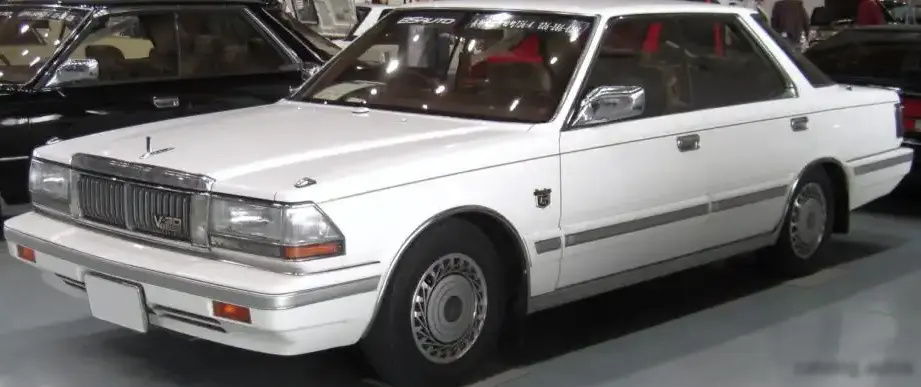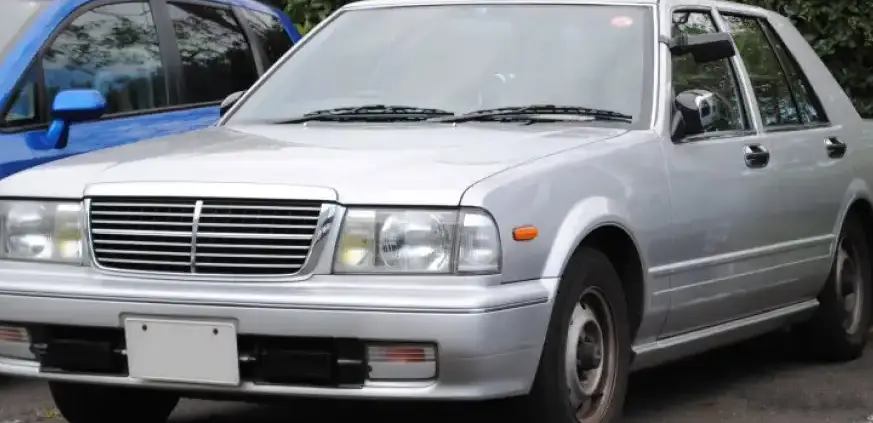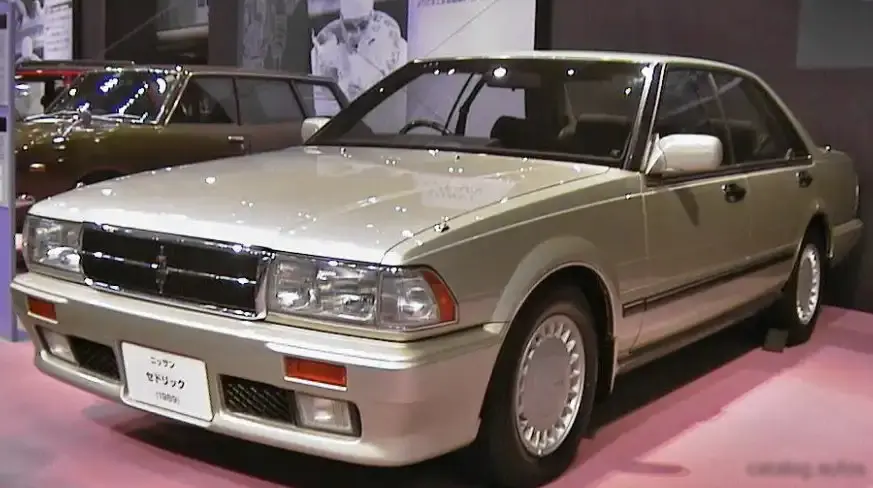
The Nissan Cedric Y31 2.0i V6 (125 hp) represents a significant iteration of Nissan’s flagship sedan, produced between 1987 and 1991. Positioned as a mid-range offering within the Y31 generation (1987-1991), this variant aimed to balance performance and affordability for the Japanese domestic market. The Y31 Cedric, along with its sibling the Gloria, were traditionally favored by Japanese businessmen and taxi fleets, representing a blend of comfort, reliability, and a degree of prestige. This 2.0-liter V6 model offered a step up from the smaller displacement engines, providing a more refined driving experience while remaining accessible to a broader customer base.
Technical Specifications
| Brand | Nissan |
| Model | Cedric |
| Generation | Cedric (Y31) |
| Type (Engine) | 2.0i V6 (125 Hp) |
| Start of production | 1987 |
| End of production | 1991 |
| Powertrain Architecture | Internal Combustion engine |
| Body type | Sedan |
| Seats | 5 |
| Doors | 4 |
| Fuel consumption (urban) | 10.6-14 l/100 km (22.2 – 16.8 US mpg, 26.6 – 20.2 UK mpg, 9.4 – 7.1 km/l) |
| Fuel consumption (extra urban) | 7.3-9.6 l/100 km (32.2 – 24.5 US mpg, 38.7 – 29.4 UK mpg, 13.7 – 10.4 km/l) |
| Fuel consumption (combined) | 9.9 l/100 km (23.8 US mpg, 28.5 UK mpg, 10.1 km/l) |
| Fuel Type | Petrol (Gasoline) |
| Acceleration 0 – 100 km/h | 10.9 sec |
| Acceleration 0 – 62 mph | 10.9 sec |
| Acceleration 0 – 60 mph | 10.4 sec |
| Maximum speed | 185 km/h (114.95 mph) |
| Weight-to-power ratio | 10.6 kg/Hp, 94 Hp/tonne |
| Weight-to-torque ratio | 8 kg/Nm, 125.6 Nm/tonne |
| Power | 125 Hp @ 6000 rpm |
| Power per litre | 62.6 Hp/l |
| Torque | 167 Nm @ 3200 rpm (123.17 lb.-ft. @ 3200 rpm) |
| Engine layout | Front, Longitudinal |
| Engine Model/Code | VG20 |
| Engine displacement | 1998 cm3 (121.93 cu. in.) |
| Number of cylinders | 6 |
| Engine configuration | V-engine |
| Cylinder Bore | 78 mm (3.07 in.) |
| Piston Stroke | 69.7 mm (2.74 in.) |
| Compression ratio | 9.5:1 |
| Number of valves per cylinder | 2 |
| Fuel injection system | Multi-port manifold injection |
| Engine aspiration | Naturally aspirated engine |
| Valvetrain | SOHC |
| Kerb Weight | 1330 kg (2932.15 lbs.) |
| Fuel tank capacity | 72 l (19.02 US gal | 15.84 UK gal) |
| Length | 4690 mm (184.65 in.) |
| Width | 1690 mm (66.54 in.) |
| Height | 1425 mm (56.1 in.) |
| Wheelbase | 2735 mm (107.68 in.) |
| Front track | 1440 mm (56.69 in.) |
| Rear track | 1450 mm (57.09 in.) |
| Ride height (ground clearance) | 155 mm (6.1 in.) |
| Drag coefficient (Cd) | 0.4 |
| Minimum turning circle | 11 m (36.09 ft.) |
| Drivetrain Architecture | Rear wheel drive |
| Drive wheel | Rear wheel drive |
| Number of gears | 5 gears, manual transmission |
| Front brakes | Ventilated discs |
| Rear brakes | Disc |
| Steering type | Steering rack and pinion |
| Tires size | 195/70 R14 |
| Wheel rims size | 14 |
Powertrain & Engine Architecture
The heart of the Y31 2.0i is the VG20E engine, a 2.0-liter (1998 cc) V6. This engine, part of Nissan’s VG series, is known for its smoothness and relative durability. The VG20E features a single overhead camshaft (SOHC) valvetrain operating two valves per cylinder. Fuel delivery is managed by a multi-port fuel injection system, contributing to improved efficiency and responsiveness compared to earlier carbureted engines. The engine produces 125 horsepower at 6000 rpm and 167 Nm (123.17 lb-ft) of torque at 3200 rpm. The engine is longitudinally mounted in the front of the vehicle, driving the rear wheels. The standard transmission for this variant was a 5-speed manual, although a 4-speed automatic transmission was also available, impacting performance and fuel economy.
Driving Characteristics
The 2.0-liter V6 with the 5-speed manual transmission offered a reasonably engaging driving experience for its time. Acceleration to 60 mph took approximately 10.4 seconds, and the car could reach a top speed of 185 km/h (114.95 mph). While not a sports car, the VG20E provided adequate power for comfortable highway cruising and city driving. The automatic transmission option, while offering convenience, noticeably dulled acceleration and increased fuel consumption. The gear ratios in the manual transmission were well-spaced, allowing for effective use of the engine’s torque band. Compared to the larger 3.0-liter V6 variants, the 2.0-liter model felt less powerful, but it also offered better fuel economy and a lighter front end, contributing to more balanced handling.
Equipment & Trim Levels
The Y31 Cedric 2.0i typically came equipped with features considered standard for a mid-range Japanese sedan of the late 1980s. These included power steering, air conditioning, and a basic audio system. Interior upholstery was typically cloth, with options for upgraded velour or leather available on higher trim levels. Dashboard configuration featured analog gauges for speed, tachometer, fuel level, and coolant temperature. Optional extras included power windows, central locking, and an upgraded sound system. The trim level often dictated the availability of these features, with the 2.0i serving as a stepping stone between the more basic models and the luxurious higher-end trims.
Chassis & Braking
The Y31 Cedric utilized a traditional body-on-frame construction, providing a comfortable ride but also contributing to a higher curb weight of 1330 kg (2932.15 lbs). The suspension consisted of independent front suspension with MacPherson struts and a solid rear axle with leaf springs. Braking was handled by ventilated discs on the front wheels and discs on the rear. Steering was rack and pinion, providing reasonably precise control. The suspension setup prioritized ride comfort over sporty handling, making it well-suited for long journeys on Japanese highways. Stabilizer bars were included to reduce body roll, but the overall handling characteristics were geared towards a smooth and relaxed driving experience.
Market Reception & Comparison
The Y31 Cedric 2.0i V6 was generally well-received in the Japanese market as a practical and reliable family sedan. Critics praised its comfortable ride, spacious interior, and smooth engine. However, some noted that its styling was somewhat conservative compared to some of its competitors. Compared to the larger 3.0-liter V6 models, the 2.0-liter version offered better fuel economy (around 9.9 l/100 km combined) and a lower price point, making it an attractive option for budget-conscious buyers. The 2.0-liter automatic variant was particularly popular with those prioritizing convenience over performance.
Legacy
The Nissan Cedric Y31 2.0i V6, while not a particularly rare or collectible model, remains a respected example of Japanese automotive engineering from the late 1980s. The VG20E engine is known for its durability and relatively simple maintenance requirements. In the used car market, these Cedrics are often sought after for their affordability and reliability. Parts availability can be a challenge outside of Japan, but the VG20E engine shares components with other Nissan engines, making sourcing parts somewhat easier. The Y31 Cedric continues to be appreciated by enthusiasts for its classic styling, comfortable ride, and the enduring quality of its engineering.