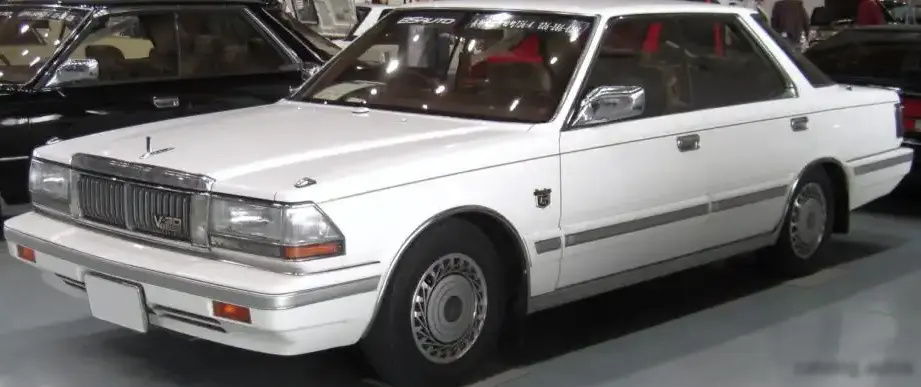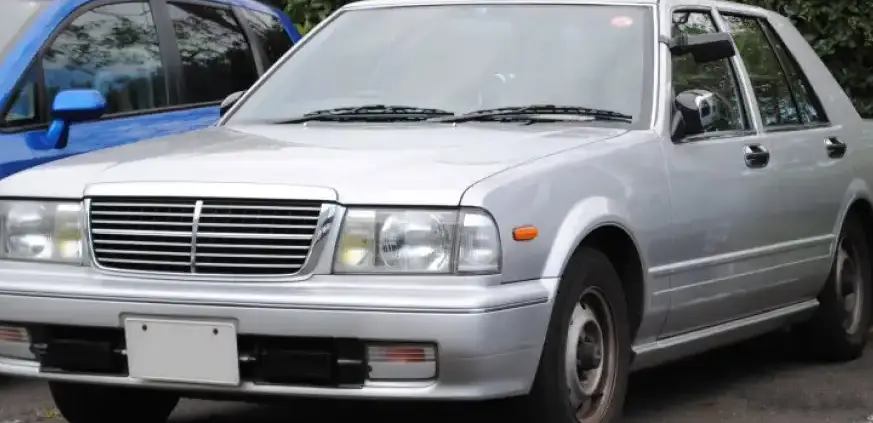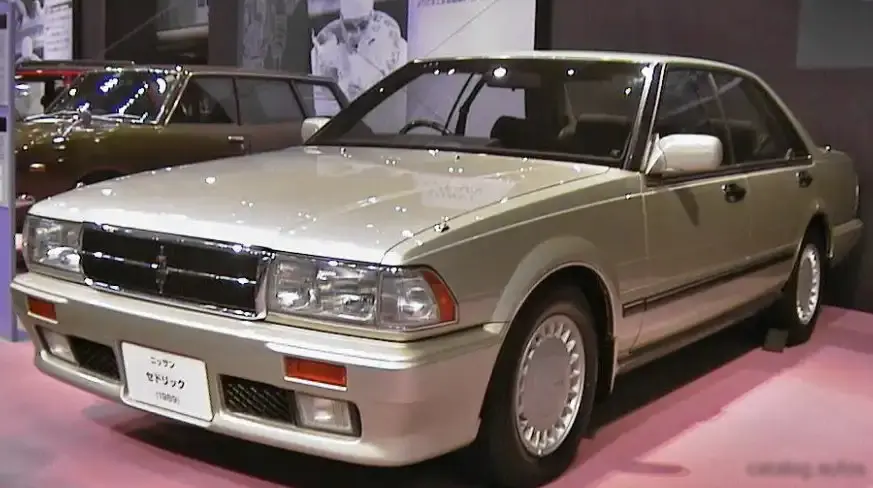
The Nissan Cedric Y31 2.0i V6 Automatic, produced between 1987 and 1989, represents a significant iteration of Nissan’s flagship sedan. Positioned as a mid-range offering within the broader Y31 generation (1987-1991), this variant aimed to balance performance and comfort for the discerning Japanese domestic market (JDM) buyer. The Y31 Cedric, as a whole, continued the tradition of the Cedric line as a spacious, well-appointed vehicle favored by families and business professionals. This 2.0-liter V6 automatic configuration offered a step up from the base models, providing increased power and a smoother driving experience, while remaining more accessible than the top-tier trims equipped with larger engines.
Technical Specifications
| Brand | Nissan |
| Model | Cedric |
| Generation | Cedric (Y31) |
| Type (Engine) | 2.0i V6 (185 Hp) Automatic |
| Start of production | 1987 |
| End of production | 1989 |
| Powertrain Architecture | Internal Combustion engine |
| Body type | Sedan |
| Seats | 5 |
| Doors | 4 |
| Fuel consumption (urban) | 12.2-16 l/100 km (19.3 – 14.7 US mpg, 23.2 – 17.7 UK mpg, 8.2 – 6.3 km/l) |
| Fuel consumption (extra urban) | 7.6-10 l/100 km (30.9 – 23.5 US mpg, 37.2 – 28.2 UK mpg, 13.2 – 10 km/l) |
| Fuel consumption (combined) | 10.7 l/100 km (22 US mpg, 26.4 UK mpg, 9.3 km/l) |
| Fuel Type | Petrol (Gasoline) |
| Acceleration 0 – 100 km/h | 9.5 sec |
| Acceleration 0 – 62 mph | 9.5 sec |
| Acceleration 0 – 60 mph | 9 sec |
| Maximum speed | 203 km/h (126.14 mph) |
| Weight-to-power ratio | 7.9 kg/Hp, 125.9 Hp/tonne |
| Weight-to-torque ratio | 6.8 kg/Nm, 146.9 Nm/tonne |
| Power | 185 Hp @ 6800 rpm |
| Power per litre | 92.6 Hp/l |
| Torque | 216 Nm @ 4800 rpm (159.31 lb.-ft. @ 4800 rpm) |
| Engine layout | Front, Longitudinal |
| Engine Model/Code | VG20 |
| Engine displacement | 1998 cm3 (121.93 cu. in.) |
| Number of cylinders | 6 |
| Engine configuration | V-engine |
| Cylinder Bore | 78 mm (3.07 in.) |
| Piston Stroke | 69.7 mm (2.74 in.) |
| Compression ratio | 8.5:1 |
| Number of valves per cylinder | 4 |
| Fuel injection system | Multi-port manifold injection |
| Engine aspiration | Naturally aspirated engine |
| Valvetrain | DOHC |
| Kerb Weight | 1470 kg (3240.8 lbs.) |
| Fuel tank capacity | 72 l (19.02 US gal | 15.84 UK gal) |
| Length | 4690 mm (184.65 in.) |
| Width | 1690 mm (66.54 in.) |
| Height | 1425 mm (56.1 in.) |
| Wheelbase | 2735 mm (107.68 in.) |
| Front track | 1440 mm (56.69 in.) |
| Rear track | 1450 mm (57.09 in.) |
| Ride height (ground clearance) | 155 mm (6.1 in.) |
| Drag coefficient (Cd) | 0.4 |
| Minimum turning circle | 11 m (36.09 ft.) |
| Drivetrain Architecture | Rear wheel drive |
| Number of gears | 4 |
| Gearbox type | Automatic transmission |
| Front brakes | Ventilated discs |
| Rear brakes | Disc |
| Steering type | Steering rack and pinion |
| Tires size | 205/65 R15 |
| Wheel rims size | 15 |
Introduction
The Y31 Nissan Cedric, launched in 1987, represented a significant update to Nissan’s long-running Cedric lineage. This generation aimed to modernize the car’s styling and improve its overall refinement. The 2.0i V6 Automatic variant, powered by the VG20 engine, was a popular choice for buyers seeking a balance between performance and fuel efficiency. It occupied a middle ground in the Y31 lineup, offering more power than the base 2.0-liter four-cylinder models but remaining more affordable and fuel-conscious than the 3.0-liter V6 options. The Cedric, throughout its history, was primarily a JDM vehicle, designed to cater to the specific needs and preferences of Japanese consumers, emphasizing comfort, spaciousness, and a smooth driving experience.
Powertrain & Engine Architecture
At the heart of the Cedric 2.0i V6 Automatic lies the VG20 engine, a 1,998 cc (121.93 cu. in.) naturally aspirated V6. This engine, part of Nissan’s VG series, is known for its relatively smooth operation and decent power output. The VG20 featured a double overhead camshaft (DOHC) valvetrain with four valves per cylinder, contributing to its improved breathing and performance. Fuel delivery was handled by a multi-port fuel injection system, optimizing fuel atomization and combustion efficiency. The engine produced 185 horsepower at 6,800 rpm and 216 Nm (159.31 lb.-ft.) of torque at 4,800 rpm. Paired with the VG20 was a four-speed automatic transmission, designed to provide smooth and effortless gear changes. This transmission was a conventional hydraulic automatic, prioritizing comfort over outright performance. The engine is longitudinally mounted, driving the rear wheels.
Driving Characteristics
The Cedric 2.0i V6 Automatic offered a comfortable and refined driving experience. While not a sports sedan, the 185 hp V6 provided adequate power for everyday driving and highway cruising. Acceleration to 60 mph took approximately 9 seconds, and the car had a top speed of around 126 mph. The automatic transmission, while smooth, did contribute to a slight loss of responsiveness compared to the available manual transmission. Gear ratios were tuned for comfort and fuel economy, rather than aggressive acceleration. The rear-wheel-drive configuration provided a balanced feel, although it wasn’t particularly engaging for enthusiastic drivers. Compared to the larger 3.0-liter V6 models, the 2.0i offered a lighter feel and slightly better fuel economy, making it a more practical choice for urban commuting.
Equipment & Trim Levels
The Cedric 2.0i V6 Automatic typically came equipped with a respectable level of standard features. Interior appointments included comfortable cloth upholstery, power windows, power locks, and an AM/FM radio. Higher trim levels offered options such as power-adjustable seats, a more sophisticated sound system, and even early iterations of navigation systems. The dashboard layout was functional and straightforward, prioritizing ease of use. Optional extras included a sunroof, alloy wheels, and upgraded interior trim materials. The overall interior ambiance was one of understated elegance, reflecting the Cedric’s positioning as a premium sedan.
Chassis & Braking
The Y31 Cedric utilized a conventional body-on-frame construction, providing a robust and durable chassis. The suspension system consisted of independent front suspension with MacPherson struts and a solid rear axle with leaf springs. This setup prioritized ride comfort over handling precision. Braking duties were handled by ventilated discs at the front and solid discs at the rear. The braking system was adequate for normal driving conditions, but lacked the stopping power of more modern systems. Stabilizer bars were fitted to both the front and rear axles to reduce body roll during cornering.
Market Reception & Comparison
The Nissan Cedric Y31 2.0i V6 Automatic was generally well-received in the Japanese market. Critics praised its comfortable ride, spacious interior, and refined engine. However, some noted that the automatic transmission could feel sluggish at times, and the handling wasn’t as sharp as some of its competitors. Compared to the 3.0-liter V6 models, the 2.0i offered a more affordable price point and better fuel economy, making it a popular choice for buyers who prioritized practicality. Against rivals like the Toyota Crown and Mazda Luce, the Cedric offered a compelling combination of features and value.
Legacy
The VG20 engine, while not known for being particularly groundbreaking, proved to be a reliable and durable powerplant. The four-speed automatic transmission, while somewhat dated by modern standards, also demonstrated good longevity. Today, the Y31 Cedric 2.0i V6 Automatic is a relatively uncommon sight, even in Japan. Well-maintained examples are sought after by enthusiasts who appreciate the car’s classic styling and comfortable driving experience. Parts availability can be a challenge, but the VG20 engine shares components with other Nissan engines of the era, making it easier to source replacements. The Y31 Cedric remains a testament to Nissan’s commitment to building comfortable, reliable, and well-equipped sedans for the Japanese domestic market.