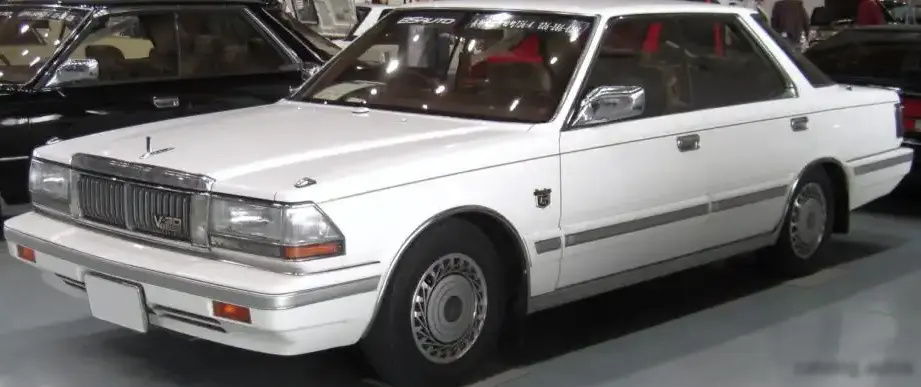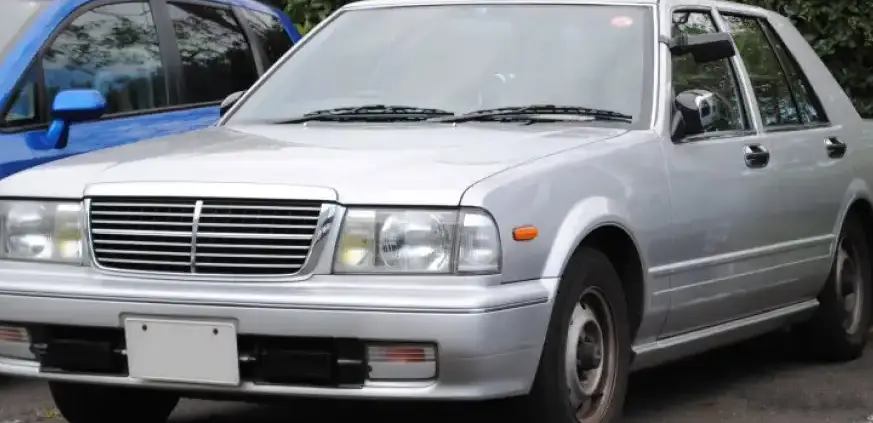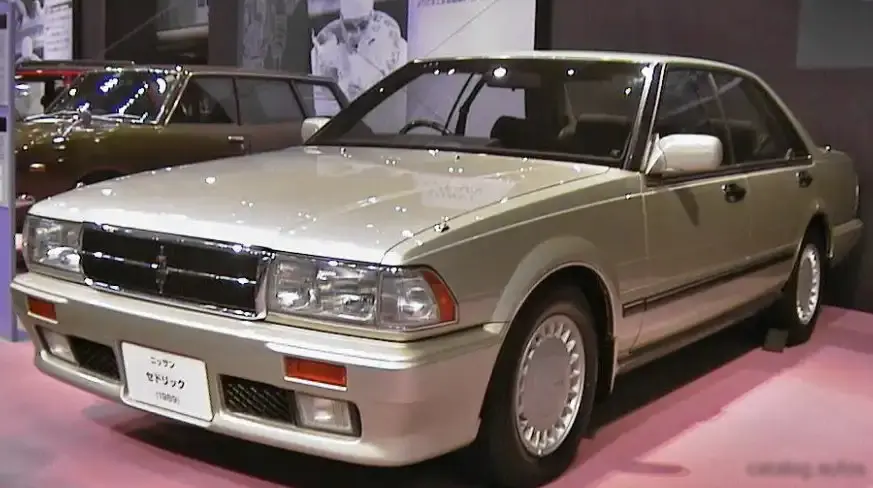
The Nissan Cedric Y31 2.0i V6 Automatic, produced between 1989 and 1991, represents a significant iteration of Nissan’s flagship sedan. Part of the broader Y31 generation (1987-1991), this variant occupied a middle ground in the Cedric lineup, offering a balance between performance and comfort. The Y31 series was designed to appeal to a more affluent Japanese buyer, emphasizing luxury and refinement. This 2.0-liter V6 model, paired with an automatic transmission, was aimed at customers seeking a smooth, sophisticated driving experience without the outright sportiness of some of its competitors. The Cedric, historically, was a key model for Nissan, often seen as a symbol of status and reliability within the Japanese domestic market.
Technical Specifications
| Brand | Nissan |
| Model | Cedric |
| Generation | Cedric (Y31) |
| Type (Engine) | 2.0i V6 (210 Hp) Automatic |
| Start of production | 1989 |
| End of production | 1991 |
| Powertrain Architecture | Internal Combustion engine |
| Body type | Sedan |
| Seats | 5 |
| Doors | 4 |
| Fuel consumption (urban) | 13.4-17.6 l/100 km (17.6 – 13.4 US mpg, 21.1 – 16.1 UK mpg, 7.5 – 5.7 km/l) |
| Fuel consumption (extra urban) | 7.4-9.8 l/100 km (31.8 – 24 US mpg, 38.2 – 28.8 UK mpg, 13.5 – 10.2 km/l) |
| Fuel consumption (combined) | 11.1 l/100 km (21.2 US mpg, 25.4 UK mpg, 9 km/l) |
| Fuel Type | Petrol (Gasoline) |
| Acceleration 0 – 100 km/h | 7.8 sec |
| Acceleration 0 – 62 mph | 7.8 sec |
| Acceleration 0 – 60 mph | 7.4 sec |
| Maximum speed | 215 km/h (133.59 mph) |
| Weight-to-power ratio | 7.4 kg/Hp, 135.5 Hp/tonne |
| Weight-to-torque ratio | 5.8 kg/Nm, 171 Nm/tonne |
| Power | 210 Hp @ 6800 rpm |
| Power per litre | 105.1 Hp/l |
| Torque | 265 Nm @ 3600 rpm (195.45 lb.-ft. @ 3600 rpm) |
| Engine layout | Front, Longitudinal |
| Engine Model/Code | VG20 |
| Engine displacement | 1998 cm3 (121.93 cu. in.) |
| Number of cylinders | 6 |
| Engine configuration | V-engine |
| Cylinder Bore | 78 mm (3.07 in.) |
| Piston Stroke | 69.7 mm (2.74 in.) |
| Compression ratio | 8.5:1 |
| Number of valves per cylinder | 4 |
| Fuel injection system | Multi-port manifold injection |
| Engine aspiration | Turbocharger, Intercooler |
| Valvetrain | DOHC |
| Kerb Weight | 1550 kg (3417.17 lbs.) |
| Fuel tank capacity | 72 l (19.02 US gal | 15.84 UK gal) |
| Length | 4690 mm (184.65 in.) |
| Width | 1720 mm (67.72 in.) |
| Height | 1425 mm (56.1 in.) |
| Wheelbase | 2735 mm (107.68 in.) |
| Front track | 1440 mm (56.69 in.) |
| Rear track | 1450 mm (57.09 in.) |
| Ride height (ground clearance) | 155 mm (6.1 in.) |
| Drag coefficient (Cd) | 0.4 |
| Minimum turning circle | 11 m (36.09 ft.) |
| Drivetrain Architecture | The Internal combustion engine (ICE) drives the rear wheels of the vehicle. |
| Drive wheel | Rear wheel drive |
| Number of gears | 5 |
| Gearbox type | automatic transmission |
| Front brakes | Ventilated discs |
| Rear brakes | Disc |
| Steering type | Steering rack and pinion |
| Tires size | 205/65 R15 |
| Wheel rims size | 15 |
Powertrain & Engine Architecture
The heart of the Y31 2.0i is the VG20E engine, a 2.0-liter, naturally aspirated V6. This engine, part of Nissan’s VG series, is known for its smoothness and relative reliability. The VG20E features a 60-degree V-angle, contributing to its balanced operation. It utilizes multi-port fuel injection for precise fuel delivery and a double overhead camshaft (DOHC) valvetrain for improved breathing. The engine produces 210 horsepower at 6800 rpm and 265 Nm (195 lb-ft) of torque at 3600 rpm. The automatic transmission is a 5-speed unit, designed to provide smooth shifts and comfortable cruising. While not a particularly advanced transmission by modern standards, it was well-regarded for its durability and refinement during its time. The engine is longitudinally mounted, driving the rear wheels, a configuration common for larger sedans of this era.
Driving Characteristics
The Cedric Y31 2.0i Automatic delivers a comfortable and refined driving experience. Acceleration from 0 to 60 mph takes approximately 7.4 seconds, which was respectable for a full-size sedan in the early 1990s. However, it’s noticeably slower than versions equipped with the larger 3.0-liter V6 or manual transmissions. The automatic transmission prioritizes smooth shifts over aggressive acceleration, making it ideal for city driving and long highway journeys. The suspension is tuned for comfort, absorbing bumps and providing a stable ride. The rear-wheel-drive layout contributes to balanced handling, although it’s not a particularly sporty car. The steering is light and precise, making it easy to maneuver in tight spaces.
Equipment & Trim Levels
The 2.0i V6 Automatic trim typically included features such as power windows, power locks, air conditioning, and a high-quality audio system. Interior upholstery was usually cloth, although leather options were available. The dashboard layout is functional and well-designed, with clear instrumentation. Optional extras included a sunroof, upgraded audio systems, and power-adjustable seats. The Cedric Y31 generally offered a higher level of standard equipment compared to some of its domestic competitors, reflecting its positioning as a luxury sedan.
Chassis & Braking
The Y31 Cedric features a traditional body-on-frame construction, providing a robust and durable chassis. The suspension consists of independent front suspension with MacPherson struts and a solid rear axle with leaf springs. This setup prioritizes ride comfort over handling precision. Braking duties are handled by ventilated discs on the front wheels and solid discs on the rear. The braking system is adequate for normal driving conditions, but it lacks the stopping power of more modern systems. The car rides on 15-inch wheels with 205/65 R15 tires.
Market Reception & Comparison
The Nissan Cedric Y31 2.0i V6 Automatic was generally well-received by Japanese consumers. Critics praised its comfortable ride, refined interior, and smooth engine. However, some noted that it lacked the sporty character of some of its rivals, such as the Toyota Crown. Compared to the 3.0-liter V6 versions of the Cedric, the 2.0-liter model offered lower running costs and slightly better fuel economy, but at the expense of performance. The 2.0i was often seen as a good compromise for buyers who wanted a luxurious sedan without the higher price tag of the top-of-the-line models.
Legacy
The Nissan Cedric Y31 remains a popular classic car in Japan, appreciated for its reliability, comfort, and distinctive styling. The VG20E engine is known for its durability, and many examples are still on the road today with relatively high mileage. While parts availability can be a challenge outside of Japan, the Cedric Y31 is a relatively easy car to maintain for those with mechanical skills. In the used car market, the 2.0i V6 Automatic variant is often more affordable than the higher-spec models, making it an attractive option for enthusiasts and collectors.