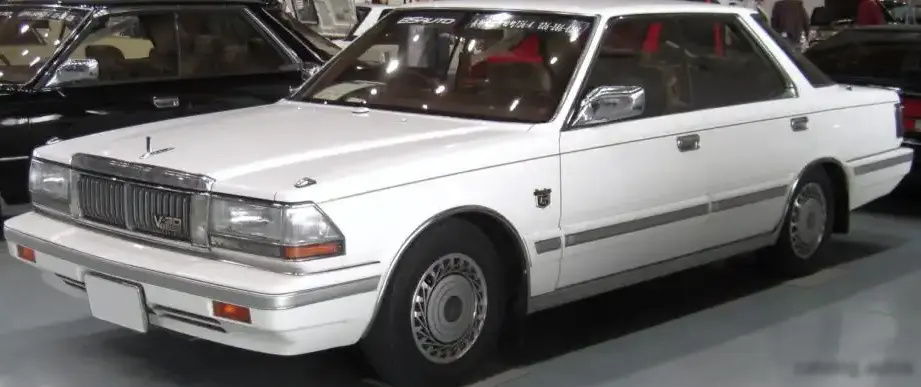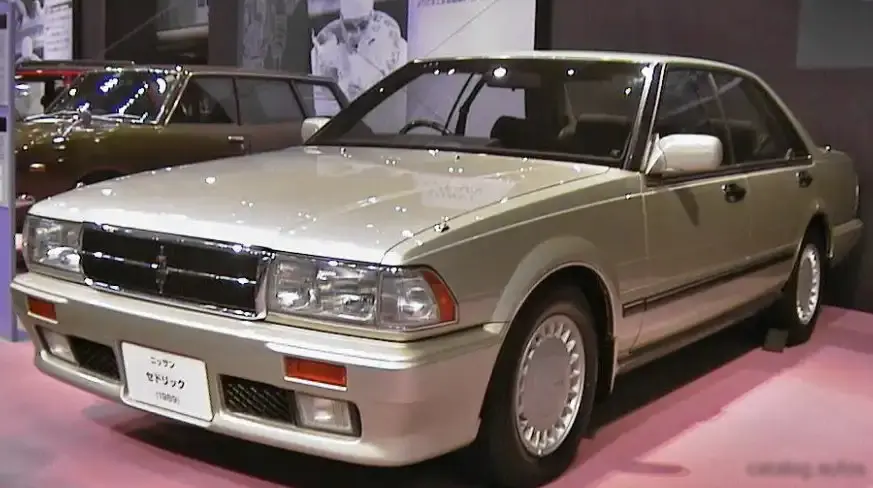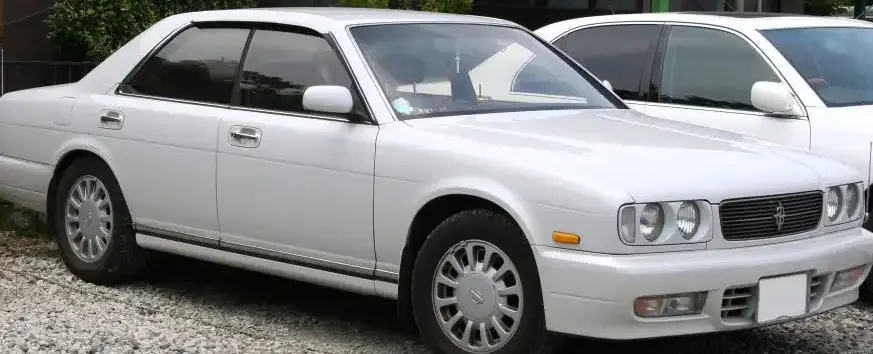
The Nissan Cedric Y32 2.8d Automatic, produced between 1993 and 1995, represents a specific configuration within the broader Y32 Cedric generation. Positioned as a more economical option within the lineup, this variant catered to buyers prioritizing fuel efficiency and comfortable cruising over outright performance. The Y32 Cedric, as a whole, was Nissan’s flagship sedan in the Japanese domestic market (JDM), competing with the Toyota Crown and Mitsubishi Debonair. This diesel-powered automatic model offered a refined driving experience, albeit with modest power, and was popular with families and business users seeking a spacious and reliable vehicle. It was never officially sold in the US market.
Technical Specifications
| Brand | Nissan |
| Model | Cedric |
| Generation | Cedric (Y32) |
| Type (Engine) | 2.8d (100 Hp) Automatic |
| Start of production | 1993 |
| End of production | 1995 |
| Powertrain Architecture | Internal Combustion engine |
| Body type | Sedan |
| Seats | 5 |
| Doors | 4 |
| Fuel consumption (urban) | 9.9-13 l/100 km (23.8 – 18.1 US mpg, 28.5 – 21.7 UK mpg, 10.1 – 7.7 km/l) |
| Fuel consumption (extra urban) | 7.2-9.5 l/100 km (32.7 – 24.8 US mpg, 39.2 – 29.7 UK mpg, 13.9 – 10.5 km/l) |
| Fuel consumption (combined) | 9.5 l/100 km (24.8 US mpg, 29.7 UK mpg, 10.5 km/l) |
| Fuel Type | Diesel |
| Acceleration 0 – 100 km/h | 17.6 sec |
| Acceleration 0 – 62 mph | 17.6 sec |
| Acceleration 0 – 60 mph | 16.7 sec |
| Maximum speed | 163 km/h (101.28 mph) |
| Weight-to-power ratio | 15.9 kg/Hp, 62.9 Hp/tonne |
| Weight-to-torque ratio | 8.9 kg/Nm, 111.9 Nm/tonne |
| Power | 100 Hp @ 4800 rpm |
| Power per litre | 35.4 Hp/l |
| Torque | 178 Nm @ 2400 rpm (131.29 lb.-ft. @ 2400 rpm) |
| Engine layout | Front, Longitudinal |
| Engine Model/Code | RD28 |
| Engine displacement | 2825 cm3 (172.39 cu. in.) |
| Number of cylinders | 6 |
| Engine configuration | Inline |
| Cylinder Bore | 85 mm (3.35 in.) |
| Piston Stroke | 83 mm (3.27 in.) |
| Compression ratio | 22.4:1 |
| Number of valves per cylinder | 2 |
| Fuel injection system | Precombustion chamber injection |
| Engine aspiration | Naturally aspirated engine |
| Valvetrain | SOHC |
| Kerb Weight | 1590 kg (3505.35 lbs.) |
| Fuel tank capacity | 80 l (21.13 US gal | 17.6 UK gal) |
| Length | 4780 mm (188.19 in.) |
| Width | 1745 mm (68.7 in.) |
| Height | 1410 mm (55.51 in.) |
| Wheelbase | 2760 mm (108.66 in.) |
| Front track | 1500 mm (59.06 in.) |
| Rear track | 1495 mm (58.86 in.) |
| Ride height (ground clearance) | 150 mm (5.91 in.) |
| Drag coefficient (Cd) | 0.38 |
| Minimum turning circle | 11 m (36.09 ft.) |
| Drivetrain Architecture | Rear wheel drive |
| Number of gears | 4 |
| Gearbox type | Automatic transmission |
| Front brakes | Ventilated discs |
| Rear brakes | Ventilated discs |
| Steering type | Steering rack and pinion |
| Tires size | 205/65 R15 |
| Wheel rims size | 15 |
Introduction
The Nissan Cedric Y32, launched in 1989 and continuing through 1995, represented a significant evolution for Nissan’s luxury sedan. The Y32 generation moved towards a more rounded, aerodynamic design, and offered a wider range of engine options. The 2.8d Automatic variant, introduced in 1993, was specifically aimed at buyers seeking a comfortable and economical long-distance cruiser. It occupied the lower end of the Y32 spectrum, below the more powerful gasoline-powered variants like the 3.0-liter V6. This diesel model was particularly popular in Japan, where diesel fuel was often cheaper and offered better fuel economy than gasoline.
Powertrain & Engine Architecture
The heart of the Y32 2.8d is the RD28 diesel engine, a 2.8-liter inline-six cylinder unit. This engine utilizes a precombustion chamber injection system, a common design for diesel engines of the era. This system involves injecting fuel into a small precombustion chamber within the cylinder head, which then ignites the main combustion chamber. The RD28 is a naturally aspirated engine, meaning it doesn’t employ a turbocharger or supercharger. It produces 100 horsepower at 4800 rpm and 178 Nm (131.29 lb-ft) of torque at 2400 rpm. The engine features a single overhead camshaft (SOHC) valvetrain, operating two valves per cylinder. The engine is longitudinally mounted in the engine bay. Paired with the RD28 is a four-speed automatic transmission, designed for smooth and comfortable shifting. This transmission was chosen to complement the engine’s torque characteristics and provide a relaxed driving experience.
Driving Characteristics
The Y32 2.8d Automatic is not a performance-oriented vehicle. Acceleration is leisurely, with a 0-60 mph time of around 16.7 seconds. However, the engine’s torque delivery provides adequate power for everyday driving and highway cruising. The automatic transmission is tuned for comfort, with relatively smooth gear changes. Compared to the gasoline-powered Y32 models, the 2.8d offers significantly less horsepower but comparable low-end torque. Manual transmission versions of the Y32 offered a more engaging driving experience, but the automatic was favored by those prioritizing convenience. The relatively heavy weight of the vehicle (1590 kg / 3505.35 lbs) further contributes to its relaxed driving character.
Equipment & Trim Levels
The Y32 2.8d Automatic typically came equipped with a reasonable level of standard features, reflecting its position as a mid-range offering. Standard equipment generally included power windows, power steering, central locking, and air conditioning. Interior upholstery was typically cloth, although leather options were available. The dashboard layout was functional and straightforward, with a focus on ease of use. Optional extras included an upgraded audio system, power-adjustable seats, and a sunroof. Higher trim levels within the Y32 range offered more luxurious appointments, such as wood trim and more sophisticated audio systems.
Chassis & Braking
The Y32 Cedric features a traditional body-on-frame construction, providing a comfortable ride quality. The suspension consists of independent front suspension with MacPherson struts and a multi-link rear suspension. The 2.8d variant typically used ventilated disc brakes on all four wheels, providing adequate stopping power for its weight and performance. Stabilizer bars were fitted to both the front and rear axles to reduce body roll during cornering. The steering system is a rack and pinion setup, offering precise and responsive steering feel.
Market Reception & Comparison
The Y32 2.8d Automatic was generally well-received in the Japanese market as a practical and economical luxury sedan. Critics praised its comfortable ride, spacious interior, and fuel efficiency. However, its lack of outright performance was often noted. Compared to the gasoline-powered Y32 variants, the 2.8d offered significantly better fuel economy, making it a popular choice for high-mileage drivers. Reliability was generally good, although diesel engines of this era could be prone to issues with fuel injectors and the precombustion chambers. Against competitors like the Toyota Crown, the Cedric Y32 offered a similar level of comfort and refinement, with the diesel engine providing a distinct advantage in fuel economy.
Legacy
The Nissan Cedric Y32 2.8d Automatic, while not a particularly rare or sought-after variant today, remains a reliable and comfortable classic car. The RD28 diesel engine, while not known for its high performance, is generally durable and long-lasting when properly maintained. In the used car market, these vehicles are often found with high mileage but are still capable of providing years of service. Parts availability can be a challenge outside of Japan, but many components are still available through specialist suppliers. The Y32 Cedric 2.8d represents a unique blend of luxury, comfort, and fuel efficiency, making it a compelling choice for enthusiasts seeking a classic Japanese sedan.