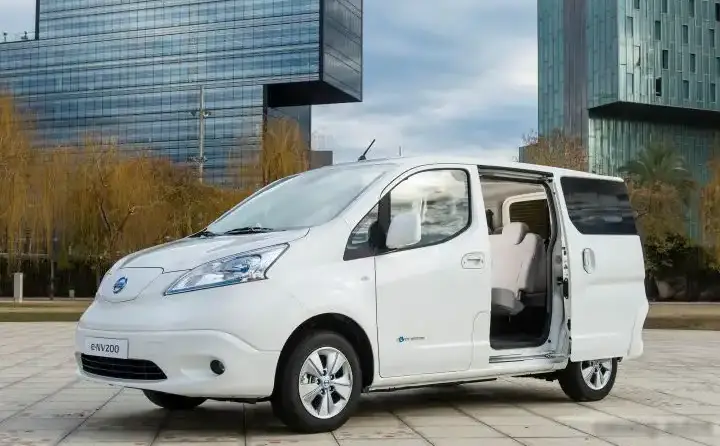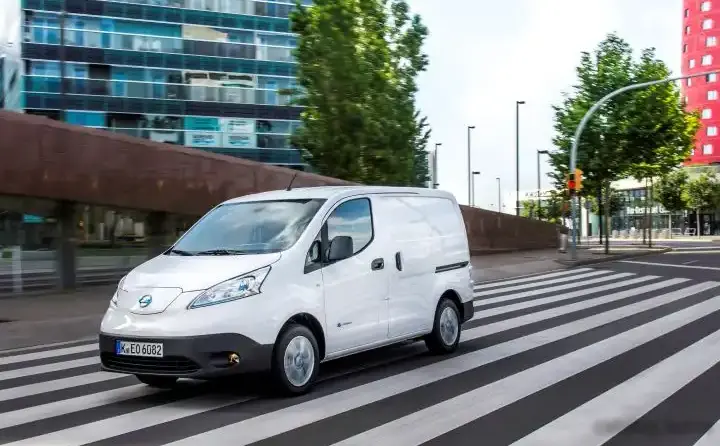
The Nissan e-NV200 24 kWh, producing 109 horsepower, was an all-electric variant of the NV200 commercial van, introduced by Nissan in 2013 and remaining in production through 2018. Designed primarily for commercial use, particularly in urban environments, the e-NV200 aimed to provide a zero-emission solution for last-mile delivery and specialized transport. It represented Nissan’s early foray into the electric light commercial vehicle segment, building upon the LEAF platform and powertrain technology. This specific 24 kWh configuration served as the entry point into the e-NV200 range, offering a balance between affordability and practicality.
Technical Specifications
| Brand | Nissan |
| Model | NV200 |
| Generation | e-NV200 |
| Type (Engine) | 24 kWh (109 Hp) |
| Start of production | 2013 |
| End of production | 2018 |
| Powertrain Architecture | BEV (Electric Vehicle) |
| Body type | Minivan |
| Seats | 2 |
| Doors | 5 |
| Fuel Type | Electricity |
| Acceleration 0 – 100 km/h | 14 sec |
| Acceleration 0 – 62 mph | 14 sec |
| Acceleration 0 – 60 mph | 13.3 sec |
| Maximum speed | 123 km/h (76.43 mph) |
| Weight-to-power ratio | 13.6 kg/Hp, 73.6 Hp/tonne |
| Weight-to-torque ratio | 5.8 kg/Nm, 171.6 Nm/tonne |
| Gross battery capacity | 24 kWh |
| Battery voltage | 360 V |
| Battery technology | Lithium-ion (Li-Ion) |
| Battery location | Below the floor |
| All-electric range (NEDC) | 163 km (101.28 mi) |
| Average Energy consumption (NEDC) | 16.5 kWh/100 km (26.55 kWh/100 mi) |
| Average Energy consumption (MPGe) | 127 MPGe |
| Average Energy consumption (km/kWh) | 6.1 km/kWh |
| Average Energy consumption (mi/kWh) | 3.8 mi/kWh |
| Electric motor power | 109 Hp @ 3008-10000 rpm |
| Electric motor Torque | 254 Nm @ 0-3008 rpm (187.34 lb.-ft. @ 0-3008 rpm) |
| Electric motor model/code | EM57 |
| Maximum revolutions of the electric motor | 10500 rpm |
| Electric motor location | Front axle, Transverse |
| System power | 109 Hp @ 3008-10000 rpm |
| System torque | 254 Nm @ 0-3008 rpm (187.34 lb.-ft. @ 0-3008 rpm) |
| Kerb Weight | 1480 kg (3262.84 lbs) |
| Max. weight | 2250 kg (4960.4 lbs) |
| Max load | 770 kg (1697.56 lbs) |
| Trunk (boot) space – maximum | 4200 l (148.32 cu. ft.) |
| Max. roof load | 100 kg (220.46 lbs) |
| Permitted towbar download | 75 kg (165.35 lbs) |
| Length | 4560 mm (179.53 in) |
| Width | 1755 mm (69.09 in) |
| Width including mirrors | 2011 mm (79.17 in) |
| Height | 1850 mm (72.83 in) |
| Wheelbase | 2725 mm (107.28 in) |
| Front track | 1530 mm (60.24 in) |
| Rear (Back) track | 1530 mm (60.24 in) |
| Front overhang | 985 mm (38.78 in) |
| Rear overhang | 850 mm (33.46 in) |
| Ride height (ground clearance) | 145 mm (5.71 in) |
| Minimum turning circle | 11.13 m (36.52 ft) |
| Approach angle | 15.5° |
| Departure angle | 21.6° |
| Ramp-over angle | 12.7° |
| Drivetrain Architecture | One electric motor drives the front wheels |
| Drive wheel | Front wheel drive |
| Number of gears | 1 |
| Gearbox type | Automatic transmission |
| Front suspension | Independent type McPherson, Transverse stabilizer |
| Rear suspension | Leaf spring, Torsion |
| Front brakes | Ventilated discs, 283×28 mm |
| Rear brakes | Ventilated discs, 292×16 mm |
| Assisting systems | ABS (Anti-lock braking system) |
| Steering type | Steering rack and pinion |
| Power steering | Electric Steering |
| Tires size | 185/65 R15 |
| Wheel rims size | 6J x 15 |
Powertrain & Engine Architecture
The e-NV200 24 kWh utilizes a fully electric powertrain, centered around the EM57 electric motor. This motor, delivering 109 horsepower and 254 Nm (187 lb-ft) of torque, is mounted transversely at the front of the vehicle, driving the front wheels. The power is supplied by a 24 kWh lithium-ion battery pack located under the vehicle floor, contributing to a lower center of gravity. The battery pack operates at 360 volts. The e-NV200 employs a single-speed automatic transmission, typical of electric vehicles, providing seamless acceleration. The motor’s torque is immediately available, offering brisk acceleration for urban driving conditions. The charging port location varied depending on the market, but generally supported both CHAdeMO fast charging and standard AC charging.
Driving Characteristics
The 109 hp and 254 Nm of torque provided adequate performance for city and suburban driving. Acceleration to 60 mph took approximately 13.3 seconds, and the top speed was limited to 76.43 mph. While not designed for high-speed highway travel, the e-NV200 offered a smooth and quiet driving experience. The single-speed transmission meant there were no gear changes, resulting in linear acceleration. Compared to potential higher-range variants (which were not widely available in the US market), the 24 kWh version prioritized affordability over extended range. The instant torque delivery made it surprisingly nimble in urban traffic, and the low center of gravity contributed to stable handling.
Equipment & Trim Levels
The e-NV200 24 kWh typically came with a relatively basic level of equipment, reflecting its commercial vehicle origins. Standard features generally included air conditioning, power windows, and a basic audio system. The interior was functional and durable, with hard-wearing plastics and easy-to-clean surfaces. Optional extras included a navigation system, rear parking sensors, and upgraded upholstery. The van’s configuration was primarily focused on cargo space, with a large rear compartment accessible through rear doors and side sliding doors. The 2-seat configuration maximized cargo volume.
Chassis & Braking
The e-NV200’s chassis was based on the standard NV200 platform, featuring an independent McPherson strut suspension at the front and a leaf spring suspension at the rear. The rear leaf spring setup was a cost-saving measure common in commercial vehicles. Braking was provided by ventilated discs on all four wheels, supplemented by an Anti-lock Braking System (ABS). The steering was electrically assisted, providing light and easy maneuverability. The vehicle’s relatively high curb weight of 1480 kg (3262.84 lbs) impacted handling, but the low center of gravity helped to mitigate body roll.
Market Reception & Comparison
The Nissan e-NV200 24 kWh received mixed reviews. Critics praised its zero-emission operation and practicality for urban deliveries, but the limited range of 101.28 miles (NEDC) was a common concern. Compared to the standard gasoline-powered NV200, the e-NV200 offered lower running costs due to the elimination of fuel expenses, but the higher initial purchase price was a barrier for some buyers. Within the e-NV200 lineup, the 24 kWh version was positioned as the entry-level model, offering a more affordable option for businesses with shorter delivery routes. Competitors included other electric vans, such as the Renault Kangoo Z.E. and the Ford Transit Connect Electric.
Legacy
The Nissan e-NV200 24 kWh played a significant role in demonstrating the viability of electric commercial vehicles. While its range was limited by today’s standards, it provided a valuable platform for Nissan to gain experience in electric powertrain integration and battery technology. On the used car market, the e-NV200 24 kWh remains a relatively affordable option for businesses seeking a low-emission delivery vehicle. Battery health is a key consideration for potential buyers, as battery degradation can impact range and performance over time. The e-NV200 paved the way for Nissan’s subsequent electric commercial vehicle offerings, including the larger e-NV400.